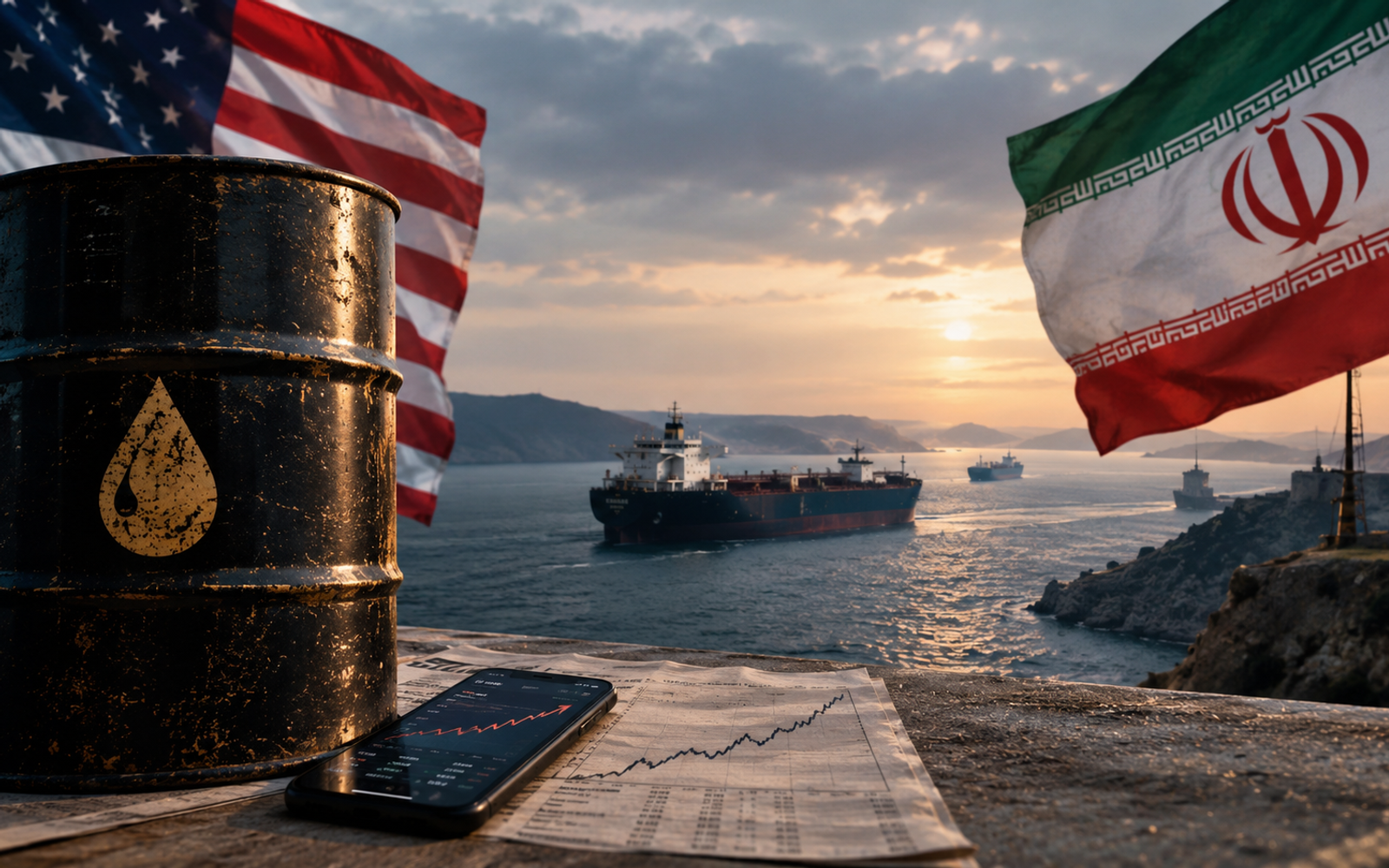
Why Waiting Out the Oil Crisis Is the Costly Mistake
Six months of US-Iran strikes show oil prices ratchet up, not spike and recover. Waiting for normal now costs households real money.

Monday morning brought the ritual back. Oil futures climbed toward their highest level in nearly six weeks after a weekend of strikes in and around the Strait of Hormuz, with Washington targeting three Iranian tankers and Tehran firing a ballistic missile toward American warships patrolling the waterway. Between coffee and the first meeting, many households did the quiet arithmetic this conflict has made routine: what this round costs at the pump, in the delivery surcharge, in the energy bill that arrived with an unfamiliar number. The math has shifted, and not in the way the headlines frame it.
For six months, the dominant framing has treated each flare-up as a spike: a temporary surge that fades once the fighting pauses, with prices settling back toward something close to normal. That assumption is now the most expensive line in the household budget. The record from late February, when the war began with US and Israeli missile strikes on Iran, through the spring ceasefire and the renewed hostilities of July and this week, points somewhere else. Prices in this conflict don't spike and recover. They step up and stay.
The Calm Between Rounds Keeps Getting Pricier
The September 1 round is a clean example. The United States launched a barrage of airstrikes against Iran, Tehran retaliated against American assets in Jordan, Bahrain and Iraq, and oil jumped more than $4 a barrel to a five-week high, according to Reuters. The Islamic Revolutionary Guard Corps said the attacks would "tighten the lock" on the Strait of Hormuz, the waterway that carried one of every five barrels of the world's oil before the war. A week later, after tanker strikes and missile fire over the weekend, futures were pushing toward a six-week high.
What matters is the floor beneath each jump. When fighting paused earlier this year, prices didn't return to the pre-war baseline, because the persistent closure of the strait, which Reuters reports Iran has effectively closed to shipping, moves the market more than the combat itself. Each escalation round has therefore started from a higher point than the one before it. That's the signature of a ratchet, and it's the detail most budget advice still misses.
The difference between those two readings shows up in real decisions. A spike invites patience: wait out the surge, keep spending as usual, resume normal plans once prices drift back down. A ratchet demands restructuring: accept the new floor as permanent and redesign fixed costs around it. Most of the personal-finance advice circulating during energy shocks still assumes the first model. Six months of evidence supports the second.
The Economies That Coped Share One Trait
The six-month record offers a cleaner lesson than the price charts. The countries that absorbed the shock best weren't the ones that braced hardest or subsidized most generously. They were the ones whose essential systems never ran on the imported-oil spot market in the first place. India and Indonesia generate roughly two-thirds of their electricity from domestic coal, so the war barely touched their power prices. Vietnam and the Philippines, which lean heavily on imported fuel, spent the early months scrambling with subsidies and tax exemptions.
China, the world's largest oil importer, has responded by accelerating its shift toward electric vehicles and alternative trading partners rather than absorbing the price. The pattern repeats at every scale: damage tracks exposure, not vigilance. The households that feel this war most acutely are the ones with fixed costs wired directly to the oil price, a long car commute, an oil-heated home, a daily delivery habit. Households with the least exposure barely register escalation weeks.
That observation cuts against the instinct most of us reach for during a crisis. When prices jump, the mind goes to sacrifice: drive less, skip the order, tighten variable spending until things calm down. Sacrifice is a response to an event. This conflict has stopped being an event, and the households still treating it as one are paying a compounding tax of vigilance.
Austerity Is the Wrong Frame for a Condition
Six months in, the war has moved from headline to environment, closer to a shift in climate than a stretch of weather. The news cycle still covers every strike as a fresh emergency, which invites a fresh round of monitoring and deferral. But monitoring a condition doesn't change it, and deferring decisions until things settle means waiting for a baseline that no longer exists. The professionals who cope best aren't the ones refreshing price apps and casualty feeds. They're the ones who stopped treating each escalation as a new crisis and made one or two structural decisions against a backdrop of permanently expensive oil.
The trap is that vigilance feels productive. Checking the market, discussing the strikes in the group chat, recalculating the commute for the third time this month, all of it carries the sensation of engagement without the substance of change. The professionals who handle these cycles best treat the news as a scheduled check rather than a background feed, the same boundary they apply to any recurring distraction. They don't monitor the conflict into submission. They renegotiate their exposure to it.
One Structural Change Beats a Dozen Vigils
The practical version is less dramatic than it sounds. Find the single biggest oil-linked fixed cost in the monthly budget and remove oil from its structure, rather than trimming around it. For most people that cost is the commute. One renegotiated remote day removes roughly a fifth of driving from the household ledger permanently, and it pays off in every future escalation, not just this one. The same logic explains why the stay-put trend in travel has outlasted its pandemic novelty: when movement gets expensive and unpredictable, people redesign around less of it, a shift NovaRift covered earlier this year.
For households where the commute isn't the lever, the equivalent sits elsewhere: an electricity tariff with more non-fossil generation, a second car traded for one that runs fewer oil miles, a delivery habit rebuilt around a single weekly trip. The principle holds across all of them. Run the calculation once, at today's price rather than the price from before the war, and act on the largest lever you find.
This week, price your largest oil-linked fixed cost at today's level and change its structure rather than just its usage. The calculation takes ten minutes, and it removes one line of the budget from the reach of the next escalation, which is more than any amount of monitoring will accomplish. The war will keep producing headlines. The households doing best are the ones whose fixed costs no longer depend on the strait at all, and that's a change anyone can make without waiting for the fighting to end.
Comments (0)
No comments yet. Be the first to share your thoughts.