August's Biggest Culture Story Was Signed in Cholpon-Ata
While feeds ran on pop drama, two Turkic nations signed an alliance whose real payload is cultural.

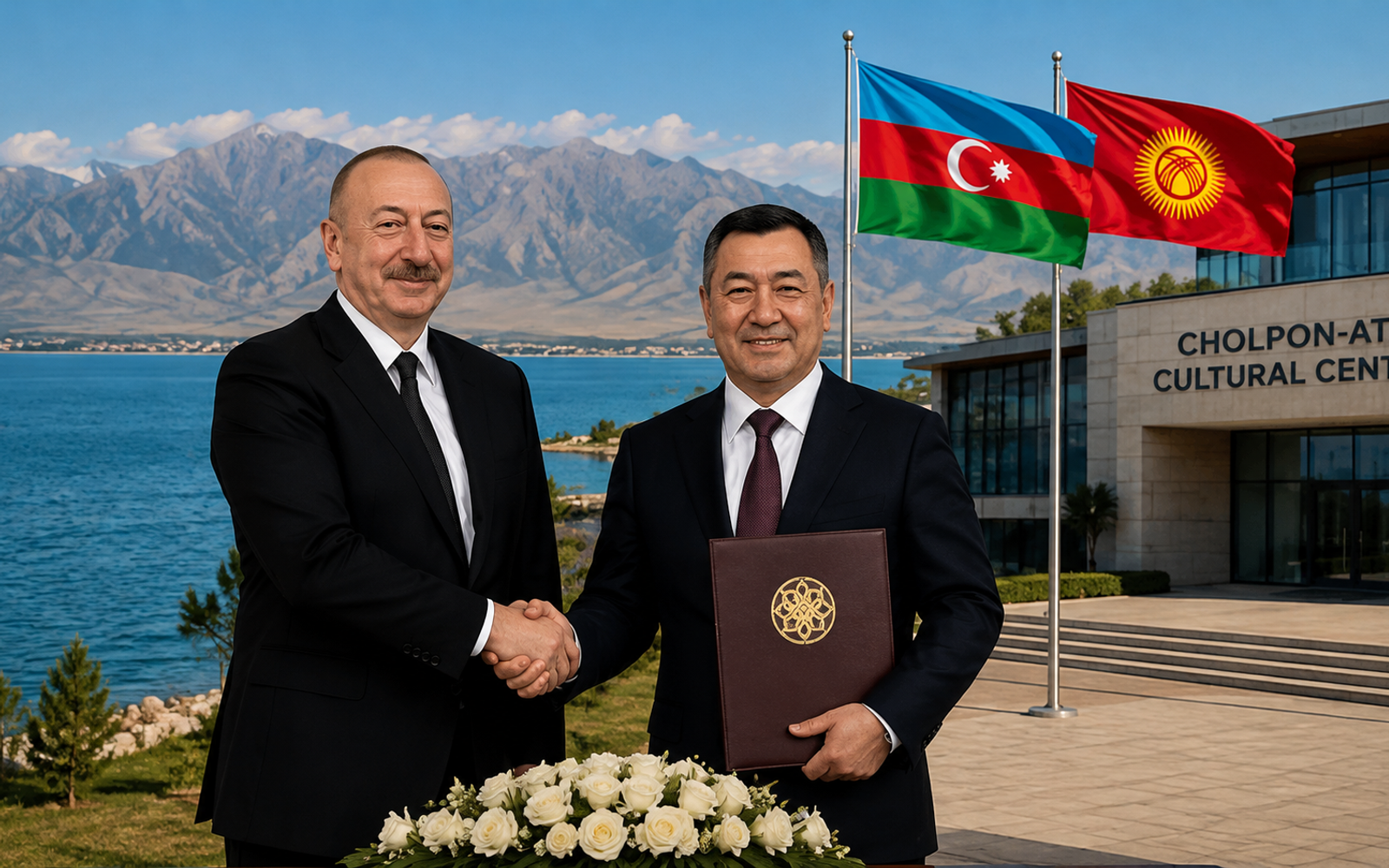
The paperwork landed on Friday in Cholpon-Ata, a resort town on the northern shore of Lake Issyk-Kul, and the setting did more work than the signing pens. President Ilham Aliyev of Azerbaijan and President Sadyr Japarov of Kyrgyzstan put their names to a Treaty on Alliance Relations inside a cultural complex rather than a government palace. Alongside it came 14 cooperation documents covering finance, energy, cybersecurity, transport and humanitarian exchanges. Japarov described the signing as "truly historic," a new stage in Kyrgyz-Azerbaijani cooperation, according to the Kyrgyz president's press service.
The headline in Bishkek and Baku is strategic: an allied partnership between two states that had kept each other at a warm but formal distance. But the treaty's real texture is cultural. Kyrgyzstan's Culture Minister Mirbek Mambetaliev has already laid out the calendar, with Kyrgyzstan holding Days of Culture in Azerbaijan in 2027 and Azerbaijan bringing its own program to Kyrgyzstan in 2028. That exchange is the part worth watching.
The Treaty's Real Payload Is a Festival Calendar
Cultural diplomacy usually plays garnish on state visits, the photo op with folk dancers that runs beneath the serious talk. This treaty inverts that order. The Days of Culture exchanges are scheduled, named and reciprocal, and they sit inside the same document package as the energy and transport agreements. That isn't a friendship card. It's infrastructure.
Central Asia has learned to use heritage as alliance currency. The region spent the past decade staging festivals, games and epic celebrations designed to make its identity legible to outsiders. Azerbaijan has been doing the same across the Caspian, funding cultural weeks, literary translations and music collaborations from Tashkent to Astana. A treaty that puts those programs on a fixed two-year schedule commits real money and real staff to the bet.
The content of that bet is specific. Azerbaijani mugham, the modal tradition that UNESCO inscribed on its intangible heritage list, is a different sonic world from Kyrgyz komuz playing and the recitation of the Manas epic. Yet they share a Turkic root, and the exchange programs are designed to make that root audible to audiences who have never thought about it.
The Turkic Axis Gets Its Soft Power
The shared language family is the quiet engine of this alliance. Azerbaijan and Kyrgyzstan are both members of the Organization of Turkic States, the bloc that has spent recent years trying to convert linguistic kinship into something closer to political gravity. Baku has been the most active mover in that project, using its energy revenue and its media reach to position itself as the hinge between the Turkic world and the wider region.
Aliyev's state visit continues a pattern of Azerbaijani outreach across Central Asia that has accelerated over the past few years. For Kyrgyzstan, the calculus is different but complementary: a small, landlocked nation that has learned to balance its big neighbors by collecting allies. The treaty gives it a partner with capital, infrastructure ambitions and no competing territorial claims.
And the cultural layer is what makes the arrangement feel less like a transaction. Both nations carry epics that define their sense of self, Kyrgyzstan's Manas and Azerbaijan's Book of Dede Korkut, oral traditions that survived empires precisely because they were carried in memory rather than archives. Signing an alliance between two states that still recite their founding stories aloud carries a weight no memorandum of understanding can match.
Cholpon-Ata Is the Right Address for a Cultural Treaty
The venue deserves its own paragraph. Cholpon-Ata already knows how to host the world's attention: the World Nomad Games turned the lakeside town into a recurring stage for eagle hunting, kok boru and felt-making, the kind of heritage programming that travels well in an era when expanded global tournaments are reshaping summer culture. Its streets have hosted archers and falconers from dozens of nations, and the town has never treated that role as a side gig.
Issyk-Kul itself is the backdrop, a lake so large it never freezes, ringed by mountains that make the region a summer escape for Central Asia's cities. Choosing it for a state treaty signals how these governments want the alliance understood: not as a cold document but as something that belongs to the landscape and the people who move through it.
So the cultural complex where the pens came out was not a neutral room. It was the physical argument that this partnership is about memory, performance and shared inheritance, the things that keep a calendar meaningful long after the diplomats have flown home. A treaty signed there reads differently from one signed in a capital's conference hall, and the difference is the point.
What the Global Feeds Missed
Meanwhile, the culture conversation elsewhere this week ran on a different currency. A pop star dropped from a tour, a dating franchise got debated across time zones, a beloved character actor died at 80, and the feeds dutifully cycled through all of it. None of it is trivial. But the gap between what the global attention economy picked up and what happened on the shore of Issyk-Kul is a working definition of how coverage works now.
The treaty sits at the intersection of geopolitics and culture without reducing either to the other. Two governments agreed that their shared language, music and epic traditions are worth formal alliance status, and then they wrote the exchange dates into the same treaty as the cybersecurity clauses. That framing deserves more of the cultural press than it's getting.
The alliances being signed across Eurasia in this decade will determine which languages get translated, which music tours cross borders and which festivals get state funding, the raw material of cultural life for millions of people. Stories like this one are where the next decade of that life gets decided, quietly, at tables most of the world didn't watch.
The treaty's real test won't be read in diplomatic cables. It will be heard in Baku in 2027, when Kyrgyz ensembles bring the Manas epic to a Caspian audience, and in Bishkek in 2028, when Azerbaijani mugham fills a hall in the shadow of the Ala-Too range. If those nights land, the alliance will have done what treaties rarely manage, making itself felt in the bodies and memories of people who never read a single clause. If they don't, the document joins the shelf of agreements that looked historic at the table and meant nothing at the door. The verdict gets delivered in halls, not cables, and the dates are already on the calendar.
Comments (0)
No comments yet. Be the first to share your thoughts.