The $2 Trillion Bet on Elon Musk's Brain
SpaceX just minted the first trillionaire. The real story is what that valuation says about the market's hunger for narrative over numbers.

Tom Mueller still sounded a little stunned. The guy who bolted the first rocket engines together in a Los Angeles warehouse back in 2002, employee number one at a company that barely had a name, watched his old firm open for trading on the Nasdaq Friday morning. Gwen Shotwell rang the bell. The board, the bankers, the early investors all grinned into the cameras. And Mueller, now retired, told the BBC something revealing: he never expected this. Not the scale. Not the speed. Definitely not the number.
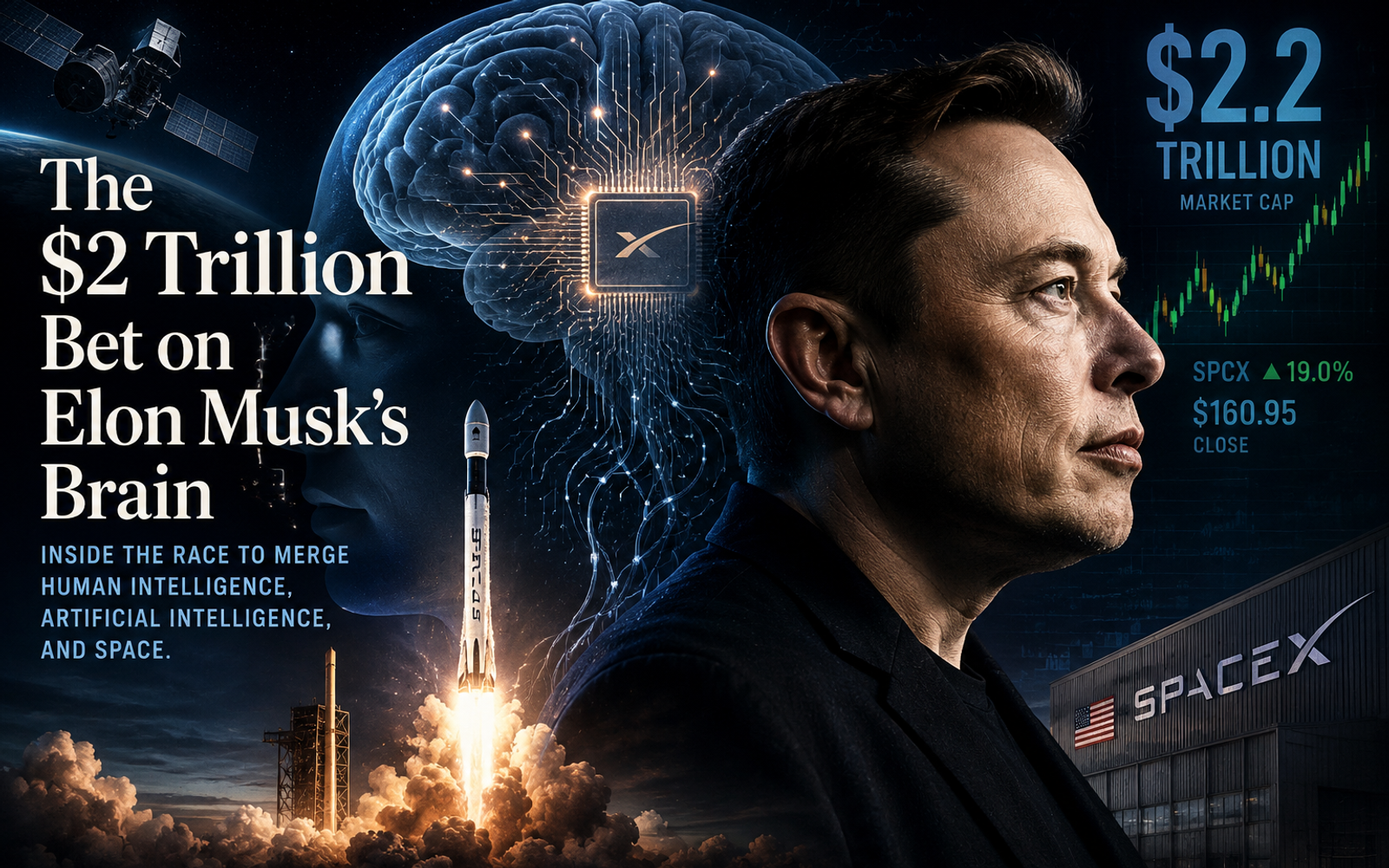
That number was $1.77 trillion. At least at the start. By the closing bell, SpaceX had tacked on another $400 billion in market value. Shares finished at $160.95, a crisp 19% pop from the $135 IPO price. The company that Mueller helped build from aluminum shavings and pure stubbornness was now worth more than $2.1 trillion. Bigger than Tesla. Bigger than Meta. Bigger than every company on earth except Apple, Microsoft, Nvidia, Amazon, and Alphabet. Elon Musk, who owns roughly 42% of the equity, watched his personal net worth cross a trillion dollars for the first time in human history. The IPO raised $75 billion. The largest ever. By a wide margin.
The Numbers Behind the Headlines
Let's get the scoreboard straight before we talk about what it means. SpaceX sold 555.6 million shares at $135 each. That $75 billion haul is not a loan. It's not a convertible note. It's cash. Real cash. The company ended its first public day with a market capitalization around $2.2 trillion. For context, that's roughly the GDP of Canada. The stock opened at $150, popped to $165 intraday, and settled. The bankers priced this thing tight, and the market still wanted more.
But here is where my job starts. I write about unit economics and operational reality. And the operational reality of SpaceX is genuinely impressive, but it does not explain a $2 trillion valuation. Not even close.
SpaceX generated $18.7 billion in revenue in 2025. Starlink accounted for $11.4 billion of that, roughly 61%. The remaining chunk came from launch services, government contracts, and the early rumblings of Starship commercialization. For 2026, analysts project Starlink revenue hitting $20 billion on its own, with total company revenue approaching a $60 billion annualized run rate by year-end. Those are big numbers. They are not $2 trillion big.
The Elon Premium Problem
Reuters called it the "Elon premium" in their coverage of the IPO. That is a polite way of saying investors are buying the man, not the margin. Matt Kennedy at Renaissance Capital put it bluntly: "Much like Tesla, SpaceX is a bet on Elon Musk." He's right. And that creates a structural problem for anyone trying to value this thing on fundamentals.
At 94 times trailing revenue, SpaceX is priced for perfection. It is priced for Starship to fly daily. It is priced for Starlink to sign every airline, every cruise ship, every rural school district on the planet. It is priced for the xAI merger that closed in February 2026 to produce an AI platform that competes with OpenAI and Anthropic. It is priced for Mars. Literally. There is a non-trivial portion of this valuation that assumes humans building a city on another planet inside fifteen years.
Cash ran out at a lot of good companies. The graveyard of space ventures is full of names that had better engineering than business models. Iridium. Globalstar. Virgin Galactic. SpaceX is not those companies. It has real revenue. Real customers. Real technology that nobody else can replicate. But the margin for error at 94x revenue is zero. One bad Starship test. One Starlink spectrum dispute. One antitrust review that blows up the xAI integration. The multiple compresses fast.
The $75 Billion Question
What does a company do with $75 billion in fresh cash? That is not a rhetorical question. It is the most important operational question facing SpaceX right now.
The IPO filing revealed that SpaceX spent $10.1 billion on capital expenditures in Q1 2026 alone. $7.7 billion of that went to AI infrastructure. Think about that for a second. A rocket company that also runs a satellite internet business just spent more on AI compute in three months than most Fortune 500 companies will spend all year. The xAI merger was the strategic signal. The CapEx was the confirmation. SpaceX is no longer a launch company. It is not even a satellite company anymore. It is becoming a vertically integrated AI, space, and infrastructure conglomerate with Elon Musk's brain as the operating system.
That is either brilliant or terrifying, depending on your time horizon. Short term, it means SpaceX can amortize AI training costs across Starlink's edge compute network, Starship's data relay capabilities, and whatever xAI is building. Long term, it means the company is betting its entire future on Musk continuing to make good bets. The man is now worth a trillion dollars. What happens to his risk appetite when he has more money than any human has ever had?
The Employees Who Got Options
There is a quieter story here that matters more than Musk's net worth. It is the story of the engineers, the technicians, the supply chain managers who joined SpaceX in 2010, 2015, 2020. They took below-market salaries. They worked brutal hours. They believed in the mission. And on Friday, a lot of them became genuinely wealthy.
SpaceX had roughly 13,000 employees before the IPO. The typical early-stage engineer who joined before 2015 and held onto their options is looking at a life-changing payday. Not Musk-level money. But enough to buy a house in California outright. Enough to walk away. Enough to start their own companies.
This is where the unit economics story gets interesting. SpaceX has been famously frugal. The company's culture of vertical integration and rapid iteration kept costs down while competitors burned through venture dollars on hopeless architectures. But the IPO changes the incentive structure. When your employees are worth eight figures on paper, they think differently about risk. Some will stay. Some will leave and start the next generation of space companies. The talent bleed from SpaceX over the next eighteen months will be a better signal of the company's long-term health than any quarterly earnings report.
The Shadow of the Federal Government
SpaceX's largest customer is also its largest regulator. The U.S. government accounts for roughly 40% of SpaceX's launch revenue. NASA, the Department of Defense, the Space Force. These are sticky contracts with long tails and high margins. They are also political. One administration change. One scandal. One antitrust referral from a motivated FTC chair. The entire revenue stack wobbles.
The UK just announced it will phase out Russian diesel and jet fuel imports by the new year. That is the kind of geopolitical shift that creates tailwinds for companies like SpaceX. Governments need sovereign launch capability. They need resilient satellite communications. They need what SpaceX sells. But they also need competition. And they will subsidize it. Amazon's Project Kuiper is spending $10 billion to catch Starlink. Blue Origin is finally launching New Glenn at scale. The Chinese are building a megaconstellation that will compete directly for emerging market spectrum.
SpaceX has a moat. It is a wide one. But moats shrink when the government starts digging canals.
The Starlink ARPU Question
Let me get tactical for a minute because this is where the unit economics actually matters. Starlink's average revenue per user has been declining. It peaked around $120 per month in 2023. It is now closer to $95. That is not a disaster. It is a normal pattern for a service that is expanding into lower-income geographies. But it creates pressure. Starlink needs roughly 10 million subscribers to hit the $20 billion revenue target for 2026. It had about 5.5 million at the end of 2025. The math works if the growth trajectory holds.
But customer acquisition cost is rising. Starlink terminals used to cost $599. Now they cost as little as $299 in some markets. SpaceX is subsidizing hardware to drive adoption. That compresses margins in the short term. The bull case says ARPU stabilizes as enterprise and aviation contracts grow. The bear case says the consumer segment gets squeezed by fixed wireless and fiber expansion. The truth is probably somewhere in the middle.
The AI Merger Nobody Is Talking About
The February 2026 merger with xAI is the most consequential strategic decision SpaceX has made since Musk decided to build his own engines instead of buying Russian rockets. Absorbing the AI company gives SpaceX access to Grok, the large language model. It also gives xAI access to Starlink's edge compute network. Think about what that enables: real-time AI inference on satellites, autonomous Starship operations, military applications that the Pentagon will pay handsomely for.
But it also introduces complexity. SpaceX now competes with OpenAI, Google, and Anthropic. It competes with every defense contractor in the world. It competes with every telecom company that Starlink is disrupting. The surface area for conflict is enormous. And the regulatory scrutiny will be intense. A company worth $2 trillion that builds rockets, operates satellites, trains AI models, and has a direct line to the White House is going to attract attention. Not all of it friendly.
The Liquidity Event the Market Deserved
There is an argument that SpaceX should have stayed private longer. The company did not need the money. It was cash flow positive on Starlink. It had access to private capital at favorable terms. Going public invites quarterly scrutiny, activist investors, and the kind of short-term thinking that kills long-term engineering projects.
But the IPO was inevitable. Employees needed liquidity.
Early investors needed an exit. And Musk, for all his rhetoric about Mars, understands something about capital markets that most founders don't: public markets are the deepest pool of capital in the world. And right now, that pool is desperate for a story that isn't about interest rates or inflation or the next Fed meeting.
Read the coverage from NBC 7 San Diego or the full day-of reporting from The Guardian. The narrative is triumphant. First trillionaire. Biggest IPO ever. A new American champion. That narrative has real economic force. It drives retail demand. It drives institutional allocation. It drives the multiple expansion that makes the revenue numbers look sensible.
What the Multiple Actually Means
Let me put a number on it. At $2.1 trillion market cap and roughly $60 billion in annualized revenue, SpaceX trades at 35x forward revenue. For comparison, Nvidia trades at roughly 12x forward revenue. Microsoft trades at 8x. Apple trades at 7x. The average tech company in the S&P 500 trades at about 4x forward revenue. SpaceX is priced at nearly 9x the average multiple of the most profitable technology companies in history.
That is not a valuation. It's a religion.
And religions are fragile things. They depend on belief. They depend on the prophet continuing to deliver miracles. One bad quarter. One launch failure that kills a crew. One scandal that fractures the relationship with NASA. The multiple evaporates. It happened to Tesla in 2022 when the stock dropped 65% in twelve months. It can happen to SpaceX faster because the base is bigger and the float is smaller.
The Dawn of the Trillionaire Era
Elon Musk becoming the world's first trillionaire is not just a curiosity for the business press. It is a signal. It tells us that the market is willing to pay almost any price for a story that promises to rewrite the future. It tells us that narrative has become a first-order input to valuation, not a secondary consideration. It tells us that the gap between what a company is worth and what the market thinks it is worth can grow to proportions that defy traditional analysis.
I have sat through too many board meetings where founders presented hockey-stick projections built on hope instead of unit economics. I have watched too many companies burn cash chasing growth that never materialized. SpaceX is not those companies. It has real technology, real revenue, and a real competitive advantage. But the valuation has divorced itself from the operations. The numbers are dancing, and the music is coming from somewhere else.
Tom Mueller said he never expected this. He built rockets. He solved hard engineering problems. He did not spend his career calculating multiples.
And maybe that is the real lesson here. The companies that change the world are built by people who do not care what their stock is worth. They care about the work. The market eventually catches up. The question is whether it catches up too fast.
Spacex ended its first day as a public company worth $2.1 trillion. Elon Musk became the first human to hold a twelve-figure net worth. The IPO raised more money than most countries spend in a year. And somewhere in Los Angeles, a retired engineer who once bolted engines together in a dusty room with no air conditioning is probably still shaking his head.
He should be. The numbers don't make sense. But they don't have to. Not today.
Today belongs to the story. Tomorrow belongs to the spreadsheets. And the spreadsheets have a lot of work to do.
Comments (0)
No comments yet. Be the first to share your thoughts.