The S&P 500's Record Is an AI Earnings Story
The S&P 500 keeps setting records this August on AI profit. The question is whether earnings can outrun a hawkish Fed.

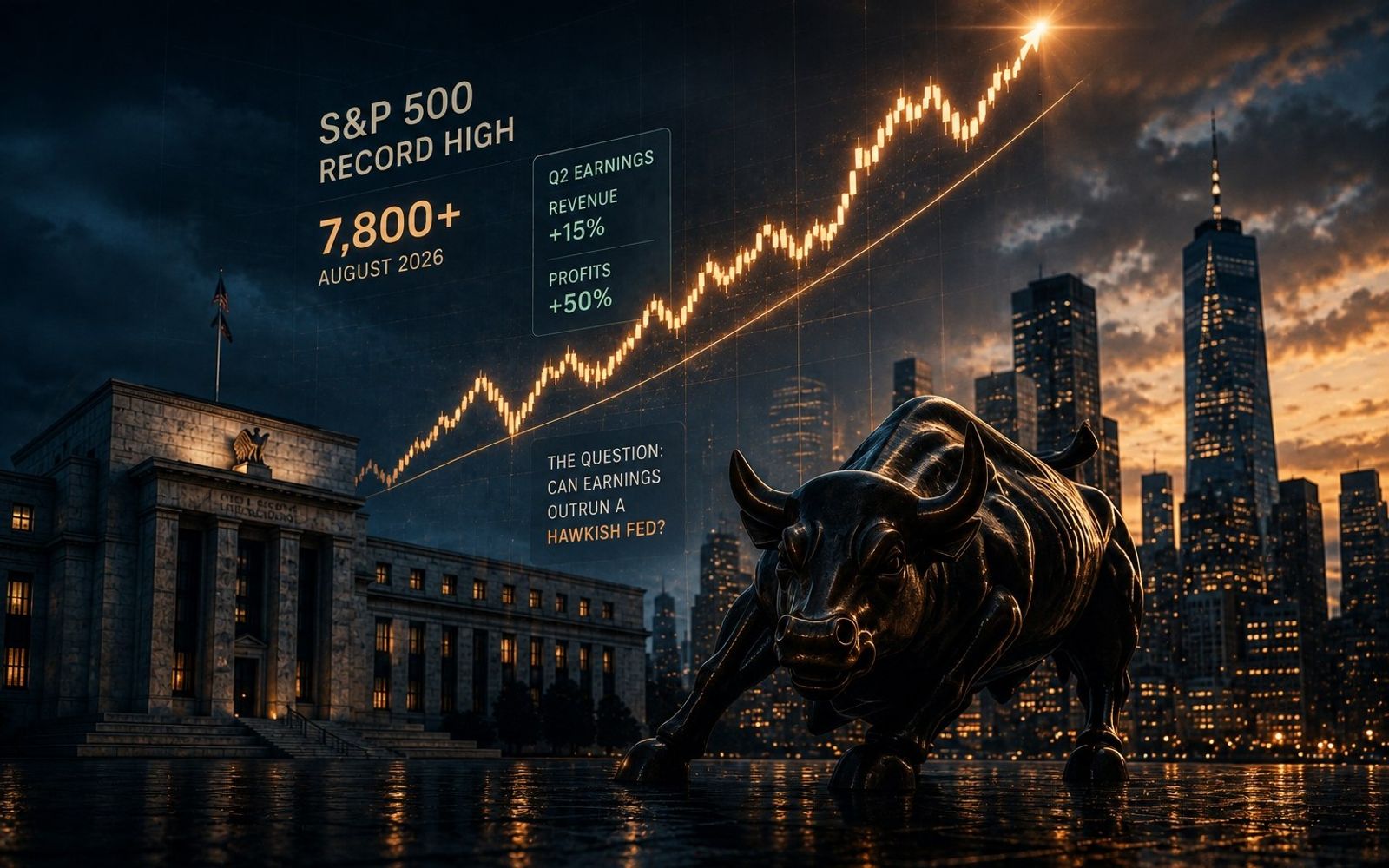
The S&P 500 enters the final trading day of August at a fresh all-time high, its fourth record close of the month and its second this week. The index first cleared its prior peak on August 4, repeated the trick on August 7, and has kept climbing since, with the Nasdaq running ahead of the broader tape at every step. The driver is not hard to isolate. S&P 500 companies grew revenue about 15% in the second quarter, the best pace since 2021, and profits jumped roughly 50% year over year, almost all of it coming from the largest technology names.
The rally is earnings-driven rather than liquidity-driven, and the distinction matters for what happens next. A market carried by cheap money dies the moment the central bank turns restrictive. A market carried by reported profit survives only as long as the profit holds up, which puts the weight of the entire index on the AI complex and on one unresolved question about the rate path.
The Tape Underneath the Record
The clearest session of the month came on August 4, when the S&P 500 jumped 1.8% and the Nasdaq rose 2.6%, both closing at records alongside the Dow, according to The Guardian. The move had two engines: a fresh run of AI-linked earnings that beat estimates and a slide in oil prices that softened the inflation narrative. Palantir was among the leaders, and hopes of a Middle East deal added a tailwind the tape had not had all summer. The pattern held through the week, and by August 7 the S&P had closed at a record for the second time in five sessions, with the major indexes posting their biggest weekly gains since April as the July jobs report came in benign enough to keep rate-hike fears at bay.
The sequence mattered as much as the levels. A record on August 4, a second on August 7, a pause, then a fresh push through 7,800 in mid-August gave the tape a rhythm that traders could work with, and each new high pulled in another wave of buyers. That is how a rally becomes a trend: the dips get bought quickly enough that no one builds a short. The August 10 wobble was the one test of that discipline, and it failed to produce a follow-through, which told the market the move was not exhausted.
The pause came on August 10, when the S&P slipped marginally and the Nasdaq dropped 0.3% as tech shares came under pressure and oil prices firmed, according to CNBC. It turned out to be a two-day wobble rather than a reversal. The tape steadied through mid-August, with the index closing at 7,814.88 on August 14 before drifting into consolidation, and the S&P still capped a third straight week of gains even as it slipped from its intraday high that Friday. The consolidation ended this week. US stock futures rose on Monday on a tech rebound ahead of Nvidia's earnings and a new run of inflation data, according to Reuters, and the records resumed.
AI Earnings Are Doing the Heavy Lifting
The reason a single company's report can move the entire index is structural. The second quarter's profit surge was not broad-based; it was concentrated in the handful of companies that build and sell AI infrastructure. Those companies accounted for almost all of the roughly 50% profit jump that made this the S&P 500's best earnings season since 2021. That is what separates this cycle from the 2021 peak, when record earnings were spread across reopening plays, consumer goods, and financials. This time the profit is stacked in one sector, and the index's fate tracks that sector's order book.
The question that hung over the AI trade all year was whether the capital spending would ever show up in reported profits. The $2.59 trillion hangover, as it was framed earlier in the year, had a simple answer in the second quarter: for the biggest names, it cleared. Capex cycles typically land in earnings with a lag, and the lag has now closed for the hyperscalers and chip designers at the center of the buildout. The market is paying up for that confirmation, and the record high is the price.
That makes Nvidia's report this week more than a single earnings event. It was the keystone of the entire quarter, the number the tape needed to confirm that the profit story was still compounding rather than peaking. Futures had risen into the release on a tech rebound, and the price action since suggests the confirmation arrived. The market's reward for the AI complex is not just a higher index. It is a premium valuation that assumes two or three more years of growth at this pace, and that assumption gets tested the moment anything in the macro picture breaks.
The Fed That Won't Stay Quiet
The complication is that the earnings engine is running while the Federal Reserve's chair is publicly signaling the opposite of what the tape assumes. Kevin Warsh used his Jackson Hole address to settle some nerves on the growth side, but he was unambiguous on inflation. Warsh said the Fed has "work to do" if price rises don't ease for Americans, and he has signaled the Fed will raise rates if inflation does not fall soon. That is a central bank preparing to act, and the market has chosen to hear the calming parts of the speech rather than the warning.
The data so far has given the market cover to ignore that language. July's Consumer Price Index rose just 0.1% month over month, with the annual rate settling at 3.4%, figures that have kept the equity bid intact. Cooling inflation plus robust earnings is the textbook recipe for a record. The problem is that 3.4% is still above the Fed's target, and the central bank is choosing not to tighten further rather than actively stimulating. Those are two different postures, and the market is treating them as the same thing.
The market's response has been to treat the hike threat as noise. As Bloomberg reported, Mark Slimmon argues the threat of a Fed rate hike is changing the leadership in markets, and that leadership change is visible in the tape. The sectors that led the spring rally have given way to the AI complex, the one group with earnings strong enough to ignore rate risk. That is a rational trade only if the profits keep compounding. The market's July riddle was what happens when good data meets a hawkish Fed. August answered it with earnings winning the argument. September will ask the same question with a fresh inflation print.
What the Record Does and Doesn't Prove
The directional read here is that the equity market has priced the earnings cycle correctly and the Fed's reaction function incorrectly. The record is backed by reported profit rather than multiple expansion alone, which makes it more durable than the 2021 high that needed zero rates to justify itself. But the concentration that built this rally is the same thing that makes it fragile. With the funds rate at 3.50% to 3.75% and inflation at 3.4%, real rates are positive, and the Fed chair has publicly committed to raising rates if the next prints don't cooperate. The market has decided, without evidence, that he won't have to.
That assumption is the soft spot. The AI names at the center of the rally trade on expectations for two or three more years of steep profit growth. A single rate hike would not break the earnings story, but it would compress the multiples those expectations are priced through, and the index's concentration means there is no second sector large enough to absorb the hit. The leadership that carried the S&P through the spring was broad. The leadership carrying it now is narrow, and narrow trades reverse faster than they build.
None of this argues for selling the record outright. The second quarter's numbers are real, the AI buildout is still expanding, and the market is correct to pay for profit that has actually arrived. The argument is about sequence. The market treats the Fed as a solved problem, and it is not solved. It is deferred to the next inflation print.
The Variable That Decides the Next Leg
The record can survive a lot of what August threw at it. It absorbed a hawkish Jackson Hole speech, a mid-month consolidation, and a week of firmer oil prices without giving back more than a fraction of its gains. What it has not been tested by is a hot inflation print, and that is the one scenario none of this month's price action has priced.
Nothing in the second quarter's profit numbers prevents the repricing that a hike would force, and nothing in Warsh's Jackson Hole speech suggests he would hesitate to trigger it. The market has spent August proving it can make new highs on AI earnings. It has not yet shown it can hold them while pricing a Fed that means what it says.
One unresolved variable determines whether this record holds: the next inflation print and what Warsh does with it. If the data continues to cool, the current setup extends, because the earnings engine is real and the Fed's threat stays theoretical. If inflation stalls at 3.4% or ticks higher, the hike Warsh has been signaling becomes the base case, and the market will have to reprice the very multiples that built this record. That gap between the earnings story and the rate story is the whole of the risk in this tape, and it will resolve on an inflation morning, not on an earnings call.
Disclaimer: This article is for informational purposes only and does not constitute financial advice. Past performance is not indicative of future results. Consult a qualified financial advisor before making investment decisions.
Comments (0)
No comments yet. Be the first to share your thoughts.