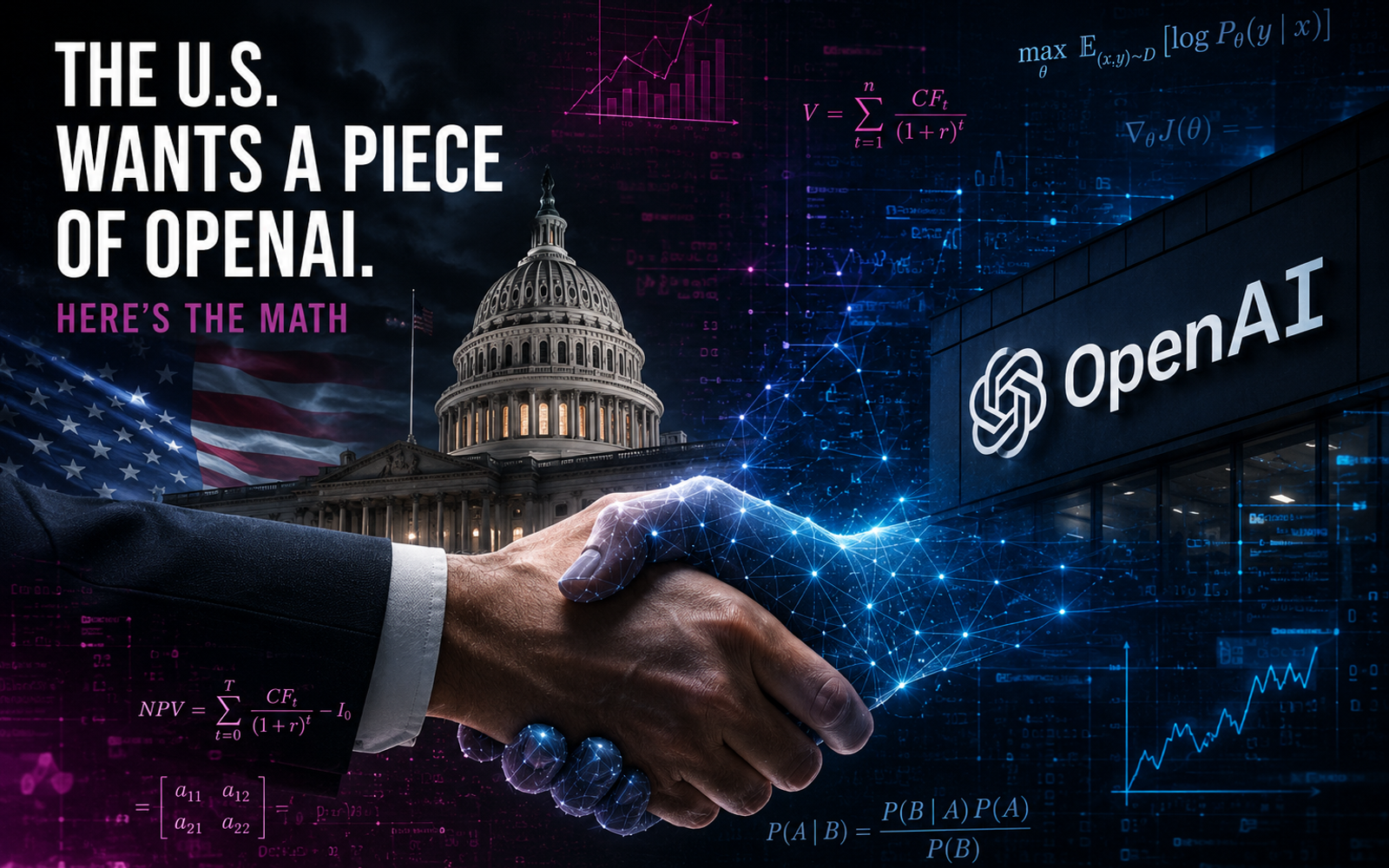
The U.S. Government Wants a Piece of OpenAI. Here's the Math
Trump administration eyes equity stake in OpenAI. The numbers behind the deal and what it means for AI's future.

Sam Altman walks into the White House in early 2025 with a pitch that sounds more like a national infrastructure plan than a venture capital term sheet. Give the government a piece of OpenAI, he says. Not a loan. Not a grant. Equity. Real ownership. The returns go back to the American people, distributed as dividends to every household. It's wild. It's also happening.
Senior U.S. officials have held preliminary discussions with leading AI companies about the government acquiring equity stakes in their businesses, NOTUS reported in early 2026. The talks focused on OpenAI specifically, though the framework could extend to other firms. Altman first pitched the concept directly to Trump during the president's second term. The conversations have continued ever since, per sources familiar with the matter.
The Mechanism Nobody's Modeling
Here is the core tension. OpenAI is currently a capped-profit company structured around a non-profit parent, OpenAI Inc. It's weird. It's messy. It's the product of a org chart drawn by lawyers who wanted to raise money without technically being a for-profit. The company has raised $190.6 billion in total funding to date, per public records. Its latest round closed in February 2026 at $122 billion in committed capital, giving it a post-money valuation of $852 billion. That makes it the most valuable private tech company in history.
And now the U.S. government wants a cap table seat.
Altman's argument runs like this. AI will generate enormous economic value over the next decade. A small fraction of that value, routed through a government equity stake, could fund a sovereign wealth pool that pays out to citizens who don't own tech stocks. Think Alaska's Permanent Fund but powered by transformers and GPUs. OpenAI's own report proposes a "Public Wealth Fund that provides every citizen including those not invested in financial markets with a stake in AI-driven economic growth." The returns on the investment could then be directed to public purposes, such as distributing a dividend payment to all American households.
It sounds almost utopian. But the mechanics get gnarly fast.
Valuation Is a Political Problem
The government wouldn't buy shares at the same price as SoftBank or Amazon. That's the first knot. OpenAI's February 2026 round valued the company at $852 billion. Amazon put in $50 billion. SoftBank put in $30 billion. Nvidia put in $30 billion. Those are sophisticated counterparties with access to OpenAI's financials, its burn rate, its compute contracts. They negotiated hard.
The government, by contrast, would be negotiating in public. Every leaked term becomes a news cycle.
Every discount or premium gets scrutinized as a giveaway or a shakedown. The Trump administration can't quietly sign a side letter with favorable liquidation preferences. The deal would face congressional oversight, FOIA requests, and whatever political opposition decides to make of it.
And there is a real question of price. What is a fair price for the government's stake? If the government pays the same $852 billion valuation that private investors just paid, critics will say the public is overpaying for a company that isn't profitable yet. If the government gets a discount, critics will say the administration handed a sweetheart deal to Sam Altman. There is no clean answer.
The IPO Clock Is Ticking
OpenAI is preparing a confidential IPO filing with Goldman Sachs and Morgan Stanley advising, according to CNBC. The target window is late 2026, possibly September. A confidential filing means the S-1 won't be visible for 60 to 90 days after submission, putting the earliest public prospectus around late July or August.
That IPO changes everything about a government stake. Here's why.
Private company equity is illiquid. You can't sell it easily. You can't mark it to market daily. The government would be sitting on shares that trade infrequently and at opaque prices. But once OpenAI goes public, the government's stake becomes a tradable security. Suddenly you have a sovereign wealth fund seeded with OpenAI stock, generating real returns that can be distributed to households. Or sold. Or held. Or mismanaged.
The timing matters enormously. If the government takes a stake before the IPO, it gets in at the private valuation. If it takes a stake after the IPO, it pays whatever the market decides. The difference could be hundreds of billions of dollars.
Three Constraints That Will Define This Deal
- **Liquidity timeline.** The government can't sell pre-IPO shares without triggering SEC scrutiny. Lockup periods after the IPO typically run 90 to 180 days. Any public dividend program would need to account for this window. - **Valuation gap.** Private investors in the February 2026 round got preferred shares with protections. The government would likely get common stock with fewer rights. That gap matters when calculating the fair value of the stake. - **Conflict surface area.** The government would sit on the cap table of a company it also regulates. OpenAI faces rules on export controls, data privacy, national security review, and antitrust. Every policy decision becomes a potential conflict.
None of these are dealbreakers. But they are the constraints that will shape the actual mechanics, and nobody is talking about them yet.
The Precedent Problem
The U.S. government has taken equity stakes in private companies before. The 2008 TARP bailouts gave the Treasury warrants in banks. The 2020 CARES Act gave the government equity in airlines that accepted payroll support. Those were crisis interventions. This is different.
This would be the government taking an ownership position in a healthy, hyper-growth company because the returns from that company's technology should, in Altman's framing, belong partly to the public that generated the data and infrastructure the technology runs on.
That is a genuinely new argument. And it's worth taking seriously.
OpenAI trained its models on data scraped from the public internet. Content written by people. Images posted by users. Conversations recorded across the web. The company then built a product that generates trillions of dollars in market value largely from that training data. The argument that the public deserves a slice of that value is not crazy. It's the same logic behind public domain, copyright exceptions, and the idea that knowledge commons should benefit the common person.
But the execution is everything.
How the Money Would Flow
Let's get concrete. OpenAI's annualized revenue hit $25 billion in February 2026, up from $20 billion at the end of 2025 and $6 billion in 2024. The company is growing revenue roughly 3x year over year. If that growth continues, OpenAI could be doing $75 billion in annual revenue by late 2027, maybe more.
A 5% government stake in a company doing $75 billion in revenue, assuming a 20% net margin, would generate roughly $750 million in annual profits attributable to the government. That's enough to send every American household roughly $6 per year.
Not life-changing. But it scales.
If the valuation hits $1 trillion, as some analysts expect around the IPO, a 5% stake is worth $50 billion. The government could sell a portion each year and distribute the proceeds.
Or it could hold and collect dividends. Or it could use the stake as collateral for borrowing to fund other programs.
Altman reportedly discussed the idea of federal loan guarantees for chip factories as part of this framework. In 2025, he said OpenAI had spoken with the U.S. government about loan guarantees to spur construction of domestic chip fabrication facilities, though he clarified the company had not sought government guarantees for building its data centers.
The Critics Have a Point
Not everyone loves this idea. Critics warn that a government stake creates an impossible conflict of interest. OpenAI competes with Anthropic, which is also preparing for an IPO with Goldman Sachs and Morgan Stanley. Anthropic has confidentially filed for a U.S. IPO this year, following SpaceX's mega-offering. If the government owns OpenAI shares, does it tilt policy toward OpenAI? Does it slow-walk antitrust reviews of OpenAI's competitors? Does it give OpenAI preferential access to federal compute resources?
These aren't hypothetical. The government is already the single largest purchaser of AI services through defense, intelligence, and civilian agencies. Adding an equity stake to that relationship creates a feedback loop that is hard to unwind.
And there's the question of who decides. The Trump administration is negotiating this deal. The next administration might not want it. A government stake in a private AI company is not something you can easily reverse. You can't just call your broker and dump the shares. The sale would move markets. The announcement alone would move markets.
What This Actually Means for Developers and Users
For the vast majority of people building on top of OpenAI's APIs or using ChatGPT for work, this deal changes nothing in the short term. The models keep running. The pricing stays the same. The rate limits don't shift.
But in the medium term, a government stake could shift OpenAI's incentive structure in subtle ways. A public shareholder with a national mandate might push for broader access at lower prices. Or it might push for more conservative deployment to avoid reputational risk. Or it might push for more domestic compute infrastructure, which could affect where data centers get built and who pays for the power.
The real shift is in how we think about AI ownership. The dominant model today is private capital funding immense compute clusters, training models on public data, and selling access back to the public. The government stake model flips one piece of that equation. Instead of the public paying twice once through data contribution and once through subscription fees it gets a return on the value its data helped create.
That's the argument anyway.
The Sticky Questions Nobody Has Answered
I keep coming back to the same few issues.
Who manages the government's stake? The Treasury Department? A newly created sovereign wealth fund? An independent board appointed by the president? The answer determines whether this becomes a professional investment or a political football. The Alaska Permanent Fund works because it's managed independently with a clear mandate. The U.S. government has no equivalent institution for managing concentrated equity positions in private companies.
What happens if OpenAI fails? The company burns through cash at a staggering rate. Its compute costs are in the billions annually. If the revenue growth slows or the next model generation disappoints, the valuation could crater.
The government would be holding a depreciating asset funded by taxpayers. That's not just a bad investment. It's a political catastrophe.
And what about the other AI companies? Anthropic is right behind OpenAI in valuation and capability. Google's DeepMind is a division of a public company. Meta's Llama is open source. A government stake in just one AI company creates a tiered system where the government has insider access to one competitor's roadmap and not the others. That distorts the market.
The Quiet Detail in the Background
OpenAI's cap table already includes Microsoft, which has invested roughly $13 billion over multiple rounds. The relationship has been complicated. Microsoft initially got a significant revenue share from OpenAI's profits. That arrangement was restructured as OpenAI raised more capital. The details of the current Microsoft deal are not fully public.
Now imagine adding the U.S. government to that cap table. You have Microsoft, the world's most valuable public company, sitting next to the U.S.
Treasury. You have Sam Altman, who has shown he is willing to restructure the company repeatedly to keep control. You have a board that has already fired and rehired Altman once. The governance complexity is staggering.
The confidential IPO filing will eventually reveal some of these dynamics. The S-1 will show who owns what, what the liquidation preferences look like, and how the capped-profit structure converts to a standard for-profit corporation. But that disclosure is months away. In the meantime, the negotiations happen in private.
The Thing That Keeps Me Up
There is a version of this where it works. The government gets a 5-10% stake at a fair price. OpenAI goes public. The stake appreciates. The government sells a portion each year and distributes the proceeds to every American household. It's small money at first, $6 or $7 per family. But it grows. And it establishes a principle: the economic returns from AI belong partly to the people whose data and infrastructure made AI possible.
There is another version where this fails. The government overpays. The IPO gets delayed. The political pressure to distribute money early forces a sale at a bad price. The stake becomes a symbol of government overreach instead of public benefit. The next administration unwinds the position at a loss. The whole experiment gets labeled a failure and nobody tries again for a generation.
Which path we take depends on details that are being negotiated right now, in rooms without press access, between people who are not thinking about the long-term institutional questions. They are thinking about the deal. The timeline. The next round.
And that is how big things get decided. Not through public debate or consensus but through a series of small choices made by people who are tired and hungry and trying to get something done before the weekend.
Comments (0)
No comments yet. Be the first to share your thoughts.