Maruti Suzuki's 5 Startup Bet: Your Playbook for 2026
How five Indian startups landed deals with an auto giant and what it means for where you should spend your time this year.

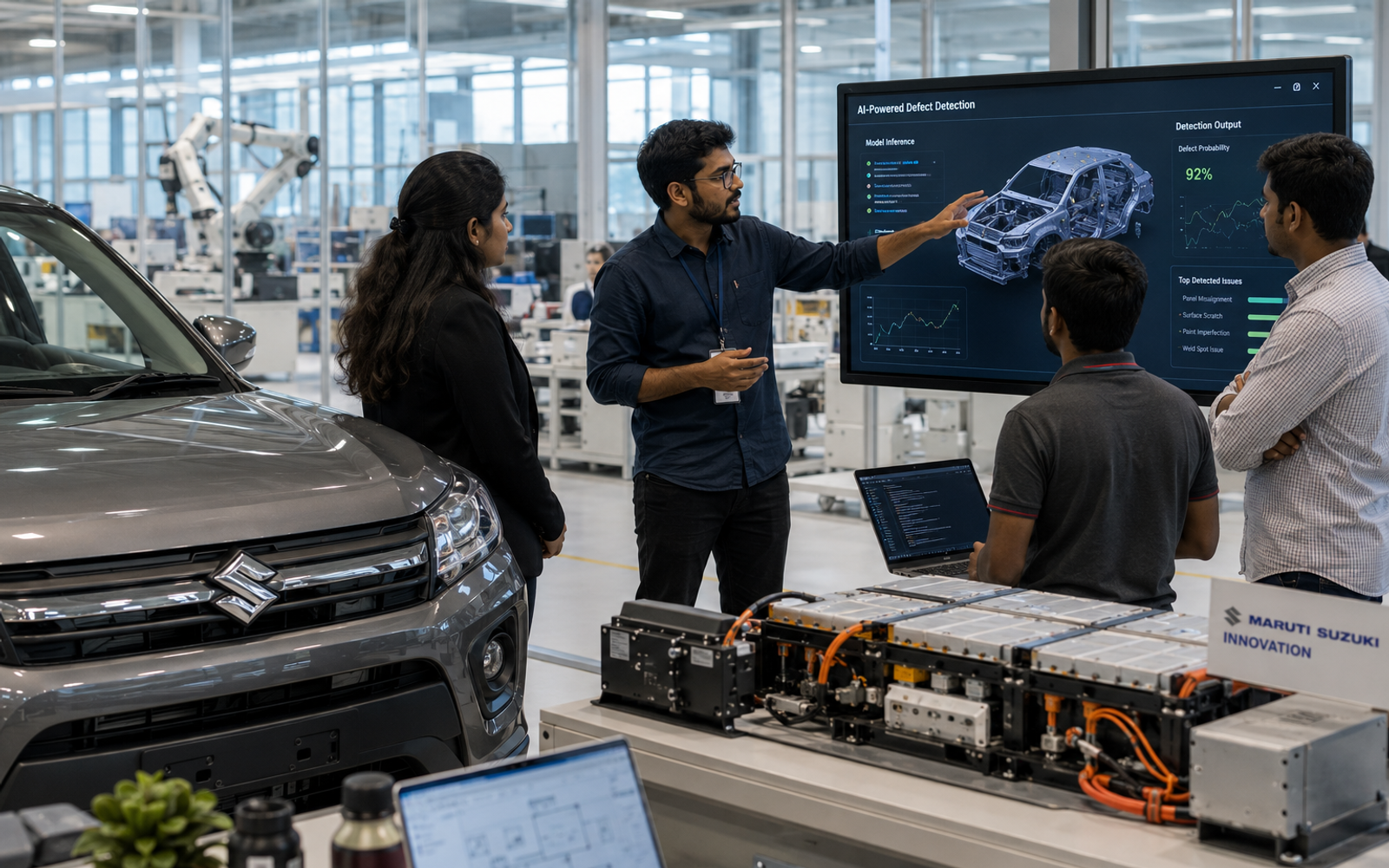
June 29 landed like a quiet bomb for anyone watching the Indian auto sector. Maruti Suzuki, the country's largest carmaker, announced it had officially onboarded five startups under the fifth cohort of its incubation program. MiniMines, Easework AI, Sarvam AI, Siftly, and CodeMate AI. Each one gets a funded proof of concept, mentorship from the Maruti Suzuki Innovation team, and direct access to an operation that moves millions of vehicles a year. The program runs in partnership with IIM Bangalore's NSRCEL, which means these founders also get academic rigor layered on top of real corporate exposure.
You should care about this even if you've never touched a car engine. The deal structure tells you something about where capital and attention are flowing in 2026. And it tells you something about the events you should be booking right now.
A Car Giant That Actually Moves Like a Startup
Maruti Suzuki has been running this incubation engine since 2021. Five cohorts deep now. The company processes over 2 million vehicles annually across 3,000 dealerships. For a startup to get inside that machine is like finding a door that most people don't know exists.
Here's what each of the five brings to the table. MiniMines recycles end of life lithium ion batteries, a problem that gets more urgent every quarter as EVs pile up on roads. Easework AI automates back office processes using computer vision and natural language processing. Sarvam AI builds multilingual customer support tools, critical for a market where India speaks in dozens of languages. Siftly handles fleet management and logistics optimization using machine learning. CodeMate AI is an automated code review platform that helps engineering teams ship faster with fewer bugs.
Notice something. Three of the five are AI companies. One is battery recycling. One is logistics. The pattern is unmistakable: Maruti Suzuki is betting that the next efficiency gains won't come from assembly line tweaks. They'll come from software that sees, speaks, and sorts better than humans can.
If you're building a startup in 2026, your time is the scarcest resource. Every conference you attend, every demo day you pitch, every corporate partnership you chase.
They all cost weeks of focus. The question is where to place your bets.
Start2explore India, the program that connects startups with Maruti Suzuki through immersion and mentorship, is one route. But you can't rely on a single door. You need a circuit.
Viva Technology in Paris runs June 17 20 this year. It's the tenth edition and AI is the red thread running through every stage. Paris Expo Porte de Versailles will host 2,000 plus startups, hundreds of corporate partners, and a density of European VCs that you won't find anywhere else on the calendar.
Then there's GITEX Africa in Marrakech, April 7 9. Over 1,800 startups showed up for the 2026 edition. The energy in that room is different from anything you'll feel in Europe.
It's frenetic. Hungry. Founders from Lagos, Nairobi, Casablanca, and Cape Town all trying to solve infrastructure problems that most Silicon Valley types don't even know exist.
Greentech Festival in Berlin, June 23 25. Techsylvania in Cluj, Romania. Web Summit in Lisbon, November. Product World Croatia in Opatija, May 7 8. The European circuit alone has 125 mapped events across 50 plus countries according to StartupBlink's 2026 research. That's overwhelming if you try to do all of them. But you don't need to.
Pick two. Three max.
The Africa Angle Nobody's Talking About
Here's the part that most global founder newsletters miss. While everyone was watching Maruti Suzuki ink deals in New Delhi, something equally consequential happened in Central Africa. Visa, M Pesa, and Onafriq launched a stablecoin pilot in the Democratic Republic of Congo for cross border payments. The pilot lets Congolese mobile money users settle transactions in dollar pegged digital currency without touching a bank branch.
This matters because it changes who can partner with whom. A logistics startup in Kinshasa can now process payments across borders with the same efficiency as a Mumbai based fleet manager working with Maruti Suzuki. The infrastructure gap is narrowing.
If you're a founder building in Africa, the event calendar is thickening. AI Expo Africa in Johannesburg runs October 28. Africa Startup Festival Kenya in Nairobi, November 2. Seamless Africa in Johannesburg. The continent is no longer just a market where Western companies extract value. It's becoming a place where startups build systems that get adopted globally.
A recent report on the state of entrepreneurship in Africa, details of which are still emerging, suggests that the narrative is shifting. The continent raised $575 million across 58 deals in January and February 2026 alone. Logistics and transport emerged as the top funded sector. That's not an accident. That's a signal.
Three Practical Moves You Can Make Right Now
Let's get tactical. You're reading this because you want to know what to do on Monday morning. Here are three things.
audit your corporate partnership strategy. Maruti Suzuki's model is instructive. They pick startups through a structured incubation program, give them a funded PoC, and then integrate the ones that work. You don't need to win a 50 million dollar contract on day one. You need a single paying customer inside a large organization who can become your champion. Focus on the smallest possible entry point.
calibrate your event attendance to your current stage. Pre seed founders should prioritize events where investors attend panels, not just exhibition halls. VivaTech and Web Summit are good for that. Growth stage founders should target industry specific events where corporate decision makers walk the floor. GITEX Africa is strong here because telcos, banks, and logistics companies send their actual procurement teams. Not just marketing people handing out stickers. The 10% Nobody Automates: Your Personal Brand in 2026 covers why showing up strategically matters more than ever.
track the infrastructure shifts that unlock new markets. The M Pesa stablecoin pilot in DRC isn't a niche fintech story. It's a signal that cross border payments in Africa are about to get cheaper and faster. If your startup relies on moving money across borders, this changes your unit economics. Same with Maruti Suzuki's battery recycling bet. If you're in climate tech, watch where the automakers are placing their incubation dollars. They're telling you where the bottlenecks are.
The Real Takeaway Is Simpler Than You Think
Every founder I respect has the same problem. Too many options. Too many events. Too many potential partners. The instinct is to say yes to everything because you're afraid of missing the one door that matters.
But look at what Maruti Suzuki actually did. They picked five startups. Not fifty. Not five hundred. Five. They chose companies that solved specific, measurable problems inside their existing operations. Battery waste that needs somewhere to go. Customer support that needs to speak more languages. Code that needs fewer bugs.
Your job is to be that specific for whoever you're trying to sell to.
And when you do find a door, walk through it fast. Because the next cohort is already forming. The next GITEX is already booked. The next stablecoin corridor is already being tested in a city you've never visited. The calendar keeps turning.
You just have to know which page to be on.
Comments (0)
No comments yet. Be the first to share your thoughts.