Pomellato's Revolution Is Everything You Think It Isn't
Pomellato's Palais de Tokyo exhibition is gorgeous. But the real story is what it says about luxury in 2026.

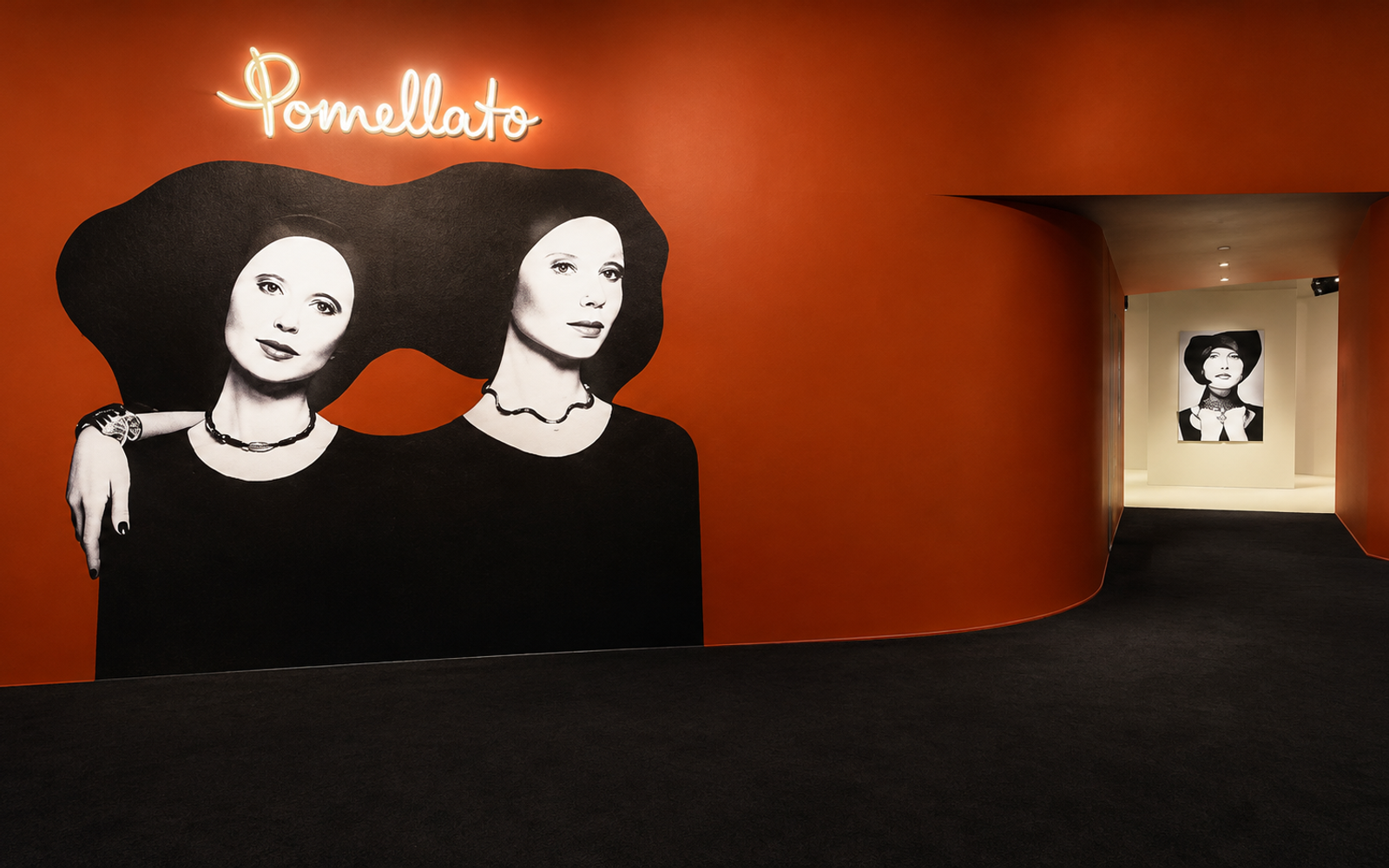
You walk into the Palais de Tokyo and the first thing you see is a chain. Not a necklace, not a bracelet, just the chain itself. A thick, almost architectural thing in rose gold, laid out like an artifact. Which it is, in a way. Pomellato built its reputation on that chain, on the idea that a necklace could be something you throw on with a t-shirt, not something you save for a gala. The exhibition, "Le Joaillier Révolutionnaire," opens June 24 and runs through July 20, and it's gorgeous. It's also exactly the kind of thing that makes me uneasy.
That unease has nothing to do with the jewelry itself. Look closely at the pieces on display, many pulled from the maison's archives and shown to the public for the first time. You can see the radicalism. In the 1960s, when every respectable jeweler was still doing floral brooches and diamond tennis bracelets, Pino Rabolini decided to make fine jewelry that felt like fashion. He used colored gemstones the way a painter uses pigment. He built necklaces that moved like fabric. He trusted women to buy their own diamond rings, which in 1967 was practically a political statement. The curatorial hand of Alba Cappellieri, a professor at Politecnico di Milano and a genuine scholar of jewelry design, gives the show real intellectual weight. Pomellato to Stage Exhibition in Paris at Palais de Tokyo reported that the show dedicates a section to each of the maison's revolutions. Image. Craftsmanship. Color. Women. Each gets its own room. Each tells a tidy story.
And that's the problem. The tidiness of it.
Real Revolutions Are Messy
The word "revolutionary" gets thrown around a lot in fashion. It's become a kind of verbal tic, a way of saying "this is important without being too specific about why." Pomellato's exhibition leans hard on that word. It's right there in the title. But the structure of the show, the museumified format that separates each revolution into its own cleanly labeled chamber, suggests something more controlled than revolutionary. Revolutions are chaotic. They leave scars. They produce things that don't fit neatly into categories. This exhibition, for all its beauty, feels like a revolution that's been curated, packaged, and priced.
I wrote about this trend earlier this year, looking at how luxury brands have seized on the museum exhibition as the ultimate marketing vehicle. It's not just Pomellato. Van Cleef does it. Dior does it. Even Hermès, whose Resort 2027 show this season was notable for its restraint, has been staging increasingly elaborate brand retrospectives. The format has become so standardized that you could almost write a template: find a prestigious cultural institution, hire a respected academic curator, pull archival pieces, organize them by theme, add some immersive elements, call it a revolution. The Vogue analysis of the jewelry market in 2026, titled "Age of Asset," noted that "once rare, museum-grade brand shows have become a central part of the luxury marketing playbook." Some maisons now stage up to two major exhibitions a year, often simultaneously across continents.
The contradiction is baked in. A revolution can't be scheduled. It can't be free with advance reservation, which this exhibition is. Admission is complimentary, you just need to book a slot. That's generous. It's also a lead generation funnel. The show is designed to make you fall in love with Pomellato, and if you fall in love, you know where to find the store.
Color as Currency
The most compelling room in the exhibition is the one dedicated to color. Pomellato has always understood something that many jewelry houses forget: gemstones don't just sparkle, they communicate. A tsavorite garnet is green in a way that says something different from an emerald. An amethyst can be dark and brooding or pale and ethereal depending on how you cut it. The maison's use of colored stones in the 1970s and 80s was genuinely disruptive because it treated color as the main event, not a supporting player. Most jewelers of that era used colored stones as accents, little pops of contrast in a field of diamonds. Pomellato flipped that. They made the colored stone the whole point.
Walking through this section, you can see the lineage clearly. The chain necklaces from the 1980s set with irregular cabochons. The massive rings that look like candy on the finger. The way the gold is worked, hammered, brushed, polished in ways that catch light differently. It's precise. It's accomplished. But I kept wondering what wasn't in the room. What didn't make the cut. Every museum show is a selection, an argument about what matters. The pieces that aren't there tell a story too. The failures. The experiments that didn't sell. The designs that were too weird even for a house that built its identity on being weird. Those are the things I wanted to see.
Craftsmanship and the Problem of Skill
The craftsmanship section is immaculate. You can watch videos of the goldsmiths in Milan working on chains that take weeks to assemble. You can see the tools, the molds, the wax models that preceded the final piece. It's the kind of transparency that luxury brands have embraced as a response to a culture that increasingly demands to know how things are made. And I'll admit: I stood there longer than I expected. There's something hypnotic about watching a skilled artisan set a stone, the tiny adjustments of the prongs, the tap of the hammer that either secures the gem or cracks it. The skill is real. The dedication is real.
But craftsmanship has become a kind of rhetorical shield for the luxury industry. When you say "this took 800 hours to make," you're also saying "this justifies the price tag." Which it might. But the emphasis on craft can also obscure the hard questions. Where do the stones come from? How are the miners treated? What's the environmental cost of extracting a tsavorite garnet from the depths of the earth and shipping it to Milan to be set in gold? Pomellato, like most luxury houses, has sustainability initiatives. The Kering Group, which owns the maison, has been a leader in environmental reporting. But the exhibition doesn't really grapple with any of this. It's a celebration, not an interrogation.
The Women's Room
The final section of the exhibition focuses on women. Pomellato has made female empowerment a central part of its identity. The brand's campaigns have long featured women who are older, more powerful, more interesting than the typical jewelry ad model. Think about those images of women in suits and silk, laughing, holding champagne, wearing a Pomellato ring on their index finger like a signet. The message is clear: this is not a gift. This is a purchase you make for yourself. The exhibition traces this approach back to the 1990s, when the maison began explicitly marketing to women as self-purchasers, long before the rest of the industry caught on.
It's a good story. It's also a story that has shown many times before, by many brands. The empowered woman who buys her own diamonds has become a cliché of luxury marketing, so familiar that it barely registers anymore. Pomellato was early to this narrative, and the exhibition makes that case convincingly. But I kept thinking about what empowerment actually means in the context of a product that costs more than most people's rent. There's a strangeness to celebrating female financial independence through an object that is itself a symbol of extreme wealth concentration. I don't have an easy answer for that tension. The exhibition doesn't either.
On the Question of Audience
The Palais de Tokyo is a smart choice for this show. It's a contemporary art space, not a natural history museum or a jewelry-specific venue. The building itself, with its concrete walls and raw industrial feel, creates a useful friction with the glittering objects on display. You can walk from a room of radical feminist art to a room of Pomellato necklaces, and the contrast asks you to think about what qualifies as art and what qualifies as commerce. The line has been blurring for decades, and Pomellato is deliberate about positioning itself on both sides.
But who is this for? The free admission lowers the barrier, but the location in central Paris still selects for a certain kind of visitor. Tourists with money. Locals who follow contemporary art. People like me, who get paid to write about this stuff. The exhibition won't change the mind of someone who thinks fine jewelry is a frivolous indulgence. It doesn't need to. It's preaching to a choir that's already wearing the necklace.
What Revolution Looks Like Now
I keep circling back to that word. Revolutionary. In jewelry, what would a real revolution look like in 2026? It might be a brand that refuses to use newly mined stones at all, working only with recycled gold and repurposed gems. It might be a house that prices its pieces transparently, showing exactly what the materials cost and what the markup is. It might be a label that abandons the traditional jewelry calendar altogether, forgoing seasonal collections in favor of a single, permanent offering that doesn't pressure anyone to buy anything.
Pomellato does none of those things. But that's not really a criticism. It's a luxury brand operating within a luxury system, and the system has rules. The exhibition is honest about what it is: a celebration of a house that made some genuinely interesting choices over the past six decades. The surprise was that this is Pomellato's first exhibition in Paris. For a brand that has been around since 1967, that's a long wait. It suggests either a certain restraint or a certain lack of ambition, depending on how you see it.
The Real Innovation Nobody's Discussing
What the exhibition gets right, quietly, is the emphasis on wearability. Pomellato's jewelry is designed to be worn, not just looked at. That sounds obvious, but it's surprisingly rare in the fine jewelry world. A lot of high jewelry is essentially sculptural, too heavy or too delicate or too precious to actually put on and live in. Pomellato's pieces, even the most elaborate ones, seem to invite touch. The chains move. The stones sit flush against the skin. You can imagine a woman wearing one of these necklaces to dinner, to a meeting, to the grocery store. That accessibility, that refusal to separate jewelry from daily life, is the real inheritance of Pino Rabolini's original vision.
And in the end, that might be the only revolution that matters. Not the marketing. Not the brand narrative. Just the fact that someone in Milan, fifty-nine years ago, decided that a woman should be able to buy herself a diamond ring and wear it on a Tuesday. Everything else is just an exhibition.
Comments (0)
No comments yet. Be the first to share your thoughts.