Stablecoins Just Broke Africa's FX Bottleneck
HyperFX and Payd/Noah are reshaping cross-border payments for African freelancers. The math on fees just changed forever.

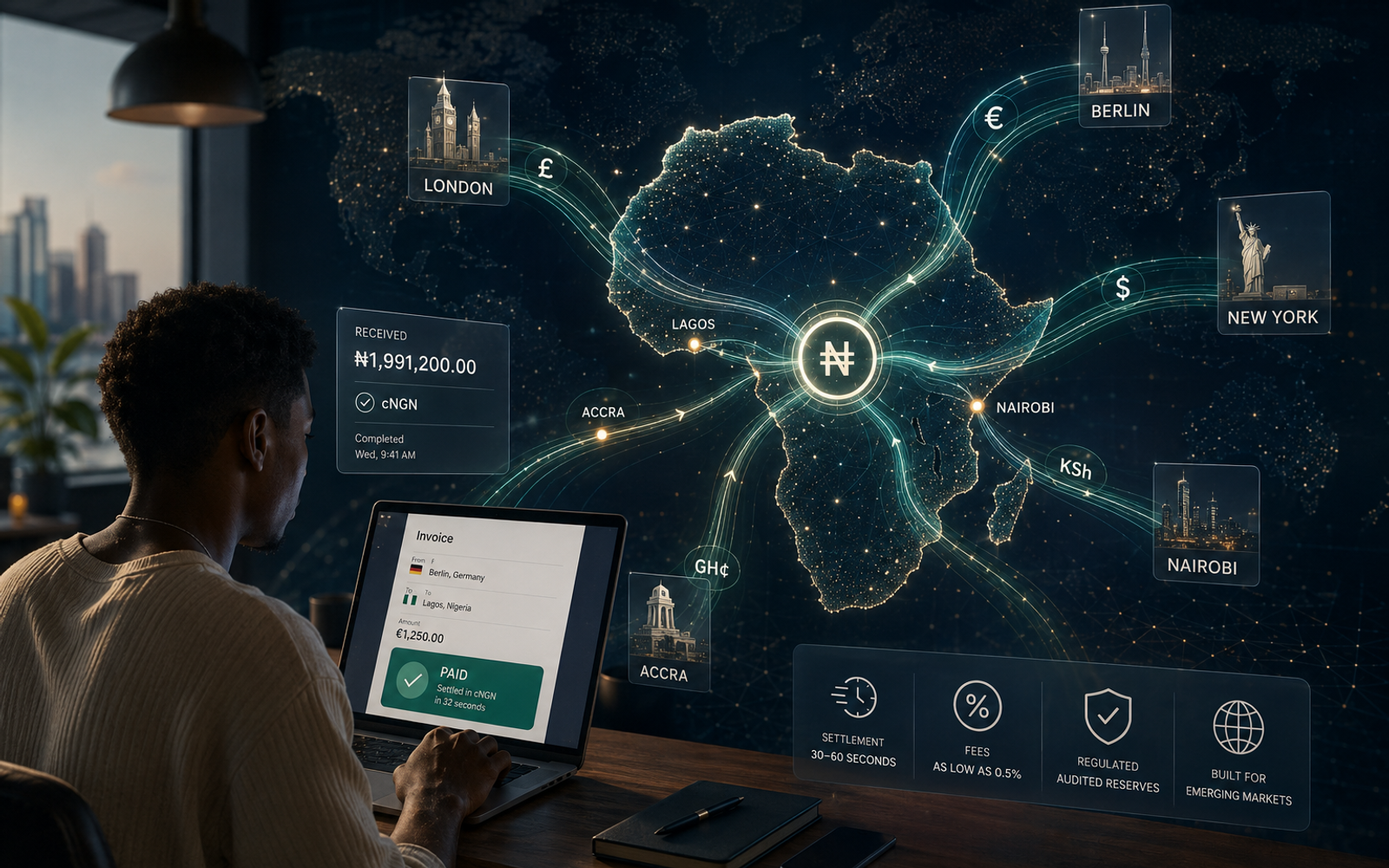
A freelancer in Lagos invoices a client in Berlin on Tuesday. The client pays in euros. By Wednesday morning, the freelancer has naira, not through a bank that sits on the transfer for three business days, not through a black-market operator charging an 8% premium on the spread. Through a stablecoin rail. This isn't a pilot. It's live. As of this week, HyperFX settles naira legs in cNGN, a regulated stablecoin built for exactly this purpose, according to TechCabal.
The global stablecoin market processed $11.6 trillion in adjusted transfer volume in 2025, a 90% year-over-year jump, according to Allium data cited by Crossmint. That number is mostly institutional plumbing. Settlement layers between exchanges. Treasury operations. Large B2B flows. But the ground is shifting. The real entrepreneurial story in 2026 isn't the volume. It's who finally has access to the pipe.
The Freelancer Tax Was 7.9%. That Changes Everything
For years, the math on cross-border freelancing from Africa was brutal. A $200 payment from a US client cost $15.80 in fees on average, nearly double the global average for remittances, per the World Bank and Thunes. That's before the exchange rate spread. Before the bank hold. Before the "we'll credit your account within 2-5 business days" that sometimes stretched into two weeks.
Historical World Bank data has long cited that remittance fees into Africa on traditional rails average around 7.9% for a $200 transfer. Stablecoins change the cost structure completely. When Noah partnered with Payd in February 2026 to offer USD and EUR accounts for African freelancers, the pitch wasn't about crypto ideology. It was about speed and spread.
The partnership targets Kenya, Nigeria, South Africa, and Senegal specifically. Freelancers in Kenya can receive USD and off-ramp directly to M-Pesa in minutes. In Nigeria, the system gives access to dollar liquidity that used to require a connection with a bureau de change operator who set their own rates. The result? A freelancer who used to lose nearly 8 cents on every dollar earned now loses less than one cent.
HyperFX Didn't Build a Fintech. It Built a Plumber's Plumber
Here's where the architecture gets interesting. HyperFX isn't another neobank for freelancers. It's a settlement layer that other fintechs plug into. Think of it as the fiber-optic cable underneath the app you actually open. The company settles its naira leg in cNGN, a stablecoin issued by a consortium of Nigerian banks and licensed under the country's 2025 Investments and Securities Act, which classifies all stablecoins as securities under SEC jurisdiction.
That regulatory clarity matters. Under Section 357 of the ISA 2025, stablecoin issuers in Nigeria must maintain mandatory reserves and submit to regular audits.
The Central Bank of Nigeria and the SEC are working on a joint framework to oversee crypto activities, responding to IMF pressure to tighten oversight over monetary sovereignty risks. The IMF called on Nigeria specifically to tighten stablecoin regulations in June 2026.
You might see regulation as red tape. The founders building on these rails see it as permission. Payd processes over $61 million in stablecoin volume, according to TechCabal.
That's real money moving through a system regulators have signed off on. That attracts institutional partners. That attracts the kind of liquidity that makes a 30-second settlement possible at scale.
Other companies are watching. VaulFi launched a stablecoin bridge for North Africa's freelancers through a partnership with Noah in March 2026. The pattern is clear: one infrastructure play, many distribution layers on top. The same model that made Stripe work for payments and Twilio work for communications is now replicating for stablecoin settlement in emerging markets.
The Trap Nobody's Talking About
Every infrastructure shift creates a gold rush. The stablecoin moment is no different. Between January and July 2026, the number of fintech startups in Nigeria offering some form of stablecoin payout has grown by an estimated 60% based on registration filings. But not every layer in the stack captures value equally.
The settlement layer, the HyperFXs and cNGNs of the world, captures thin but recurring fees on massive volume.
The distribution layer, the Payds and Noahs, captures customer relationships and brand loyalty. The application layer, the freelancer platforms, the creator payment tools, the gig marketplaces, captures the user's willingness to pay for convenience.
You need to decide which layer you're playing in. Building a stablecoin aggregator with no regulatory edge and no existing user base is a commodity business with a short shelf life. Building a specialised payment product for one vertical, say, stablecoin payroll for African creators earning on Patreon or YouTube, creates defensibility through focus. That's the difference between a feature and a company.
Most stablecoin volume still settles on Ethereum and its layer-2 networks, a dynamic explored in a recent analysis of market sentiment shifts. The infrastructure is finally cheap enough to bypass traditional middlemen.
What the IMF Thinks Matters More Than You'd Expect
None of this works if regulators pull the plug. The IMF has been vocal in 2026 about stablecoin risks to monetary sovereignty in Africa, calling on Nigeria specifically to tighten oversight. Nigerian authorities responded by pointing to the joint CBN-SEC framework under development. The Nigeria Stablecoin Summit in Lagos on July 30, 2026, will bring together policymakers, issuers, and fintech operators to hash out the next phase.
The tension is real. Central banks don't love currency substitution.
A shift toward dollar-pegged stablecoins for everyday transactions reduces demand for the naira, which complicates monetary policy. But the practical reality is that African freelancers have been using dollar-pegged workarounds for decades, bank accounts in London, cash couriers, unlicensed currency traders. Stablecoins just make the process cheaper and more transparent.
For the entrepreneur building today, the regulatory risk isn't a reason to pause. It's a reason to build with compliance baked in. The companies that survive the inevitable regulatory tightening will be the ones that already hold licenses, already submit to audits, already work with central banks rather than around them.
The Spread Between What Works and What Doesn't
Two years ago, the conversation about crypto in Africa was dominated by speculation, trading volumes on exchanges, P2P spreads, the price of Bitcoin in naira. The 2026 conversation is different. It's about settlement speed. It's about the cost of moving money. It's about a freelancer in Lagos not having to plan their life around when a bank decides to release their funds.
This has implications beyond freelancing. Importers, exporters, remittance senders, tuition payers, every person or business that touches a cross-border payment in Africa is a potential user of this rail. For context on how capital is shifting across emerging-market payment rails, 2026 Markets: $10B at Stake tracks the broader reallocation.
The $11.6 trillion in global stablecoin volume in 2025 wasn't mostly African. It was mostly institutional, mostly American, mostly wholesale. But the next wave won't look like that. The next wave will be a creator in Accra, a freelancer in Nairobi, a small business in Lagos. The pipe is built. The regulators are watching but not blocking. The user demand is real and growing.
The question isn't whether stablecoins will reshape cross-border payments for African entrepreneurs. They already are. The question is which builders will capture the margin between a 7.9% fee and a 0.5% fee. Because that spread is where businesses get built.
Frequently Asked Questions
What is cNGN and how is it different from other stablecoins?
cNGN is a naira-backed stablecoin engineered to align with Nigerian regulatory requirements under the ISA 2025, which classifies all stablecoins as securities. Unlike USDC or USDT, cNGN is designed specifically for domestic settlement within Nigeria's financial system and issued by a consortium of Nigerian banks.
How does HyperFX settlement actually work for a freelancer?
A freelancer receives payment in foreign currency through a partner fintech like Payd, which converts it to cNGN stablecoin on HyperFX's rail. The freelancer then off-ramps to naira through licensed exchangers or directly to mobile money wallets like M-Pesa in Kenya. The entire process takes minutes instead of days.
Are stablecoin payments legal for African freelancers in 2026?
Yes, but the regulatory environment varies by country. Nigeria classifies stablecoins as securities under SEC jurisdiction and requires issuers to maintain reserves and undergo audits. Kenya, South Africa, and Senegal have more permissive frameworks. The IMF has urged tighter controls, and joint CBN-SEC regulations are under development.
What fees do stablecoin transfers charge compared to traditional bank transfers?
Historical data places average traditional remittance fees into Africa at 7.9% for a $200 transfer, though newer solutions are lowering this. Stablecoin-based transfers typically cost under 1%, with some rails charging as little as 0.1% to 0.5% depending on the corridor and settlement method. Exchange rate spreads also narrow significantly.
Which African countries have the highest stablecoin adoption in 2026?
Nigeria leads in absolute volume due to its large freelance workforce and persistent FX liquidity challenges. Kenya follows closely, driven by M-Pesa integration with stablecoin rails. South Africa, Senegal, and Ghana are emerging markets, with Ghana seeing growing use for diaspora remittances.
How does Payd and Noah's partnership work for freelancers?
Payd provides the wallet infrastructure where freelancers receive USD and EUR payments. Noah provides the stablecoin settlement rail that converts those payments to local currencies. Freelancers can then withdraw to mobile money or bank accounts in Kenya, Nigeria, South Africa, and Senegal with near-instant settlement.
Comments (0)
No comments yet. Be the first to share your thoughts.