144 Years Later: Gaudí's Tower Finally Pierces the Sky
Pope Leo XIV inaugurated the Tower of Jesus Christ at the Sagrada Família this week. What does it mean to finish the unfinishable?
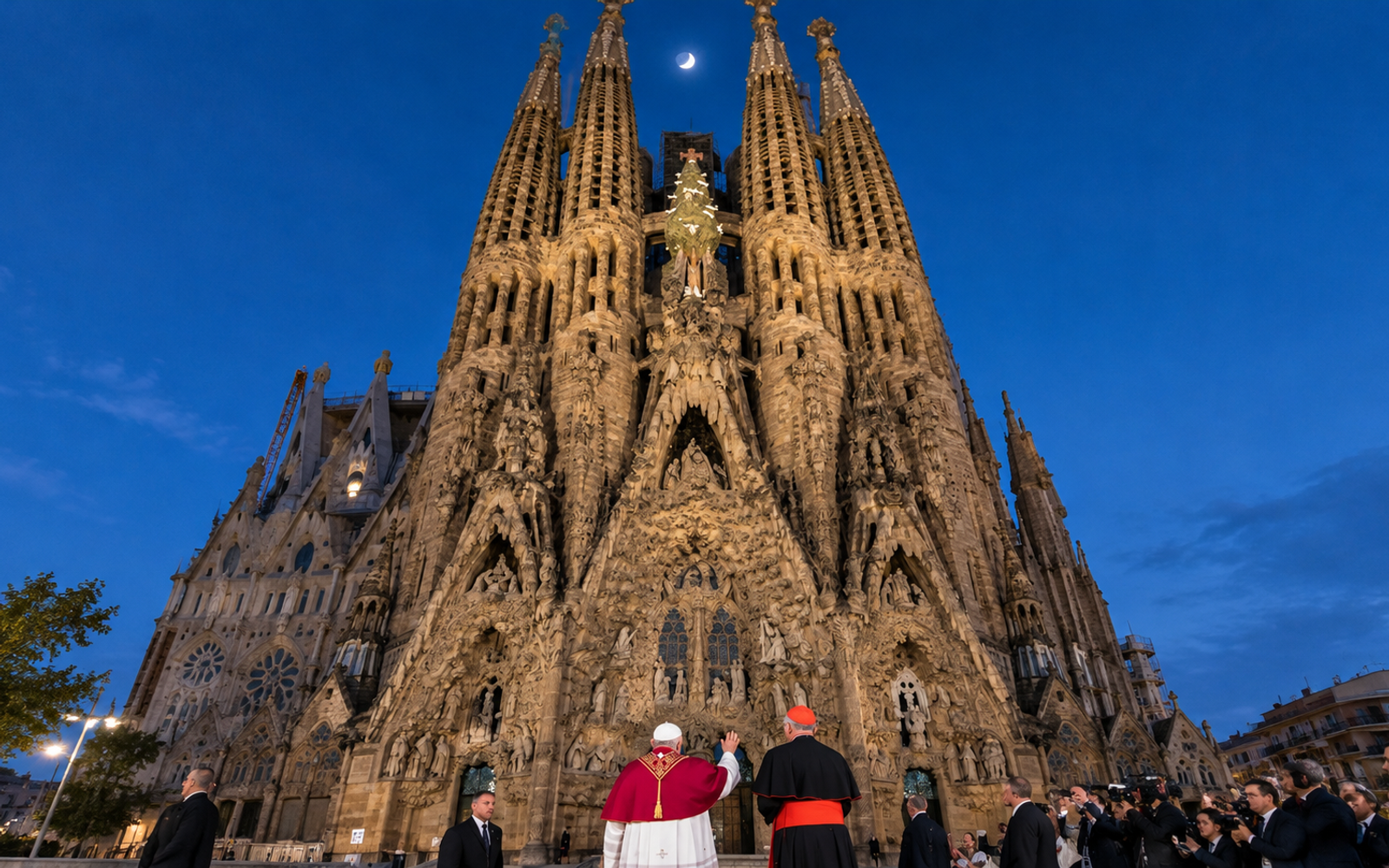
The crane came down in February. Workers installed the final piece of the central tower on the twentieth of that month, and for a few months, Barcelona adjusted to the sight of a skyline that had stopped changing. Then, on June 10, Pope Leo XIV walked through the nave of the Sagrada Família, said Mass, and blessed the thing into its official life. The Tower of Jesus Christ now stands at 172.5 meters, making the basilica the tallest church in the world, a title previously held by Germany's Ulm Minster. Around 120,000 people lined the streets. Euronews called it a spectacle. But spectacle undersells what actually happened here.
This was not a ribbon-cutting. This was the end of a 144-year argument between an architect and time itself.
The Centenary That Almost Wasn't
Antoni Gaudí died on June 10, 1926, struck by a tram on the Gran de Gràcia. He was 73, dressed poorly, and initially mistaken for a beggar. They buried him in the unfinished church. A hundred years later to the exact day, the first American pope, elected just over a year ago, stood in the same building and declared the central spire complete. The symmetry is almost too neat, the kind of narrative closure that novelists avoid because real life never cooperates. But it cooperated this time.
Pope Leo XIV, whose full biography now includes this event as a defining moment of his early papacy, called the basilica a masterpiece of "stone, colour and light" in his homily. He said beauty can lead people to God. That line matters, because the Sagrada Família has always been an aesthetic argument more than a theological one. Gaudí was profoundly Catholic, but his faith expressed itself through structure, branching columns that look like trees, facades that read like scripture in limestone. The building converts people through wonder, not doctrine. And now, with the tower complete, the wonder has a capstone.
What Completion Means in an Age of Perpetual Unfinish
Here is the strange thing about finishing the Sagrada Família. We live in a culture that has abandoned completion entirely. Software ships in beta. TV seasons end on cliffhangers that never resolve. Buildings get wrapped in scaffolding and stay that way for decades. The Sagrada Família was itself the most famous example of this, a construction site that became an icon of its own incompleteness. Tourists came to photograph the cranes. The cranes were the point.
And now they are gone. The basilica is not fully decorated, the final ornamental details will take until at least 2035, according to the foundation, but the main structure is done. The central spire rises and holds. This is a rare cultural event: the conclusion of a long, public, collective project. It is worth asking what that does to a city, to a faith community, to a global audience that has, for generations, known this building as the one that was never finished.
The answer, judging by the 120,000 who came, is something between relief and grief. Relief that it happened within living memory. Grief that the waiting is over. Waiting gave the building a kind of perpetual presence in Barcelona's cultural imagination. Now it just exists. Like any other monument.
Stone as Counterargument to the Screen
Gaudí once said, "Originality consists of returning to the origin." He meant God and nature. But the phrase lands differently in 2026. The origin, for Gaudí, was material. Stone carved by hand. Glass colored by mineral compounds. Geometry derived from trees, bones, the human ribcage. The Sagrada Família is an artifact of a world that touched what it made.
That tactile quality has become its most radical feature. In a culture where more and more experience happens through glass rectangles, phones, tablets, the AR overlays that tourists now use to "see" the basilica's hypothetical completed form, the building itself insists on the primacy of the physical. The columns are not digital renderings. The light through the stained glass is not a filter. You can touch the stone. It is warm or cold depending on the season. This is not a metaphor. This is the actual experience of being inside Gaudí's church, and it is harder to replicate than most architecture firms want to admit.
There is a parallel worth drawing with certain traditions in African sacred architecture, the Great Mosque of Djenné, for instance, which is replastered every year by the community, its surface maintained by hand in a ritual that rejects permanence in favor of participation. The Sagrada Família is the opposite: built to last centuries, every stone locked into place with geometric precision. But both buildings demand something from the people who encounter them. Neither can be consumed on a screen. The Flag Went Up. Now What? asked a similar question about political symbols, what happens after the ceremony, after the flag rises, when the symbol must hold meaning without the support of the event that revealed it. The Sagrada Família now faces the same test. The pope has come and gone. The blessing is done. The building remains.
The Weight of the Symbol
The Tower of Jesus Christ is not just a spire. It is a cross-shaped structure topped with a four-armed cross that glows at night. Gaudí designed it so that the entire basilica would read as a vertical ascent from the human to the divine. The tower is the punchline to a joke he spent 43 years setting up. Every other element, the nativity facade, the passion facade, the columns that open like palms, points toward this single vertical gesture.
But symbols only hold meaning when people agree to read them. And the people who filled Barcelona's streets on June 10 were not a monolith. Catalans who see the basilica as a monument to their regional identity. Catholics who see it as a statement of faith.
Tourists who see it as a bucket-list checkbox. Architects who see it as a solved problem. The tower means different things to each group, and the inauguration did not resolve those differences. It just gave them a higher place to gather.
Pope Leo XIV understood this. His homily emphasized unity and harmony for Spain, a country that still carries the weight of its internal tensions. The Sagrada Família, he suggested, can be a sign of unity. But unity is not the same as agreement. It is the willingness to occupy the same space while holding different views. The building now does that work. Whether it succeeds depends on what happens in the decades ahead, when the scaffolding is long gone and the crowds have thinned.
The Final Detail
One hundred and forty-four years, five generations of builders, a civil war, a pandemic, and a papal visit later, the Sagrada Família has reached its full height. The cranes are dismantled. The tower catches the Mediterranean light. Gaudí's bones remain in the crypt below, exactly where they have been since 1926. And the building, for the first time in anyone's living memory, is finished enough to be called finished. That is the story. Not the pope, not the crowd, not the ceremony. Just the quiet fact of completion, rare and strange, standing 172.5 meters above Barcelona.
Comments (0)
No comments yet. Be the first to share your thoughts.