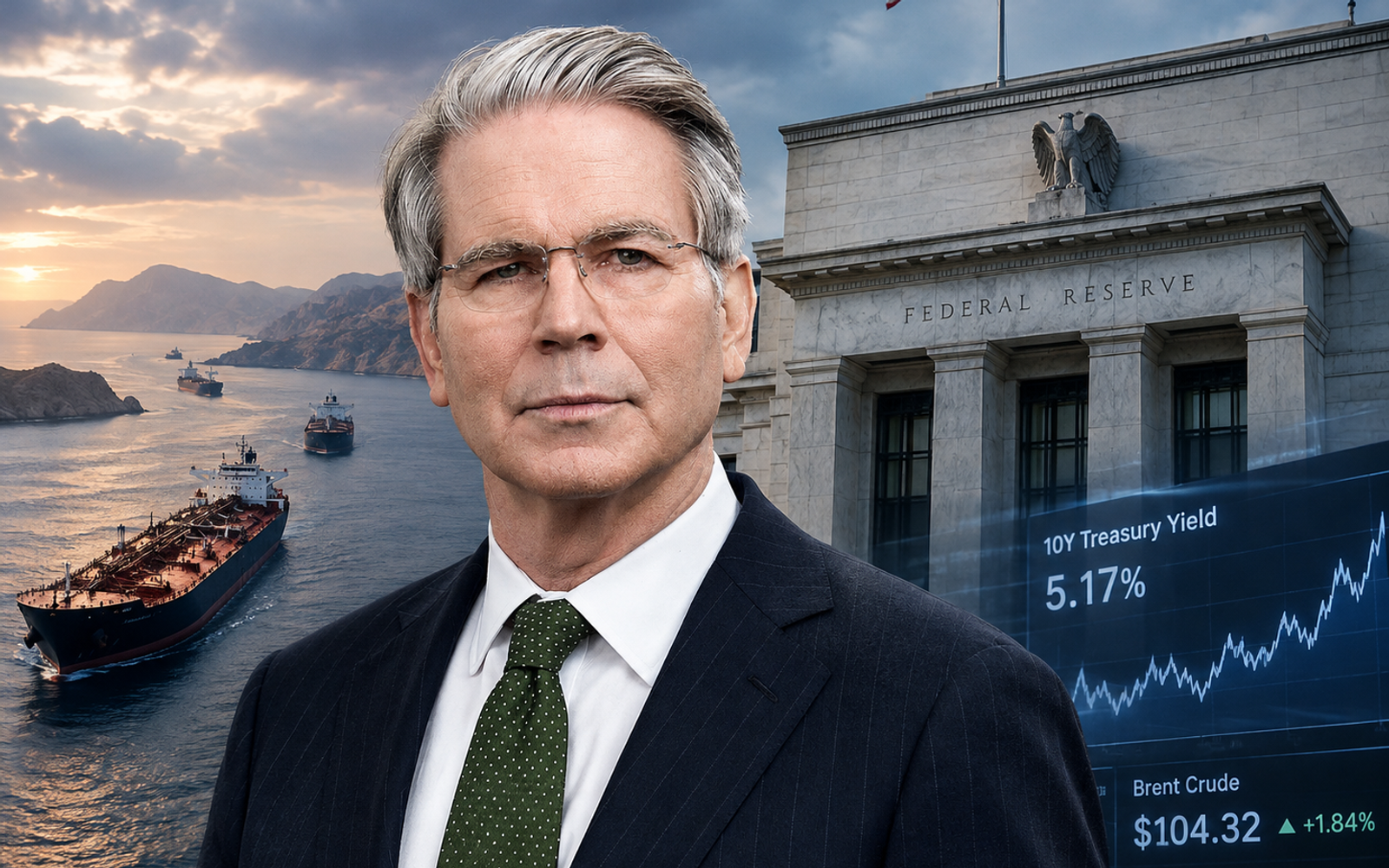
The Fed's New Hire Just Spooked the Bond Market. Broadcom Didn't Help.
When the central bank starts hiring people who want to dismantle it, you should be paying attention. Both monetary and fiscal implications.

The Bloomberg Terminal screens at my desk flickered red by 4:15 PM Thursday. Broadcom had just reported. Revenue hit $22.19 billion, a hair below the $22.27 billion analysts wanted. That $80 million miss, roughly 0.3%, was enough to drag the entire chip sector down with it. NVDA dropped 4%. AMD shed 3%. The Philadelphia Semiconductor Index took a 2.8% hit in a single session. Bloomberg called it "weighing down" the sector, which felt generous. It was more like an anchor dropped from a cruise ship.
Look, I've seen enough of these moments to know the pattern. A bellwether company reports. The number is fine. Really, it's fine. Adjusted EPS came in at $2.44 against a $2.40 estimate. Revenue climbed 48% year over year. That's not a miss, not really. That's a rounding error on a rounding error. But the market treated it like a felony.
The $80 Million Crack
The real story isn't the number. It's what the number represents. Broadcom's CEO Hock Tan told analysts the company now expects to ship more than 10 gigawatts worth of AI chips in 2027. That's up from previous estimates. AI chip revenue should exceed $100 billion by then. He said the company was "very comfortable" with its supply chain for 2026 and 2027. All of this sounds bullish.
But the market heard something else. It heard that the AI buildout might be peaking. It heard that the hyperscalers might not need infinite chips. It heard that the narrative that has carried the entire market for eighteen months might be getting tired.
That's the real crack. Not a revenue miss. A narrative miss.
And this brings me to the other story from this week, the one that should be keeping you up at night if you manage money or run a startup with any exposure to interest rates, credit, or capital markets. Which, if you're reading this, is probably you.
The Man Who Wants to Dismantle the Fed
Fed Chair Kevin Warsh was confirmed last month. It was a smooth process, all things considered. The markets barely blinked. A former Fed governor with Bush administration ties, Warsh was seen as a known quantity. Establishment. Safe.
Then he made his first hires.
Warsh tapped two outside associates as temporary advisers. One is Daniel Heil, a Hoover Institution fellow. Standard policy wonk stuff. The other is Paul Winfree. And Winfree is something different.
He authored a chapter in Project 2025, the conservative policy blueprint that attracted widespread attention for entertaining a concept called "free banking" as its highest-ranked reform option. Free banking means dismantling the Federal Reserve entirely. No central bank. No Fed funds rate. No open market operations. Privately issued currencies tied to commodities. Complete decentralization of monetary policy.
This isn't reform. It's abolition.
The Room Where It Happens
I need to be precise here because this matters. Winfree didn't just mention free banking as a theoretical possibility. It was the top-ranked option in his chapter. The document lays out a 180-page roadmap for the Fed's future, and the first item on the list is: get rid of it. Replace it with a system where private banks issue their own currency, backed by commodities, and the market decides which ones hold value.
Is this going to happen tomorrow? No. Congress would need to pass legislation. The political appetite for abolishing the Fed is not there, not yet. But that's not the point.
The point is that Warsh chose to put this person in a room where policy is discussed. He chose to give Winfree a desk and a badge and access to the levers. Smart people hire smart people who disagree with them. But they don't hire people who want to abolish their own institution unless they're at least willing to entertain the argument.
Divisions at the Fed that defined 2025 are expected to carry into 2026. The FOMC has been fractured for months. Dissenting votes. Public disagreements. Rare fractures emerging among members who couldn't reach consensus on the best path for monetary policy. Now add a chairman who's brought in someone who thinks the whole thing should be liquidated.
That's not stability. That's the opposite of stability.
Three Paragraphs on Free Banking
Free banking isn't new. It's been tried. Scotland had a version of it in the 18th and 19th centuries. Canada operated with a decentralized system for decades. The results were mixed. There were panics. There were runs. Banks failed. The research consensus over the past century has shifted toward central banking as the more stable model. Not perfect. More stable.
But here's what matters for your portfolio: markets hate uncertainty about the monetary regime more than they hate any single policy decision. A Fed that raises rates is predictable.
A Fed that cuts rates is predictable. A Fed that might not exist in its current form in five years is not predictable.
Bond markets have started pricing this in. The yield curve has been doing strange things for weeks. Long-term rates are moving on headlines that wouldn't have mattered six months ago. The "Warsh effect" that JPMorgan's CEO recently dismissed as something that can't "actually change anything in six months" is already showing up in the data.
The Other Side of the Coin
Now bring Broadcom back in. The chip sector is the most rate-sensitive growth trade in the market. AI infrastructure requires massive capital spending. Cloud providers borrow billions to build data centers. Those borrowings get repriced every time the yield curve shifts. A 50 basis point move in long-term rates adds hundreds of millions in carrying costs to a single hyperscale buildout.
If the Fed's credibility frays, if the market starts to doubt that monetary policy will remain predictable, the cost of capital for AI infrastructure goes up. The buildout slows. The chip orders get pushed out. The narrative breaks.
That's what Thursday's selloff was really about. Not an $80 million revenue miss. A recognition that the two pillars supporting the market, the Fed's steady hand and Big Tech's AI spend, are both wobbling.
The Numbers Don't Lie
Let me show you what I mean with some quick math. Broadcom's Q2 revenue was $22.19 billion. The AI portion was roughly $16 billion. That's growing at 48% year over year. Impressive. But the market had been pricing in 55% growth. The premium got squeezed.
Now overlay the Fed story. If Winfree's presence signals even a 10% probability that the Fed's independence erodes or its structure changes, the risk premium on all duration assets goes up. The terminal value of every growth stock gets discounted at a higher rate. The math is brutal. A 50 basis point increase in the discount rate on a stock trading at 30x earnings reduces fair value by roughly 15%.
That's not speculation. That's arithmetic.
The Trump Factor
There's another layer here that nobody is talking about enough. Trump is scheduled to meet with AI leaders to discuss US investment in their companies. The Anthropic co-founder just said "we need to stop AI developing without humans." The regulatory environment is shifting. The political winds are changing.
US stocks slumped this week as fears over Big Tech shook Wall Street. That's not a coincidence. It's a convergence. When your Fed starts hiring people who question whether the Fed should exist, when your leading chip companies start missing by fractions of a percent, when your AI narrative starts getting questioned from inside the industry itself, that's not one problem. That's three problems hitting at once.
What the Data Actually Shows
I want to be very specific about what we know and what we don't know. Here's what we know: Winfree and Heil are temporary contractors. They're not permanent FOMC members. They don't vote on rates. Their influence is indirect.
Here's what we also know: Warsh himself has written and spoken extensively about reducing the Fed's footprint in markets. He believes the Fed has held the market's hand too much. He wants a central bank that spends more time on the sidelines and sometimes makes decisions that catch investors off guard. That's not my read. That's what Fidelity wrote about his vision.
A Fed that surprises markets is a Fed that increases volatility. Increased volatility raises the cost of capital. Higher cost of capital means lower multiples. Lower multiples mean lower stock prices.
This isn't complicated.
The Long Game
Free banking won't happen this year. Probably not next year either. But the Overton window just shifted. Three years ago, the idea of privatizing US currency was fringe theory. Now it's in the Fed chairman's office, sitting at a temporary desk with a government email address.
Markets price the future. They don't wait for legislation to pass. They start moving the moment the probability shifts from 0% to 5%. And 5% is enough to move trillions.
The bond market knows this. The yield curve knows this. The question is whether equity markets have caught up yet. Thursday's chip sector selloff suggests they're starting to.
What You Do About It
I don't make specific investment recommendations. That's not my job. My job is to show you where the numbers point and let you decide.
But I will tell you what I'm watching.
the 10-year yield. If it breaks above 4.75% on no obvious catalyst, that's the Winfree premium showing up. That's a signal.
the dollar. Free banking discussions are negative for the dollar because they imply a less reliable monetary anchor. If the dollar weakens while yields rise, that's another signal.
Broadcom's next report. If Q3 guidance comes in below the $16.36 billion the Street expects, the AI narrative takes another hit. The company expects AI chip revenue of $16 billion in Q3, slightly below consensus. That's already baked in. But if Hock Tan sounds less confident about 2027, watch out.
The Hard Conversation
I've been writing about unit economics and capital markets for long enough to know when a regime is changing. The 2010s were about quantitative easing and zero rates. The early 2020s were about the reversal. The late 2020s might be about something else entirely.
A world where the Fed's structure is up for debate is a world where the cost of capital is structurally higher.
It's a world where growth stocks trade at lower multiples. It's a world where startups need to reach profitability faster because the cost of waiting just got more expensive.
That's the real story this week. Not Broadcom's minor miss. Not Winfree's temporary badge. The real story is that both events point in the same direction. The mechanisms that made capital cheap and predictable for a decade are weakening.
And when the ground shifts under the two pillars of the market, everything on top shifts too.
Comments (0)
No comments yet. Be the first to share your thoughts.