The Fox-Roku $22B Deal Broke Streaming. Here's Your Playbook.
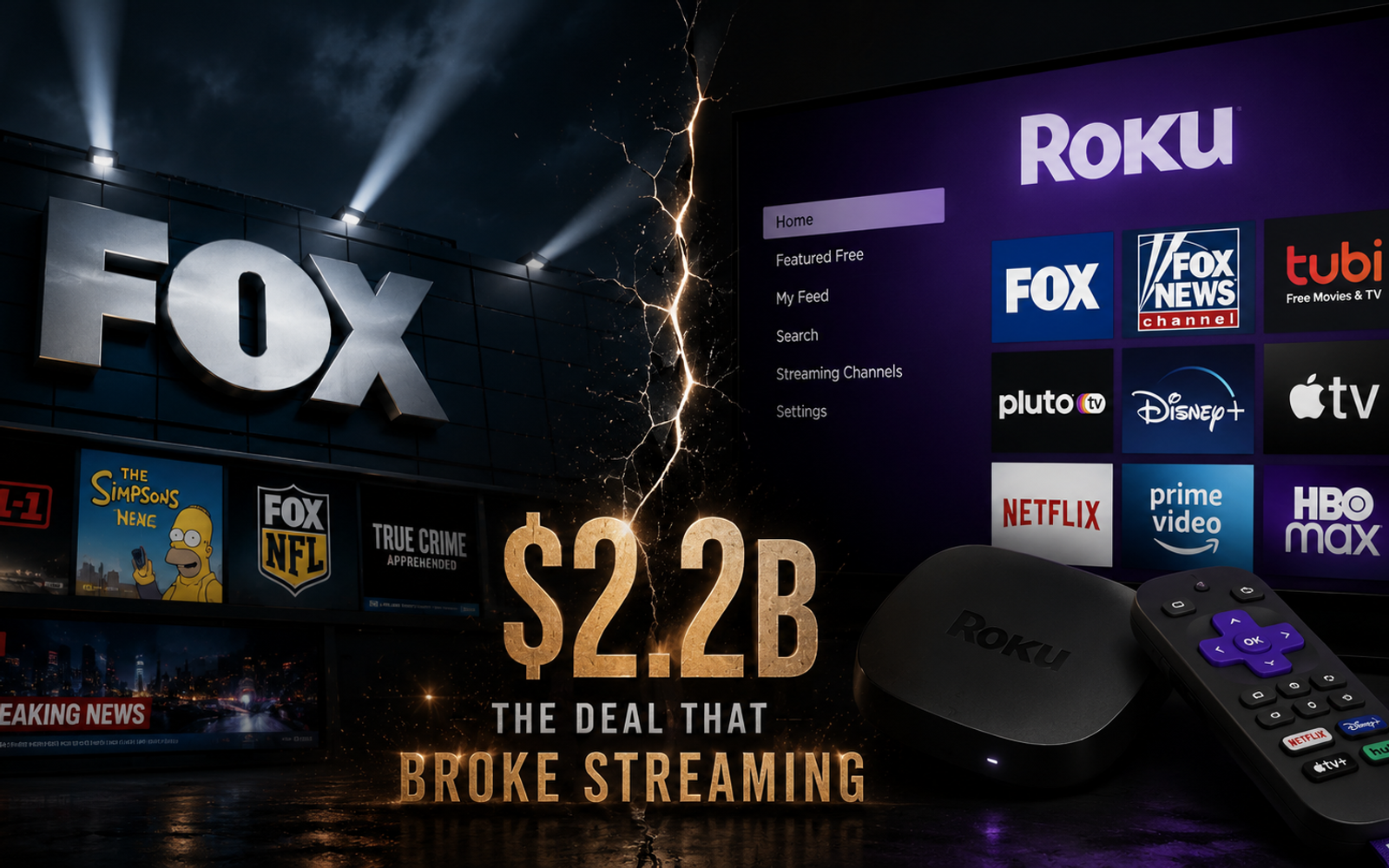
Fox just paid $22 billion for Roku. For creators and founders, the real story is about who controls distribution and what happens when neutrality ends.

Fox Corporation announced on June 15, 2026, that it will acquire Roku for $22 billion in enterprise value, paying $160 a share in a mix of cash and stock. The Hollywood Reporter broke the story before 4:30 a.m. Eastern, and by the time most of the industry logged on, it was already the only story anyone wanted to talk about.
The headline version is simple: media giant buys streaming platform. The version that matters if you make a living online is different. This deal is about who owns the door people walk through to find you, and what happens once that door stops being neutral.
What Fox Actually Bought
Fox already owns Tubi, the free ad-supported streamer that's quietly become one of the biggest success stories in the company's portfolio since it was acquired back in 2020. Add Roku's Channel and its direct relationship with more than 100 million streaming households worldwide, and Fox becomes, by its own accounting and Nielsen's viewing data, the third-largest player in U.S. television by share of viewing.
The mechanics matter here too. Fox is borrowing $12 billion to fund the deal, and its shares dropped about 10% in pre-market trading the morning the news broke, a sign that investors are nervous about the extra debt sitting on Fox's balance sheet even if they like the strategic logic. Roku's founder and CEO, Anthony Wood, described the deal as a way to "scale faster and innovate more aggressively," while Fox CEO Lachlan Murdoch called it the natural next step after a decade spent building the company around live sports and news. Fox has publicly committed to keeping Roku running as, in its words, an "open, partner-friendly platform." The deal is expected to close sometime before mid-2027, pending regulatory approval.
Roku's Business, Up Close
To understand why this deal happened now, it helps to look at what Roku actually is underneath the hardware. According to Reuters reporting cited by NBC News, advertising is Roku's real business: the company pulled in $613 million in ad revenue in the first quarter of 2026 alone, up 27% from a year earlier. The Roku Channel itself holds about 3% of all U.S. streaming viewership, per Nielsen, putting it fifth overall behind YouTube, Netflix, Disney, and Prime Video.
But the number that made Roku worth $22 billion isn't really about its own channel. It's the fact that Roku is the operating system millions of people use to open Netflix, YouTube, and everything else on their TV in the first place. That's a front door to nearly every other streaming service on the market, and Fox just bought the keys.
Why "Neutral" Platforms Don't Stay Neutral
Roku built its reputation by not playing favorites. It didn't matter if you were watching Disney+, a scrappy niche channel, or a startup with three employees, Roku treated the traffic the same way. That neutrality is exactly what made it valuable enough for a media company to pay $22 billion for it.
Once a company that owns live sports rights, a news operation, and one of the largest free ad-supported streaming services in the country also owns the operating system running on the TV itself, the incentives shift. Fox's own language about keeping Roku "partner-friendly" is worth sitting with for a second, because partner-friendly to whom is the whole question. A platform doesn't need to announce that it's playing favorites to start playing favorites. It just needs to quietly adjust what gets surfaced, what gets promoted, and whose ad inventory gets priced better.
This isn't a hypothetical. YouTube started as a genuinely open video host before it built its own ad ecosystem and began favoring content that served it. Apple's App Store opened as a neutral marketplace before it started taking a 30% cut and building competing apps of its own. Amazon did something similar with its marketplace, using seller data to launch its own competing private-label products once it understood which categories were profitable. Platforms that begin neutral rarely stay that way once their owner has a reason not to be, and Fox now has several reasons: Tubi needs inventory to compete with bigger free streamers, and its news and sports division benefits from every extra minute of attention it can pull onto a Fox-owned screen.
None of that means Roku will visibly punish outside creators or shut anyone out overnight. Vertical integration rarely announces itself. It shows up slowly, in small placement decisions, in which channels get a featured tile on the home screen, in whose ad inventory clears first. Roku's own statement that it will keep operating as a "standalone platform" is technically true and also not really the point. A subsidiary can remain operationally separate while its parent company quietly shapes the incentives underneath it.
If you publish anything online, this is worth an honest gut check: how much of your audience arrives through a door you don't control? A social platform, a streaming app, a search algorithm, an aggregator. Every one of those doors can change its rules, its owner, or its algorithm overnight, and you'll find out about it the same way everyone else does, after the fact, with no say in the decision.
The Warning Africa's Streaming Market Already Lived Through
If you want to see what happens when a streaming platform stops being a safe bet, you don't have to speculate. It already played out on a different continent this year.
In March 2026, Canal+ announced it was shutting down Showmax, the streaming service MultiChoice had spent a decade building into one of the most recognizable homegrown platforms in Africa. Canal+ had acquired MultiChoice for roughly $3 billion the previous September, and within months it confirmed that Showmax's mounting losses, which had widened sharply in its final year as an independent platform, made the service unsustainable. Subscriptions wound down through April, with content folded into MultiChoice's DStv Stream service instead.
For the creators, producers, and small studios who had built distribution relationships around Showmax, the platform they depended on simply stopped existing. Regional alternatives like Viusasa in Kenya, Kibanda Xpress in Uganda, and Avetol in Ethiopia have tried to fill the gap, but they're doing it with a fraction of the capital that global players bring to the table, competing for a market where Netflix alone is projected to capture close to half of all African video-on-demand subscribers by 2027.
The lesson isn't really about streaming specifically. It's that any platform you don't own is, structurally, someone else's decision to make. That was true for Showmax's partners in Johannesburg, and it's about to become true for a lot of channels and small media companies that built their reach on Roku.
Building Something the Deal Can't Touch
None of this means you need to build your own TV operating system, that's not a realistic goal for almost anyone reading this. But there's a version of distribution resilience that is realistic, and it comes down to three habits.
The first is owning your actual audience data, not just your follower count. An email list, a phone number, a direct line to the people who care about what you make. Roku became worth $22 billion partly because it had first-party data on 100 million households. If your entire relationship with your audience lives inside someone else's platform, you don't really have that relationship, you're renting it.
The second is spreading your distribution across channels that serve different jobs. Something you fully own, like email or a private community. Something you rent for reach, like YouTube or a streaming app. Something that helps new people discover you, like search or a podcast directory. If any single one of those gets sold, shut down, or deprioritized, the others keep the lights on.
The third is building something you can sell directly, rather than relying entirely on ad splits or platform payouts. A course, a tool, a service, a product with your name on it. When your income depends on how a platform decides to split ad revenue this quarter, you're exposed to every decision that platform's new owner makes. When people pay you directly, that exposure shrinks.
What This Means for the Next Few Years
The creator economy is on track to approach $480 billion globally by 2027, according to Goldman Sachs research, and almost all of that money moves through pipes owned by someone else: platforms, app stores, ad networks, and now, increasingly, media conglomerates buying their way into distribution instead of building it from scratch.
Fox didn't buy Roku for its hardware. It bought the relationship Roku has with 100 million households and the leverage that comes with controlling how they discover what to watch. That's the same asset every platform is quietly trying to build, and it's the same asset that makes any single platform a risky place to keep all your eggs.
The deal doesn't close until sometime before mid-2027, so there's no reason to panic and no reason to rebuild your entire strategy overnight. But it's a good prompt to actually map where your audience comes from and how much of that you'd survive losing. If the answer makes you uneasy, that's useful information. It's telling you exactly where to start building something a little more durable.
Comments (0)
No comments yet. Be the first to share your thoughts.