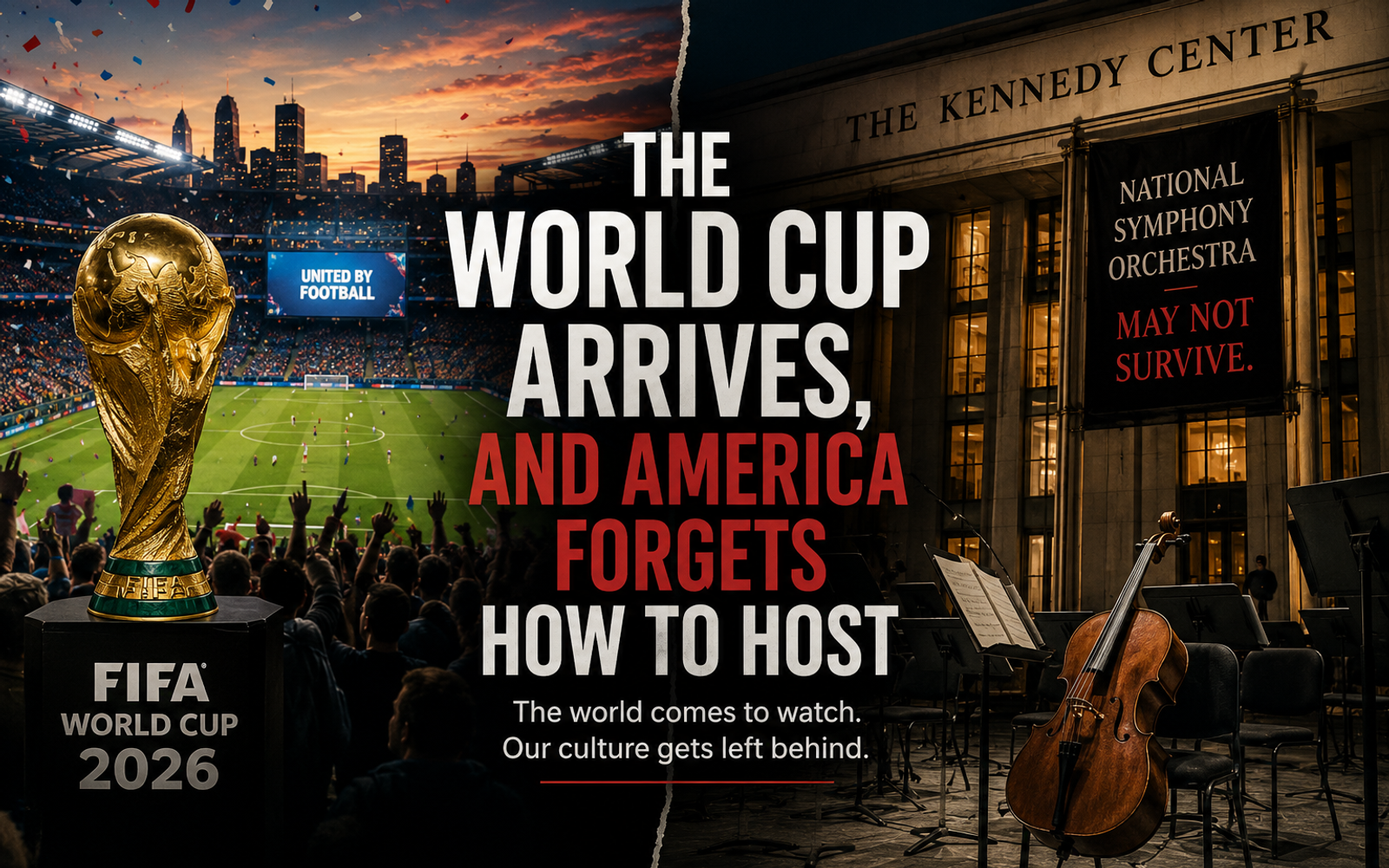
The World Cup Arrives, and America Forgets How to Host
The 2026 World Cup kicks off June 11 across 16 cities. But the real story is what we've already lost.

The opening match kicks off June 11 at Estadio Azteca, Mexico against South Africa, 3 PM local time. Sixteen cities across three countries. Forty-eight teams. One hundred four games. The 2026 FIFA World Cup is a logistical behemoth, a six-week festival of sport that will drop millions of travelers into cities from Vancouver to Mexico City to East Rutherford. And yet, scrolling through the news this week, I kept coming back to something else entirely. The National Symphony Orchestra "may not survive" the chaos at the Kennedy Center under the current administration. That's not hyperbole from a press release. That's the assessment of people inside the institution. So here we are. The largest sporting event in the world is about to land on American soil, and our cultural infrastructure is quietly collapsing in the background.
The Liquidity Drain Nobody's Watching
But let's start where the money is. The World Cup is a cash pump. FIFA expects to generate billions in revenue. Host cities have spent years building out stadiums, transit links, security perimeters. And this is the first time the tournament will be played across three nations, which means coordination on a scale that has never been attempted for a single sporting event. The Western Region groups Vancouver, Seattle, San Francisco, Los Angeles. The Central Region runs through Guadalajara, Mexico City, Monterrey, Houston, Dallas. The Eastern Region covers Kansas City, Atlanta, Chicago, Toronto, Boston, Philadelphia, Miami, and the final venue in New Jersey. That's a lot of moving parts. A lot of money changing hands. A lot of attention being paid to the wrong things.
Because while FIFA's corporate partners are setting up activation zones and the broadcast rights are being sold for record sums, the Kennedy Center is bleeding. The National Symphony Orchestra, one of the country's great cultural institutions, is staring down an existential threat. The current board, stacked with political appointees, has driven off donors, alienated artists, and created an atmosphere of such uncertainty that survival is now an open question. I wrote about this last month, but the situation has only worsened. And the World Cup, with its relentless news cycle and its demand for civic resources, will only accelerate the neglect. Police overtime. Traffic management. Security sweeps. All of that costs money. Cultural funding is already the first thing cut when cities prepare for mega-events.
So the question becomes: what are we building this thing for? The World Cup is a party. A very big party. And parties are fine. But a society that can only afford the party is a society that has stopped investing in what happens after the hangover clears.
The Real Cost of the Festival Year
The U.S. has declared 2026 a "year of festivals." The World Cup is the centerpiece, but there's also the FIFA Club World Cup, the 250th anniversary of the Declaration of Independence, and a slate of other events designed to draw tourists and project soft power. Vacasa's marketing materials lean hard into this framing: 2026 as the year America becomes one giant celebration. But celebration requires infrastructure. It requires institutions that can sustain it. And those institutions are being hollowed out in real time.
Look at what's happening at the Kennedy Center. It's not just the orchestra. It's the entire ecology of performance, education, and community engagement that the Center supports. When the board installs leadership based on loyalty rather than expertise, when programming is scrutinized for political alignment, when donors pull their money because they don't trust the stewardship, the whole thing begins to crumble. And it's not just Washington. Similar dynamics are playing out at arts organizations across the country. The World Cup will paper over these cracks for a few months. Thousands of journalists will file stories about the electric atmosphere in Atlanta, the tacos in Guadalajara, the drone shows over the Vancouver skyline. But the cracks will still be there when the last goal is scored on July 19.
And that's the part nobody wants to talk about. The festival year is a distraction. It's a way of pretending that everything is fine because the stadium is full. But the stadium was never the point. The point was the city around it. The point was the culture that made the city worth visiting in the first place.
What the World Cup Won't Fix
The 2026 World Cup will be a spectacle. It will generate memories for millions of people. It will produce moments of joy and heartbreak and all the things we love about sports. But it will not fix the underlying rot in our cultural institutions. It will not restore the Kennedy Center's endowment. It will not rebuild the trust that has been shattered between artists and the institutions that are supposed to support them. It will not make the case for public funding of the arts in a country that has never been comfortable with the idea.
What it will do is consume attention. And attention, as we've learned over the past decade, is the most finite resource we have. Every minute spent tracking the group stage standings is a minute not spent wondering why the National Symphony Orchestra might not survive the year. Every headline about the final is a headline that could have been about the slow-motion collapse of a cultural landmark. That's not an argument against enjoying the World Cup. It's an argument against pretending that enjoying the World Cup is the same thing as building a healthy society.
I'll be watching. I'll probably enjoy it. But I'll also be thinking about what we're not watching. What we're not building. What we're letting slide because the festival year demands that we look the other way. The final whistle on July 19 won't be the end of anything. It'll be the moment we have to reckon with what we ignored while the party was happening. And I'm not sure we're ready for that reckoning.
2026 FIFA World Cup - Wikipedia [National Symphony Orchestra May Not Survive Kennedy Center Chaos - Source from context RSS]
Comments (0)
No comments yet. Be the first to share your thoughts.