Sweden's 3-Seat Win Is a Test of Its Consensus Myth
Sweden's left bloc won by 50,000 votes. What happens next says more about the country than the result did.

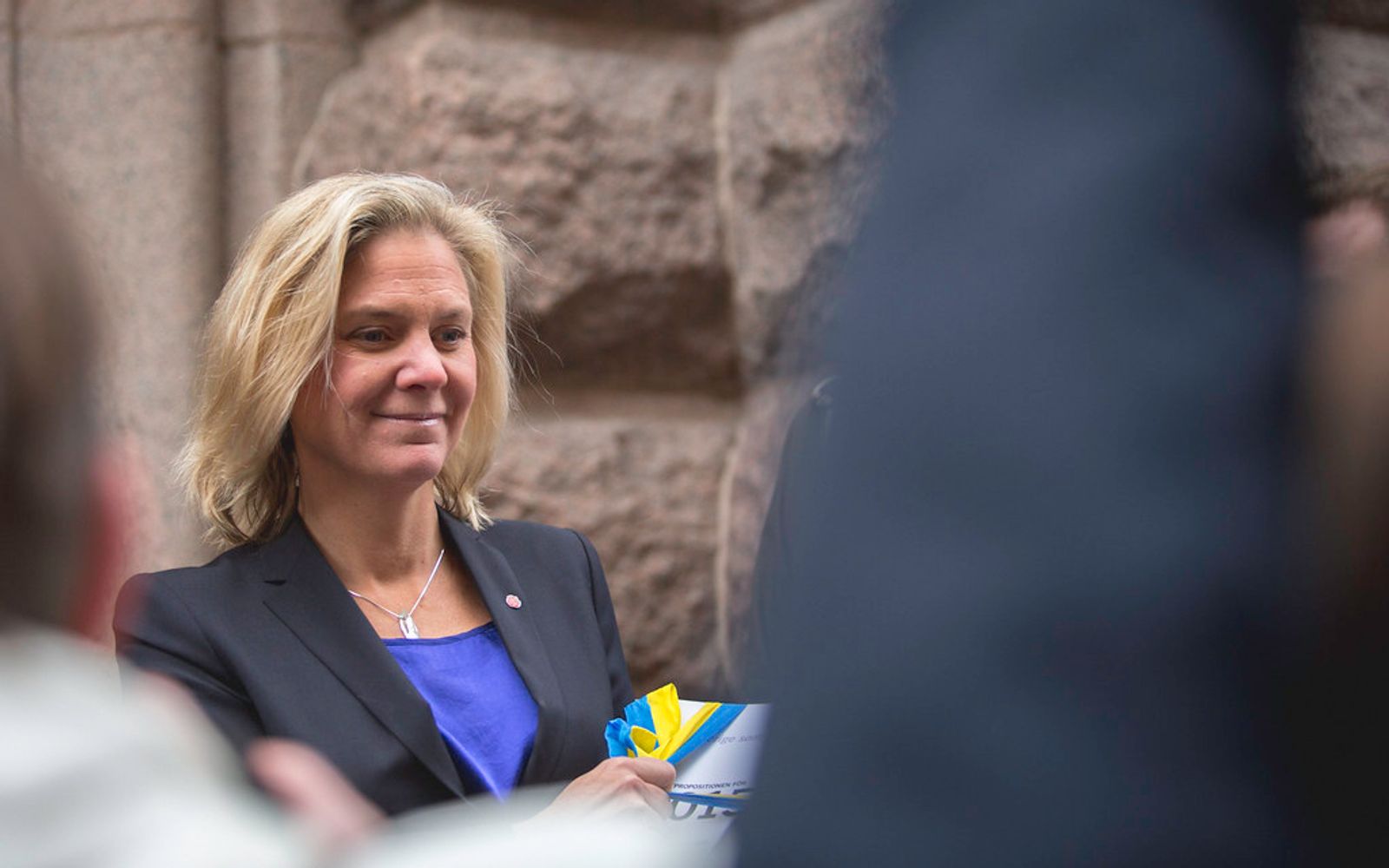
On election night in Stockholm, Magdalena Andersson walked on stage to accept flowers in front of a placard that read, in Swedish, "Social Democrat forever." The count wasn't finished, so she told the room to wait until every vote had been counted. Then she said the thing that turned out to be the real result: that a close election was reason "to seek a new spirit of cooperation in Swedish politics."
Five days later, on a Friday afternoon, the Speaker of the Riksdag, Andreas Norlén, handed her the least glamorous prize in European politics: a task rather than a job. Instead of declaring her Sweden's next prime minister, he asked her to explore "the possibilities of forming a government that can be tolerated by the Riksdag." "All party leaders have pointed out that it is reasonable for Andersson to receive this probing assignment," Norlén said. She accepted with what she called "great humility" and told Swedish media she wanted to lead in a spirit of broad cooperation: "Party politics should be set aside, and Sweden and the Swedish people should come first."
The mandate rests on arithmetic so tight it reads like a typo. Andersson's four-party bloc, made up of the Social Democrats, the Left Party, the Greens and the Centre Party, holds 176 of 349 seats, a majority of three. Around 50,000 votes separated the two blocs in a country of 10.6 million people.
A Majority Decided by Fifty Thousand Votes
The parties tell the story of a country moving in two directions at once. The Social Democrats took 99 seats, the Moderates 70, and the Sweden Democrats 62, still the third-largest force in the Riksdag after a night their opponents greeted with visible relief. Prime Minister Ulf Kristersson resigned on Thursday, and the right-wing bloc that governed with Sweden Democrats support gave way by the narrowest of margins.
Andersson knows the fragility better than most. She spent seven years as finance minister, then served as Sweden's first female prime minister from 2021 to 2022, and she carries a reputation for saying the plain thing out loud. The four parties she now has to hold together disagree about state spending, rent rules, rural policy and carbon. Any one of them can end the arrangement with a single refusal.
So the probing assignment carries real weight. It's a compatibility test run in public, before four parties have to share a cabinet room and defend the same budget. Sweden has used variations of this ritual for decades, and it's a strange, durable piece of political design. It says more about how the country thinks than the vote count does.
Why Swedish Politics Has a House Style
Sweden's political vocabulary has always come with an aesthetic attached, and the probing assignment is part of it. The word lagom, roughly "just the right amount," gets overworked by outsiders, but the instinct behind it is real and it shows up in how the country handles power. Campaign posters are muted. Leaders say things like "broad cooperation" without irony. Nobody wins by being loud.
That style is a strategy as much as a temperament. A politician who asks for humility in the moment of victory is lowering the temperature on purpose, and in a country where the far right spent a decade gaining ground on immigration and crime, temperature is the whole game. But the consensus habit does real work. It is political craft, and it's the reason a three-seat majority reads as a problem rather than a crisis.
Her own register matches the house style. Le Monde described Andersson as "a hard-nosed technocrat with a direct and no-nonsense style," which in Swedish terms counts as praise: competence without theatre. That's the tone the probing assignment was built for. A leader who treats the mandate as a task to be tested rather than a prize has already passed the first round.
A Museum Card Is Where the Consensus Gets Concrete
The clearest place to see that instinct isn't the Riksdag chamber. It's the 2026 cultural budget, which steered SEK 80 million toward scrapping entry fees at 17 state-funded museums. The country had cut free admission after the 2022 election, and the money came back through a culture ministry run by a Moderate, Parisa Liljestrand, which tells you how durable the idea turned out to be.
The same budget set aside SEK 7 million for Nordiska museet, Skansen, Tekniska museet and Arbetets museum, plus SEK 3 million to study whether Sweden should create a national museum card. That card is a strange object. It turns the right to stand in front of your own country's paintings into a subscription product, and the heritage business has been drifting that way for years, with estates and archives learning to sell access to the past in tiered packages.
Sweden is trying to make that market with public money instead, which is a different argument about who the culture belongs to. And it's the same argument Andersson is making about the government she wants to lead. A free museum door and a probing assignment both say that belonging is something the state arranges rather than something a citizen has to earn. Skansen, the open-air museum on Djurgården, was built on that premise in the nineteenth century.
What a Bad Night for the Far Right Doesn't Settle
The Sweden Democrats lost ground this month, but 62 seats isn't a small number, and the party's arguments about immigration and crime have already been absorbed into the mainstream. A narrow defeat doesn't undo a decade of that. Al Jazeera reported that many voters greeted the result with relief, which is a fair measure of how much anxiety the past four years carried.
What the left bloc won is time, and not much of it. Andersson reports back to the incoming Speaker, and then the Riksdag votes. If she fails, Kristersson gets his own attempt at assembling a majority and the choreography starts over. Three seats leaves room for a single party to determine the shape of the next government on a single demand.
For observers outside Sweden, the notable part is that the process happens at all. Coalition talks in several European capitals look like blunt force, with winners taking what they can. Sweden's version asks a winner to prove she can hold a room first, and it treats the losing side's comfort as part of the job description.
Andersson's mandate is the thinnest in modern Swedish memory, resting on 50,000 votes and a four-party bloc that argues with itself about rents, roads and carbon. The ritual she's inside was built for a country that would rather talk for three more weeks than win by force. What keeps it running is the same thing that puts free tickets back in the hands of museum visitors at Skansen and Nordiska museet: a working agreement that the country's institutions belong to the people, including the ones who didn't win.
Comments (0)
No comments yet. Be the first to share your thoughts.