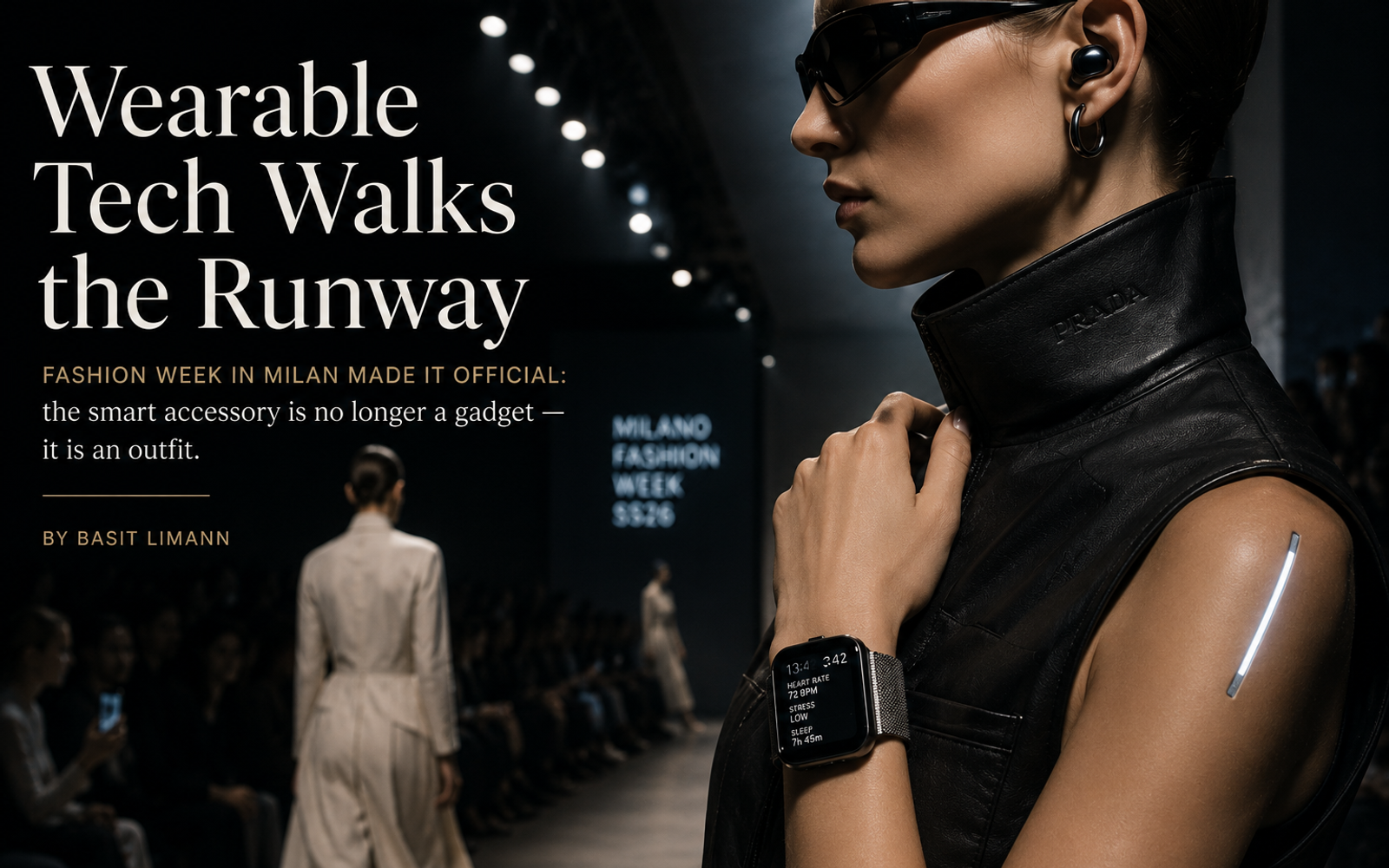
Wearable Tech Walks the Runway
Fashion week in Milan made it official: the smart accessory is no longer a gadget it is an outfit.

The Milan's spring shows were, on the surface, about silhouettes. But the more interesting story was happening at the wrist, on the ear, and along the seam.
Houses that previously kept a polite distance from technology are now integrating it as cleanly as they once integrated hardware closures or interior lining. The question is no longer whether tech belongs in fashion. The question is which house tells the story most convincingly, and more importantly, which tech company has figured out that the story is fashion's to tell first.
That distinction matters more than it sounds.
The history of wearable tech in fashion is mostly a story of failure by overreach. Technology companies would build a capable device, wrap it in a strap or a frame, and hand it to a fashion partner to dress up. The result was almost always the same: a piece of technology that happened to be shaped like an accessory, rather than an accessory that happened to carry technology. Consumers could feel the difference immediately. Sales reflected it. The runway appearances felt like product placements rather than genuine design decisions, and the fashion community treated them that way.
What is shifting in 2026 is the order of operations.
At Milan Fashion Week this past February, the conversation around technical fabric was impossible to ignore. Moncler Grenoble and Herno both stepped outside the traditional runway format to present collections built around mountain technical materials, fabrics engineered for performance that nonetheless looked and moved like luxury outerwear. Moncler Grenoble's ski jackets blended high-altitude function with a precision of cut that would not have looked out of place in a Paris atelier. Herno's essentials carried the clean lines of minimalist fashion while the materials themselves were doing significant structural work underneath. Neither house framed these pieces as technology products. They framed them as clothes, which is exactly what made the technology credible.
The MSGM show offered a different read on the same theme, blending nylon and velvet across pieces that moved between sportswear and evening wear in a single look. The brand's instinct for vibrant color and physical texture drew more attention than any embedded feature could have, and yet the choice to build around technical materials was deliberate and structural, not decorative.
Paris approached the season from a sharper conceptual angle. While Milan doubled down on Italian luxury and the tactility of premium fabric, Paris houses were doing something quieter and arguably more significant: designing around the premise that smart textiles belong inside a collection the same way silk or cashmere does. The approach treats fabric innovation not as a headline but as a given, which is a much harder cultural shift to achieve than a headline collaboration.
The two cities' approaches are converging toward the same conclusion from different directions. Milan is making technical fabric beautiful. Paris is making smart fabric normal. Both are necessary, and neither is quite sufficient on its own.
Outside the runway shows, the wearable product conversation in 2026 has been dominated by one category above all others: smart glasses. And that conversation is being shaped less by specification sheets than by who is making the frames.
Meta sold more than seven million pairs of its Ray-Ban smart glasses in 2025, tripling its year-over-year sales and establishing a market almost single-handedly. The product's success had almost nothing to do with the technology inside it and almost everything to do with the fact that it looked like a pair of Ray-Bans. EssilorLuxottica, the company that makes Ray-Ban alongside Oakley and Persol and operates most of the major optical retail chains, designed the frames through the same teams and processes that design its regular eyewear. The result was a product that fit prescription lenses through standard retail infrastructure and ended up in LensCrafters and Sunglass Hut. It reached consumers who had never thought of themselves as early adopters of wearable technology because they were buying glasses, not a gadget.
Google read that lesson clearly. At its Google I/O conference in May, the company unveiled its first consumer AI smart glasses built in partnership with Samsung, Warby Parker, and the South Korean luxury eyewear brand Gentle Monster, with a confirmed fall 2026 launch. Google had invested $100 million for a four percent stake in Gentle Monster in June 2025, a signal the collaboration was a serious long-term bet rather than a marketing arrangement. Warby Parker handles accessible, direct-to-consumer eyewear with prescription infrastructure. Gentle Monster handles the fashion-forward end, known for oversized, unconventional designs that carry a particular kind of credibility in the markets Google most needs to reach. And Gucci, through Kering Eyewear, has already confirmed it is joining the Android XR ecosystem for a luxury AI glasses launch planned for 2027.
That three-tier brand strategy, affordable and accessible through Warby Parker, fashion-forward through Gentle Monster, and luxury through Gucci, is a direct acknowledgment that the technology inside smart glasses has become table stakes. The competition now is about which company can make the thing people actually want to wear, in the same way they want to wear a watch or choose a pair of frames. Google's Gemini-powered glasses are audio-only at launch, with cameras and microphones but no in-lens display. The choice to launch without a display is as much a design decision as an engineering one. Adding a screen adds weight to the temples, and weight is a gram people will not wear all day.
That same logic drove Meta's own Ray-Ban Display, launched at $799 in September 2025, to pair its in-lens color waveguide with a separate neural wristband that reads EMG signals from the forearm and converts them into gestures. Offloading input to the wrist keeps the glasses themselves lighter. The decision to separate the interface from the hardware is the kind of design thinking that used to belong exclusively to fashion, where the relationship between a garment and the body it sits on is considered at every stage. Tech companies are slowly learning to think the same way.
The market numbers reflect how quickly this category is accelerating. Global AI smart glasses revenue is projected to quadruple in 2026, with sales volume rising from roughly six million units last year to an estimated twenty million this year, and market value expanding from $1.2 billion to $5.6 billion. Those figures were almost unimaginable three years ago, when the category was still largely associated with the failure of Google Glass in 2013 and the sense that consumers had permanently rejected the idea of wearing a camera on their face.
What changed was not consumer psychology. What changed was design. Google Glass failed largely because it looked exactly like what it was: a piece of technology sitting on a person's face, making everyone around them aware of both the device and the data it might be collecting. The lesson the industry took a decade to learn is that the social signal of a wearable matters as much as its capability. People buy fashion for the same reason they buy technology: to change what they can do or how they feel. The products that work at the intersection of those two impulses are the ones that figure out how to serve both at once, without either one feeling like a compromise.
There is a countertrend worth taking seriously. In fashion, what Vogue has described as a return to the analog world is genuinely visible and growing. Searches for digital detox concepts have surged this year according to Pinterest's trend data. Coperni put a Tamagotchi bag charm on the runway. Diesel released wired earbuds designed to look like a bag accessory rather than a tech product. These moments are not accidents. They reflect a real appetite in certain consumer segments for objects that carry a sense of physical permanence and intentional slowness. In a culture where every surface is becoming a screen, fabric that simply feels extraordinary to touch is its own kind of resistance.
The fashion industry has always been comfortable holding contradictions. A season can simultaneously champion restraint and maximalism, vintage construction and synthetic innovation. Wearable tech and analog nostalgia can occupy the same Fashion Month without canceling each other out. What they share is the premise that objects carry meaning beyond their function, and that how something sits on a body matters as much as what it is technically capable of.
The houses that are getting this right in 2026 are the ones that have stopped treating the integration of technology as a feature to announce and started treating it as a design constraint to solve quietly. A posture-correcting fabric that vibrates against the spine does not need to declare itself on the label. A pair of glasses that connects to Gemini AI and reads a parking sign aloud does not need to look like a computer. The closer the technology comes to invisible, the more powerfully it works, and the more it becomes what the fashion world has always said everything should be: something you do not think about because it simply fits.
That is the standard fashion has always set for its best work. The fact that wearable technology is finally being held to the same standard is less a story about technology catching up to fashion, and more a story about fashion deciding it is ready to absorb something new.
Which house tells that story most convincingly over the next few seasons is still an open question. But the runway has made clear that someone is going to.being that been
Comments (0)
No comments yet. Be the first to share your thoughts.