Brand Boycotts: The Spreadsheet Nobody Runs
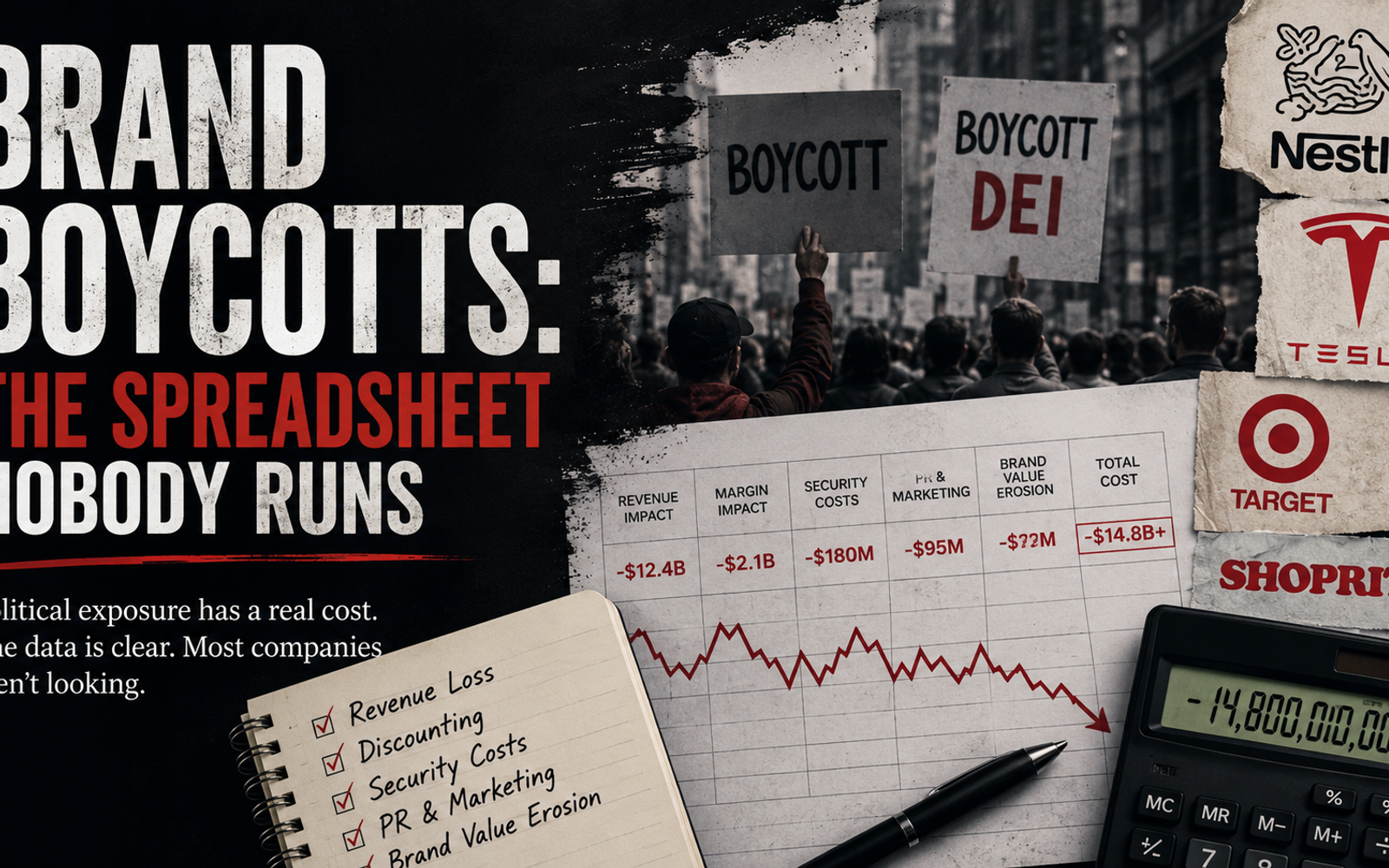
Nestlé, Tesla, Target, Shoprite. Political exposure has a real cost. The data is clear. Most companies aren't looking.

The Nestlé boycott launched on a Monday. People's Union USA organized it. The target: the company's DEI rollback, announced after the Trump administration rescinded diversity requirements. By Wednesday, the internet had mostly found something else to be angry about.
The supply chain team was still working the problem.
That's the disconnect. A boycott burns hot in the news cycle for 72 hours. Then it goes cold in the public mind. But the operational consequences do not go cold. Security costs stay elevated. Inventory gets stuck in the wrong warehouses. Procurement contracts get renegotiated under pressure. The P&L keeps bleeding even after the hashtags stop trending. Nestlé Boycott Over DEI: Which Products Could Be Affected?
The Spreadsheet Nobody Runs
Most companies do not have a line item for boycott risk. It's not on the balance sheet. It's not in the unit economics model. It's a blind spot roughly the size of a quarterly earnings miss.
The data says that's a problem. A 2025 survey by the Kearney Consumer Institute found that consumers are increasingly willing to walk away from brands over political positions. The exact numbers are still emerging, but the direction is unmistakable. Politically-charged boycotts against major businesses have increased sharply in recent years, as reported by El Estoque. The AFL-CIO now maintains a monthly official boycott list that companies can join just by making the wrong decision. Politically-charged boycotts against major businesses increase in recent years
A boycott is a contingent liability. It converts political exposure into operational cost. The question is whether the math holds up over time.
Take Target. The retailer lost an estimated $12.4 billion in revenue after its DEI rollback triggered a consumer backlash. That's not a rounding error. That's a quarter's worth of operating cash, vaporized. Take Nestlé. The company reported CHF 75 million in sales returns from product recalls in its 2025 full-year results, though the boycott's full impact on revenue will be recognized in 2026. These are not abstract risks. They hit the P&L in hard numbers.
Tesla's Margin Squeeze
Tesla's situation might be the cleanest case study in the unit economics of political exposure. The company delivered 336,681 vehicles in Q1 2025. That was down 13% from the same period a year earlier. Sales fell another 17% in January 2026. The company leaned on deep discounts, zero financing, and other incentives to move inventory.
The math is brutal.
Every dollar of discount is a dollar of margin. Every zero-financing offer is a deferred revenue hit. Tesla was buying demand with pricing power it could not afford to spend. A 13% drop in deliveries with heavy discounting means unit economics compress from both sides. Revenue per unit falls. Fixed costs per unit rise because the factories still run. The breakeven point shifts upward. Cash gets tight.
Brand Finance measured Tesla's brand value decline at 36% in 2025, the third consecutive year of decline. That number does not show up on the income statement. It shows up when the company raises capital, negotiates supplier terms, or recruits talent.
In Europe, Volkswagen sold 274,278 EVs in 2025 while Tesla sold 236,357. Tesla lost the market it once owned. The question is how much of that is politics and how much is product. Either way, the P&L pays the bill.
This is where the linkage between brand politics and operational reality becomes concrete. A founder or CEO who puts the company in the political crosshairs creates a cost of capital that nobody prices into the model. It's a tax on the entire business. The broader lesson has nothing to do with electric vehicles. It applies anywhere leadership is fused to political identity. The $2 Trillion Bet on Elon Musk's Brain
Shoprite and the Two Markets
The African counterpoint is instructive. Shoprite is a South African retailer operating across more than twenty African markets. In May 2026, protests in Nigeria targeted South African-owned businesses over xenophobia tensions. Shoprite closed several stores after demonstrators burned tires and threw rocks at a supermarket in Abuja. Traffic came to a standstill.
Shoprite did something interesting. It did not pull out. It did not issue a grand statement about values. It secured the stores, absorbed the disruption, and kept operating.
The financial results tell a different story from the headlines. In the first half of its 2026 financial year, Shoprite reported group sales of $8.3 billion, up 7.2%. Headline earnings from continuing operations rose 7.7%. Customer traffic was higher. The company beat its store-opening target early and widened its lead in South Africa's retail market.
This is the duality of brand boycotts in emerging markets. The protest is real. The damage is real.
Security costs are real. But the business is growing fast enough to absorb the hit. The operational question is not whether the boycott hurts. It's whether the growth trajectory overwhelms the damage.
For Shoprite, the answer was yes. The company operates across more than twenty markets. No single protest can crater the whole business. That is structural diversification acting as a hedge against political risk in any single market. It's the same logic that makes a portfolio less volatile than a single stock.
The Five Costs of Outrage
Breaking down what a boycott actually costs requires tracking five distinct line items.
revenue loss from customers who walk away. This is the visible number. Target's $12.4 billion. Tesla's 13% delivery drop. Nestlé's product-specific declines. The number that makes the news.
discounting and incentives to hold onto remaining customers. Tesla spent heavily on zero-financing offers and price cuts. That's margin destruction, not just volume loss. The company bought revenue with its pricing power.
security and operational costs. Store closures. Private security. Supply chain rerouting. Shoprite paid for all of these in Nigeria. So did the companies on the ICE boycott list, which in 2026 includes firms like Blue Owl Capital for selling property to the Department of Homeland Security. Don't Buy | Union Label and Service Trades Department, AFL-CIO
marketing and PR costs to stabilize the brand. Crisis communications. Rebranding efforts. Advertising campaigns designed to win back trust. These are hard costs with soft returns.
long-term brand value erosion. This is the line item that never makes the quarterly report. It shows up in higher cost of capital, harder supplier negotiations, and weaker talent acquisition. It compounds over years.
The sum of these five costs is almost always higher than the headline revenue figure suggests. The unit economics of outrage are worse than they look. A 13% revenue decline forces inventory adjustments. Slower inventory turns increase working capital needs. Higher working capital means less cash for R&D or expansion. Less R&D means a weaker product pipeline. Weaker pipeline means more vulnerability to the next boycott. It's a compounding loop.
The Political Exposure Audit
Most companies treat boycotts as PR problems. They call the crisis comms team. They draft a statement. They wait for the news cycle to move on.
That's the wrong approach.
A boycott is an operational risk with real cash consequences. The only way to manage it is to build operations that can absorb demand volatility without breaking the unit economics. The companies that survive boycotts are not the ones with the best messaging. They're the ones with the most diversified revenue base, the leanest cost structure, and the deepest cash reserves.
Shoprite's model works because of market diversification. Tesla's model breaks because the brand is fused to one person's political identity. There is no hedge. There is no diversification. The company cannot decouple its product from its founder's political positions.
Any business with a concentrated political exposure should run the stress test. Map your political exposure by market. Calculate the gross margin impact of a 10% revenue loss in each market. Model the working capital implications. Stress-test your supply chain for a 30-day disruption. If the numbers break, you need structural diversification, not a crisis comms plan. Your Mission Statement vs Your Burn Rate
The Nestlé boycott of March 2025 faded from headlines in a week. But the supply chain team is still running the numbers. They're still working the problem. That's the job nobody sees, and it's the only one that matters.
Comments (0)
No comments yet. Be the first to share your thoughts.