David Solomon Just Said the Quiet Part Out Loud
Goldman's CEO admitted markets are in greed mode. Here's what that means for AI startups chasing billions before the tone shifts.

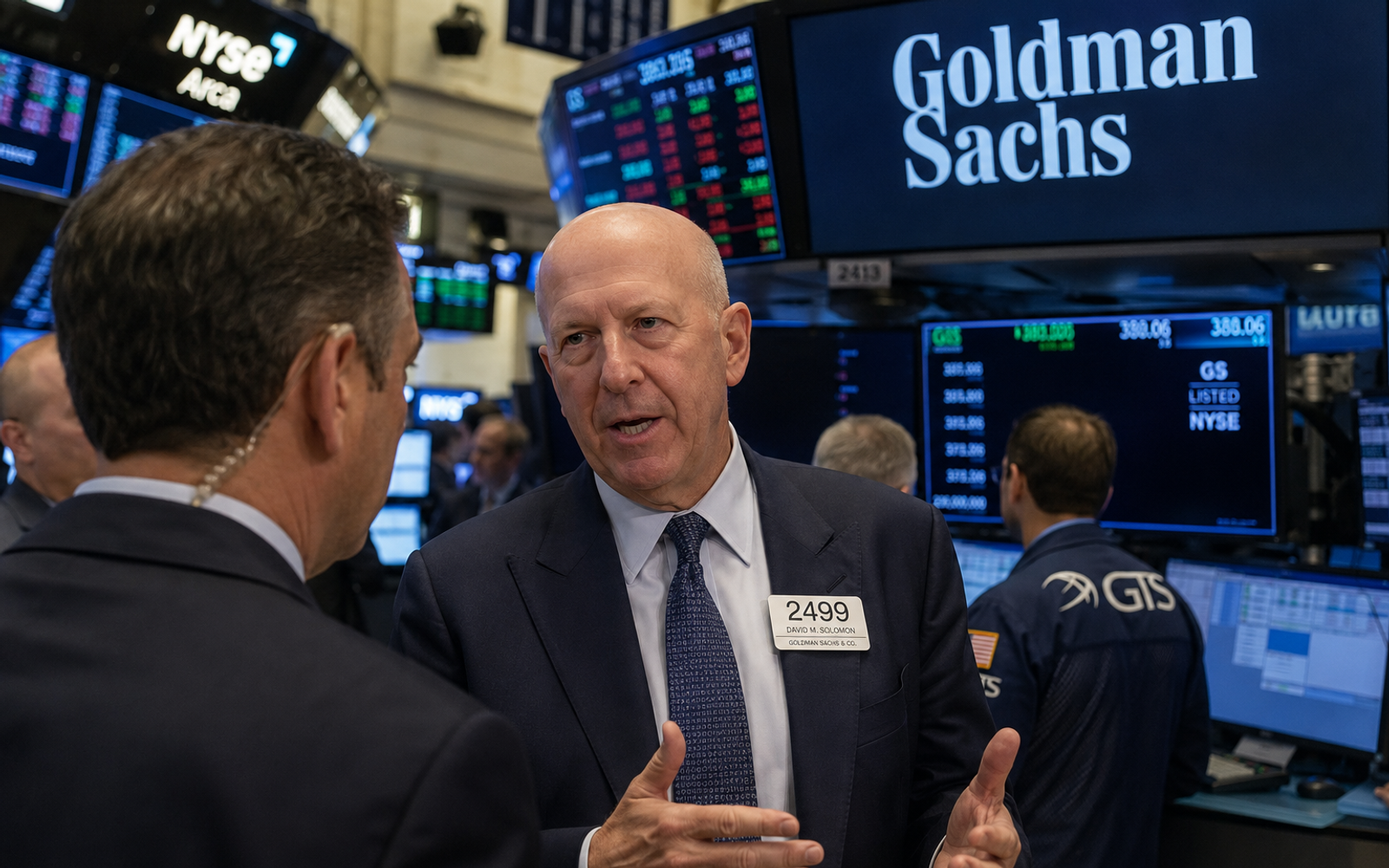
The guy who runs the most powerful investment bank on Wall Street looked into the camera and told the truth. David Solomon, CEO of Goldman Sachs, sat down with CNBC on Tuesday and said what everyone in the private markets has been whispering for months. Markets are in greed mode. Not fear. Greed. "We are definitely in a moment where there's more greed than there is fear," Solomon said. The man has a vantage point most people don't. Goldman Sachs is the lead underwriter on the biggest AI IPOs in the pipeline. His firm banked $17 billion in profit last year. He sees the decks. He knows where the bodies are buried. And he just told us the market is drunk.
This matters because it's not a neutral statement. It's a warning dressed as an observation. Solomon wasn't cheering. He was describing a condition. The question he answered came from CNBC's Leslie Picker, who asked whether markets had shifted from greed to fear or the other way around. Solomon's answer was decisive. Greed has the floor. And when the CEO of Goldman Sachs says that out loud, in public, right before the biggest wave of AI IPOs in history hits the tape, you pay attention.
There is a rhythm to these cycles. I have watched it happen three times now. The dot-com boom. The SPAC frenzy. The crypto pump. It always starts the same way. A new technology emerges. The incumbents panic. Capital floods in. Valuations detach from reality. The smart money takes notes. The dumb money takes positions. And then someone like Solomon glances at the camera and tells you exactly where we are. You just have to be listening.
What Solomon Actually Saw When He Said Greed
Solomon didn't just make a psychological observation. He tied it to something concrete. The scale of capital that AI companies are trying to raise is unprecedented. We are talking about numbers that make previous fundraising waves look like bake sales. SpaceX filed to go public with audited 2025 revenue of $18.67 billion. Anthropic is in the pipeline. OpenAI is preparing for an IPO that could land in the fourth quarter with a reported valuation of $852 billion. These are not startups. These are nation-states disguised as companies.
The fundraising wave Solomon referenced is real. It is happening right now. And it is being driven by a single conviction: that AI will remake every industry on earth within a decade. That conviction may be correct. But correct convictions and good investments are not the same thing. Between them sits the gap between price and value. And that gap is getting wider by the week.
Solomon also noted something else. Record levels of wealth and liquidity are supporting this activity. There is a lot of money sitting on the sidelines. Pensions. Endowments. Sovereign wealth funds. Family offices. All of them are looking at AI and asking the same question. How do I get in? The answer, for most of them, is through these IPOs. The problem is that when everyone wants to get in at the same time, prices stop reflecting reality. They reflect desire.
Greed turns into fear fast. Solomon knows this. He has been through enough cycles to understand that the same liquidity that creates the boom can create the bust. When capital is available, companies raise it. That is what they should do. But when the capital stops flowing, companies that raised at high valuations find themselves trapped. They cannot go back to the private markets for more money without taking a down round. They cannot go public without facing questions about growth that they cannot answer. And they cannot cut costs fast enough to preserve runway because their burn rates are built on assumptions that no longer hold.
This is the part of the cycle that startup founders do not want to think about. They are too busy raising. Too busy hiring. Too busy building. But the numbers do not lie. And the numbers coming out of the AI sector right now are beginning to show strain.
The Data That Should Worry Every Founder
OpenAI missed its revenue targets. This is not a rumor. This is a fact. Internal reports from the first quarter of 2026 show the company generated $5.7 billion in revenue. If you annualize that, you get $22.8 billion for the full year. The company had initially targeted roughly $30 billion. That is a miss of more than $7 billion. For context, that is more than most AI startups will ever generate in their entire existence. And OpenAI is the market leader.
The Wall Street Journal reported that OpenAI also missed user targets. The company is still in the process of defending its market share against Google, Anthropic, and a growing wave of open-source alternatives. The competitive dynamics are shifting faster than most people realize. A year ago, it would have been unthinkable that OpenAI would miss its numbers. Now it is a documented fact in the S-1 preparation materials that Goldman Sachs is helping to assemble.
This is where Solomon's comment becomes actionable. If the market leader is missing its targets, what does that mean for everyone else? The IPO pipeline is full of companies that have never operated in a public market environment. They have never faced quarterly earnings calls. They have never had to explain a miss to analysts who are paid to be skeptical. They have never seen their stock drop 20 percent in a single day because growth decelerated. The public markets are not kind to companies that miss. And the AI sector is going to learn this lesson the hard way.
Goldman Sachs is betting on this wave. The firm is positioned for potentially another record year. Analysts forecast 2026 will rank behind 2021 as Goldman's second-highest year ever for profits, according to data compiled by Bloomberg. But Solomon's job is not to cheerlead. His job is to manage risk. And when he says the market is in greed mode, he is telling his own traders and his own clients to be careful. He is also telling the rest of us that the window for easy money is closing.
The Structural Problem Nobody Wants to Discuss
There is a deeper issue here that goes beyond valuations. The AI industry has a structural dependency on continuous capital infusion. The compute costs alone are staggering. OpenAI's inference costs reached $8.4 billion in 2025 and are projected to rise to $14.1 billion in 2026. The company renegotiated its Microsoft deal to cap revenue-share payments at $38 billion through 2030. That is down from a prior trajectory of approximately $135 billion. The caps are helpful. But they are also an admission that the economics were not sustainable.
Every AI startup faces the same math. You spend billions on GPUs. You spend billions on talent. You spend billions on data center capacity. And you hope that the revenue shows up before the money runs out. That is a high-risk strategy in any market. It is an especially high-risk strategy in a market that Solomon just described as driven by greed rather than fear.
The greed phase is when bad decisions get funded. It is when companies with no clear path to profitability raise massive rounds because investors are afraid of missing out. It is when unit economics get ignored because growth is the only metric that matters. I have seen this movie before. The ending is never pretty.
The Anthropic Warning
Dario Amodei, the CEO of Anthropic, published a 38-page essay this week warning that superhuman AI could arrive as soon as 2027. He described it as potentially the single most serious national security threat the country has faced in a century. He also told reporters that we need to stop AI developing without humans. The irony is not lost on me. The same week the CEO of a leading AI company warns about existential risk, the CEO of the world's most powerful investment bank says the market is in greed mode for that same company's IPO.
The two statements contradict each other. Or do they? Maybe they are two sides of the same coin. The people building the technology are scared of what it can do. The people funding the technology are excited about how much money it will make. Both cannot be right. But both are probably telling the truth as they see it. And that tension is going to play out in the public markets over the next twelve months.
Donald Trump is scheduled to meet with AI leaders to discuss US investment in their companies. The political dynamics are shifting. The government wants AI to stay in American hands. That creates a tailwind for domestic companies. But it also creates regulatory risk. The same government that wants to fund AI today may want to regulate it tomorrow. And regulation tends to compress valuations.
What Happened in the Markets This Week
The market action this week tells you everything you need to know about the tension underneath the surface. On Wednesday, June 3, US indexes fell across the board, ending a run of five straight closing records. The Dow dropped 1.20 percent. The Nasdaq fell 0.9 percent. The S&P 500 snapped a nine-session winning streak. By Friday, June 5, the S&P 500 had fallen 3 percent from the previous session. Tech stocks led the decline. Cisco. Nvidia. IBM. The same companies that had been driving the rally were now driving the selloff.
This is not a crash. It is a correction. But corrections in frothy markets tend to accelerate. When sentiment shifts from greed to fear, it does not shift gradually. It shifts violently. The liquidity that was there one day is gone the next. The buyers who were chasing AI stocks at any price become sellers who cannot find bids. And the companies that priced their IPOs at the top of the greed cycle find themselves trading below their issue price before the lockup period even expires.
I am not predicting a crash. I am describing a pattern. The pattern is visible in the data. The pattern is visible in the commentary. And the pattern is visible in the behavior of the people who know the most.
Solomon did not say the market was going to crash. He said it was in greed mode. That is a diagnosis, not a prognosis. But diagnoses matter because they inform treatment. If you know the market is in greed mode, you adjust your strategy. You do not chase the top. You build resilience. You extend your runway. You focus on unit economics. You stop believing your own narrative and start looking at the numbers.
The Tactical Takeaway for Startup Founders
Here is what I would do if I were running a startup right now. Raise capital while you can. The window is open, but it will not stay open forever. Solomon's comment is a signal. When the biggest bank on Wall Street says the market is greedy, the smart money starts de-risking. The dumb money keeps buying. Be the smart money.
look at your burn rate with fresh eyes. The AI companies that survive the next downturn will be the ones that can operate efficiently. Not the ones that raised the most money.
Not the ones with the biggest valuations. The ones that can generate revenue without spending every dollar on compute costs. The ones that have a path to positive unit economics.
pay attention to your churn. If your customers are leaving faster than you are acquiring them, no amount of fundraising will save you. The public market investors who are buying AI IPOs today are not looking at your product. They are looking at the story. But stories change. Data does not.
I wrote about this dynamic back in March when the first wave of AI companies started filing their S-1s. I said then that the IPO window would open wide but close fast. That prediction is proving out. The window is open now. But the greed that Solomon identified is the same greed that kills markets. It is the greed that convinces people to pay 50 times revenue for a company that grew 30 percent last year and will grow 15 percent next year. It is the greed that ignores the warning signs.
Anthropic's co-founder told us to stop AI developing without humans. Solomon told us the market is in greed mode. The markets sold off this week. The pieces are all on the board. The question is not whether the sentiment will shift. The question is when. And whether you will have positioned yourself to survive it.
Solomon ended his CNBC interview with a note of caution wrapped in optimism. He said gains from AI companies could create a virtuous cycle as employees and investors redirect profits into new ventures. But he also acknowledged that greed can turn into fear very quickly. That is the sentence I keep coming back to. Greed can turn into fear very quickly. It usually does.
The question for every founder reading this is simple. Are you building for the greed phase or the fear phase? Because the greed phase is ending. And the fear phase does not care about your narrative. It cares about your cash. Your margin. Your churn. Your runway.
The numbers do not lie. They never have. And they are telling us something right now that Solomon was polite enough to say out loud.
We are in the greed phase. Start acting like it.
Comments (0)
No comments yet. Be the first to share your thoughts.