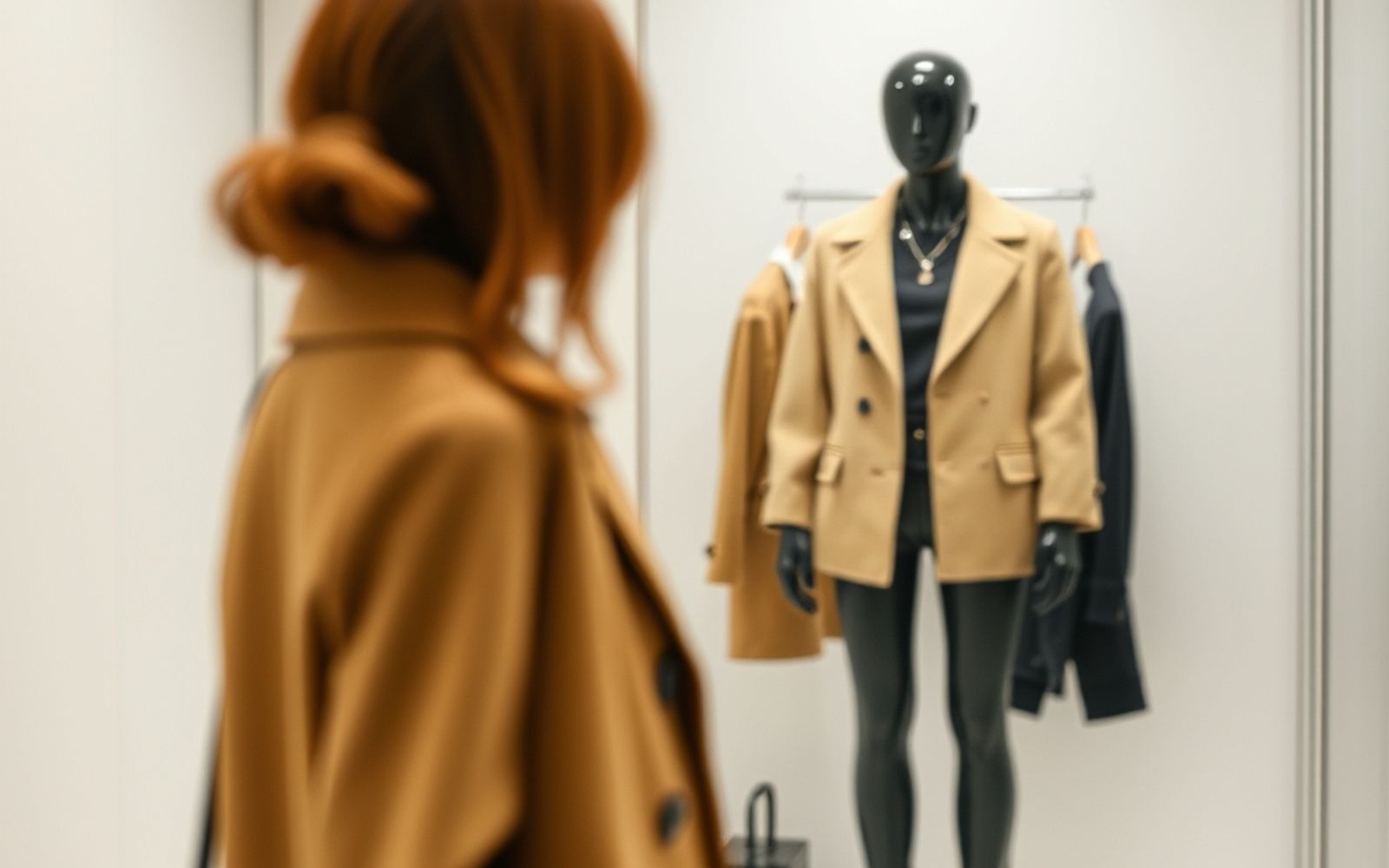
Fashion Retail Tech: Who’s Winning the AI Fitting Room Race
From Zara’s RFID tags to Nike’s AI stylists, retail tech is reshaping fashion but not all brands are keeping up.

From Zara's RFID demand network to Nike's AI stylists, retail tech is reshaping fashion. But not every brand is keeping up, and the gap between leaders and laggards is widening faster than anyone expected.
The global AI in fashion market hit $3.99 billion in 2026, growing at nearly 40% annually, and is projected to exceed $60 billion by 2034. Nearly three quarters of fashion companies now use AI in at least some capacity, according to industry tracking data. The question is no longer whether a brand has adopted AI tools. It is whether those tools are embedded deeply enough to change outcomes at scale: fewer returns, less overstock, more revenue per visitor, and customers who come back.
The brands pulling ahead have answered yes on all four. The ones falling behind are still running pilots.
The AI Arms Race
The distance between the leaders and the rest is measurable in margin points. H&M's advanced analytics team runs AI demand forecasting models that pull in sales data, weather patterns, social media trends, and local event schedules simultaneously. The result has been a documented 25% reduction in waste and a 30% profit uplift tied directly to inventory accuracy. Zara, whose parent company Inditex has invested heavily in RFID tagging and predictive analytics, has reduced overstock by 28% while maintaining a 96% in-stock rate for trending items, which is a rare combination in apparel retail where the normal tradeoff forces you to choose between one or the other.
Shein sits at a different point on the spectrum. The company uses machine learning to trigger micro-production runs of 100 to 200 units per style, keeping inventory lean and letting demand signals determine what gets scaled. The model allows Shein to list hundreds of thousands of items simultaneously while carrying far less unsold inventory than a traditional fast fashion operator. Generative AI has accelerated design ideation on top of that, training on brand archives and trend data to produce novel concepts faster than any human design team could cycle through options. The environmental cost of that speed is significant and documented, but the commercial logic is undeniable.
Nike's approach centers on personalization rather than speed. Its AI-powered styling tools analyze customer data to surface relevant products and configurations, and the Nike By You customization platform uses AI to enable mass personalization at a scale that was previously economically impossible, delivering 40% higher margins on custom products and triple the customer retention rate compared to standard catalog purchases. Stitch Fix continues to run one of the most sophisticated human-plus-AI recommendation models in the industry, pairing algorithmic suggestions with human stylists in a hybrid loop that consistently outperforms pure automation on retention metrics.
The AR Fitting Room Wars
Virtual try-on has crossed from novelty to expected feature in 2026. According to industry research, 73% of Gen Z consumers now expect virtual try-on capability when shopping online, and early adopters of the technology are reporting 20 to 40% increases in conversion rates alongside 15 to 35% reductions in return rates. Returns are fashion e-commerce's single largest cost driver. A mid-sized retailer doing $500,000 in annual revenue at a 32% return rate is absorbing $160,000 in returned goods before accounting for processing and restocking costs. Virtual try-on addresses that at the source by closing the gap between expectation and reality before the purchase is made.
Gucci's AR sneaker try-on, delivered through its mobile app using computer vision, has driven meaningful conversion improvements and helped bridge the gap between physical and digital retail for a category where fit and feel are central to the purchase decision. Dior has integrated AI-powered virtual try-on directly into its boutique experience alongside digital CRM tools, using the technology to reduce returns and reinforce brand positioning simultaneously. Guess partnered with Alibaba's FashionAI to install smart mirrors and RFID-enabled interactive technology across concept stores in Asia, an implementation that produced measurable sales gains in markets where the technology matched consumer expectations.
Zara's virtual try-on goes further than most. Its app uses 3D body scanning and generative AI to simulate how fabric drapes, stretches, and moves on a customer's digital twin, rather than simply overlaying a product image on a static photo. The result is a double-digit reduction in size-related returns, with compounding sustainability benefits from the reduction in reverse logistics emissions. ASOS has reported a 160 basis point reduction in return rates tied to its virtual try-on and fit visualization tools, a number that reads as modest in percentage terms but translates to significant margin recovery at the company's transaction volume.
Not every rollout has worked. Gap's earlier AR fitting room pilot failed primarily because it was deployed as a standalone feature rather than integrated into the core shopping journey. The lesson the industry has absorbed is that virtual try-on placed behind an extra tap or hidden in a menu does not change behavior. It has to be the default path to checkout, not an optional add-on.
The Data Divide
The difference between fashion brands winning the AI race and those watching it from the sidelines often comes down to one thing: whether their data infrastructure was built to support AI or not. Brands that invested in unified data systems, connecting point of sale, inventory, social signals, customer accounts, and returns data into a single model, can actually act on what their AI tools surface. Brands with fragmented legacy systems and siloed departments cannot, regardless of how sophisticated the AI layer on top might be.
Stitch Fix built its entire business model around data integration from the start, which is why its AI recommendations compound over time rather than plateauing. Each customer interaction adds signal that makes the next recommendation more accurate. That flywheel effect is very hard to replicate by grafting AI tools onto a traditional retail infrastructure that was not designed with data coherence in mind.
Zalando illustrated what is possible at the content level when data and AI are integrated properly. The company used generative AI to produce 70% of its Q4 editorial content, cutting production time from six to eight weeks down to three to four days. At that speed, Zalando can respond to a cultural moment with relevant editorial content within days of it happening rather than weeks after it has passed. That capability changes the relationship between trend and content in ways that a traditional production calendar simply cannot match.
The divide is also showing up in demand forecasting precision. AI-driven forecasting systems cut forecast errors by 20 to 50% compared to traditional models, while lowering excess inventory by a comparable margin and reducing lost sales by up to 65% by keeping the right products in stock at the right time. For a fashion retailer operating on thin margins where markdowns are both expensive and brand-diluting, those numbers represent the difference between a profitable quarter and a restructuring conversation.
Who Is Actually Winning
Measured against the metrics that matter most in 2026, conversion rate, return rate, inventory efficiency, and content velocity, the brands leading the AI fitting room race share three characteristics. They built data infrastructure first and AI capability second. They integrated virtual try-on into the core customer journey rather than deploying it as a feature. And they use AI to make human decisions faster rather than replacing human judgment entirely.
The brands that combined algorithmic recommendations with human editorial oversight consistently outperform those that removed the human layer. Stitch Fix is the clearest example. Pure automation in fashion personalization tends to converge toward the obvious and the safe. The combination of algorithmic signal and human taste is what produces the recommendations that feel genuinely right rather than statistically likely.
McKinsey's analysis projects that generative AI could add up to $275 billion to operating profits across apparel, fashion, and luxury over the next three to five years. More than 35% of fashion executives already run generative AI in at least one operational area and rank it as the industry's single largest opportunity going into the second half of 2026. The pattern creation cycle, which once took eight hours of skilled labor per design, now takes ten minutes with AI-assisted tools. Development costs for brands fully integrated with AI design tooling have dropped by 75%. The economics are not subtle.
The fitting room race is not really about the fitting room. It is about which brands have built the systems capable of learning from every customer interaction and acting on that learning faster than competitors can. The physical fitting room was always just a threshold, the moment where a customer decided whether something was worth buying. AI has moved that threshold online, made it faster, and made it smarter. The brands that understood that shift first are already several laps ahead.
Frequently Asked Questions
What is an AI fitting room and how does it work?
An AI fitting room is a virtual try-on tool that lets shoppers see how a garment will look on their specific body before purchasing, without needing to physically try anything on. Most implementations use a combination of computer vision, augmented reality, and 3D body modeling. The customer either uploads a photo or creates a digital avatar using body measurements, and the system renders the selected garment on that image using generative AI to simulate how the fabric would realistically drape, stretch, and move. Brands like Zara go further with full 3D body scanning and physics-based fabric simulation, while others use simpler AR overlays. The core goal in every case is closing the gap between what a customer expects a product to look like and what it actually looks like when worn, which is the single largest driver of return rates in fashion e-commerce.
Which fashion brands are leading in AI retail technology in 2026?
The clearest leaders in 2026 are Zara and Inditex for supply chain AI and demand forecasting, Nike for personalization and mass customization through Nike By You, Stitch Fix for its hybrid human-plus-AI recommendation model, Zalando for generative AI content production, and Gucci and Dior on the luxury side for AR virtual try-on integration. Shein leads in AI-driven micro-production speed, though its environmental record is a significant counterweight to that operational efficiency. Each company leads in a different dimension, so the answer depends on which metric matters most: conversion, returns, inventory efficiency, or content velocity.
Does virtual try-on actually reduce return rates?
Yes, and the data is consistent across multiple retailers and market segments. Early adopters of virtual try-on technology report 15 to 35% reductions in return rates for products featuring the tool. ASOS documented a 160 basis point reduction in return rates. Zara has reported double-digit reductions in size-related returns specifically. The mechanism is straightforward: most fashion returns are driven by fit and appearance expectations that do not match reality. Virtual try-on addresses that mismatch before the purchase rather than after, removing the primary reason most customers initiate returns. The improvement is more pronounced for categories where fit is most uncertain, particularly tops, dresses, and outerwear, than for categories like basics where sizing is more predictable.
How is AI changing fashion design and production timelines?
AI has compressed fashion's design-to-production cycle significantly. Pattern creation, which previously required eight hours of skilled labor per design, now takes approximately ten minutes with AI-assisted tools. Brands using AI design tooling report 70% faster digital pattern creation and 75% reductions in overall development costs. Generative AI allows design teams to train systems on brand archives and generate novel concepts based on trend signals and style parameters, accelerating ideation before any physical samples are produced. Zalando cut editorial content production from six to eight weeks down to three to four days using generative AI for 70% of its output. Shein uses machine learning to trigger micro-production runs of 100 to 200 units per style and scales only what demand signals support, a model that requires AI to function at the speed it operates.
What is the market size of AI in fashion retail?
The global AI in fashion market reached $3.99 billion in 2026, growing at a compound annual rate of approximately 39 to 40%. Projections put the market above $9 billion by 2030 and above $60 billion by 2034, depending on the scope of the estimate. McKinsey's analysis projects that generative AI specifically could add between $150 billion and $275 billion to operating profits across apparel, fashion, and luxury sectors over the next three to five years. More than 35% of fashion executives report already running generative AI in at least one area of operations, and nearly three quarters of fashion companies use AI in some capacity as of 2026.
Why are some fashion brands still struggling with AI adoption?
The most common reason established brands struggle with AI adoption is data infrastructure. AI tools require clean, integrated, real-time data across inventory, sales, customer accounts, social signals, and returns to function properly. Most legacy fashion retailers have data spread across disconnected systems built over decades, each optimized for a different function with no unified layer connecting them. Grafting AI capability onto that kind of fragmented infrastructure produces unreliable outputs and limits what the tools can actually learn. The second most common barrier is organizational: AI adoption in retail requires cross-functional integration between technology, buying, merchandising, marketing, and customer service teams that have historically operated independently. Brands that treat AI as a technology project rather than an operational transformation consistently underdeliver on its potential.
How does AI personalization work in fashion retail?
AI personalization in fashion works by analyzing multiple data streams simultaneously to surface products that are specifically relevant to an individual customer rather than the general population. The data inputs typically include browsing history, purchase history, return history, size and fit data, style preferences stated or inferred, social media signals, and in more sophisticated implementations, real-time contextual signals like weather and upcoming events. Recommendation engines trained on that data can predict which products a specific customer is most likely to buy, wear repeatedly, and keep rather than return. Brands like Stitch Fix pair those algorithmic signals with human stylists who add editorial judgment to the output, a combination that consistently outperforms pure automation on retention metrics. Platforms using advanced personalization report 15 to 35% increases in click-through rates and 20 to 40% increases in average order value compared to non-personalized browsing experiences.
Comments (0)
No comments yet. Be the first to share your thoughts.