Postpartum Screening And Without Care Is Paperwork
A hung jury in Plymouth puts a legal question in front of the public that medicine has only partly answered.

The hearing in Plymouth Superior Court on Tuesday morning was always going to be shorter than the walk to the courthouse door. Lindsay Clancy, 36, returned to the same Massachusetts courtroom where Judge William Sullivan declared a mistrial on September 4, after five weeks of testimony and close to 40 hours of jury deliberation produced no verdict at all. Eleven jurors were ready to find her not guilty by reason of insanity. One was not, and that single vote left the case exactly where it began.
Prosecutors still haven't said whether they'll retry her on first degree murder charges, which carry a life sentence, as Reuters reported before the hearing. Her lawyers filed motions asking the judge to enter a required finding of not guilty on the grounds that no reasonable jury could convict, and to dismiss the charges outright. Clancy has acknowledged killing her three children, Cora, Dawson and Callan, in the family's Duxbury home in January 2023. Her defense argued she was in the grip of severe postpartum psychosis. The prosecution argued she planned the killings and acted with intention.
Most public argument about this case is a fight over character, over whether she's a monster or a casualty, which is the least useful frame available. The legal question underneath it is narrower. Massachusetts asks whether a mental disease or defect left a defendant unable to appreciate that her conduct was wrong, or unable to conform it to the law. Medicine has a working model of that kind of failure. A jury was asked to reduce it to yes or no.
The Legal Test Hides a Clinical One
The standard was written for illnesses that arrive gradually and announce themselves. Postpartum psychosis does neither. It usually emerges in the days and weeks after birth, and the clinical literature describes it as uncommon but severe, distinguished from postpartum depression less by the depth of sadness than by confusion, delusions and a break from reality that the person experiencing it often cannot name. That last part is what makes it hard to catch, and it's what made the trial hard to sit through.
Defense testimony in Plymouth described a woman in free fall. Clancy had been prescribed several psychiatric medications in the months after her third child was born, and her lawyers argued the combination left her worse rather than better, a claim that turns the proceedings into an audit of her care rather than a verdict on her character. The prosecution's counter was that she planned the act and carried it out deliberately. Both accounts can describe the same person, and the law has never been built to hold that.
That the jury split 11 to 1 is the detail worth keeping. Eleven people, after weeks of clinical testimony, concluded the state had not met its burden. The holdout didn't. When a verdict turns on one person's reading of reasonable doubt, the result says less about guilt than about how badly courtroom procedure fits psychiatric evidence.
What a Screen Can and Cannot Catch
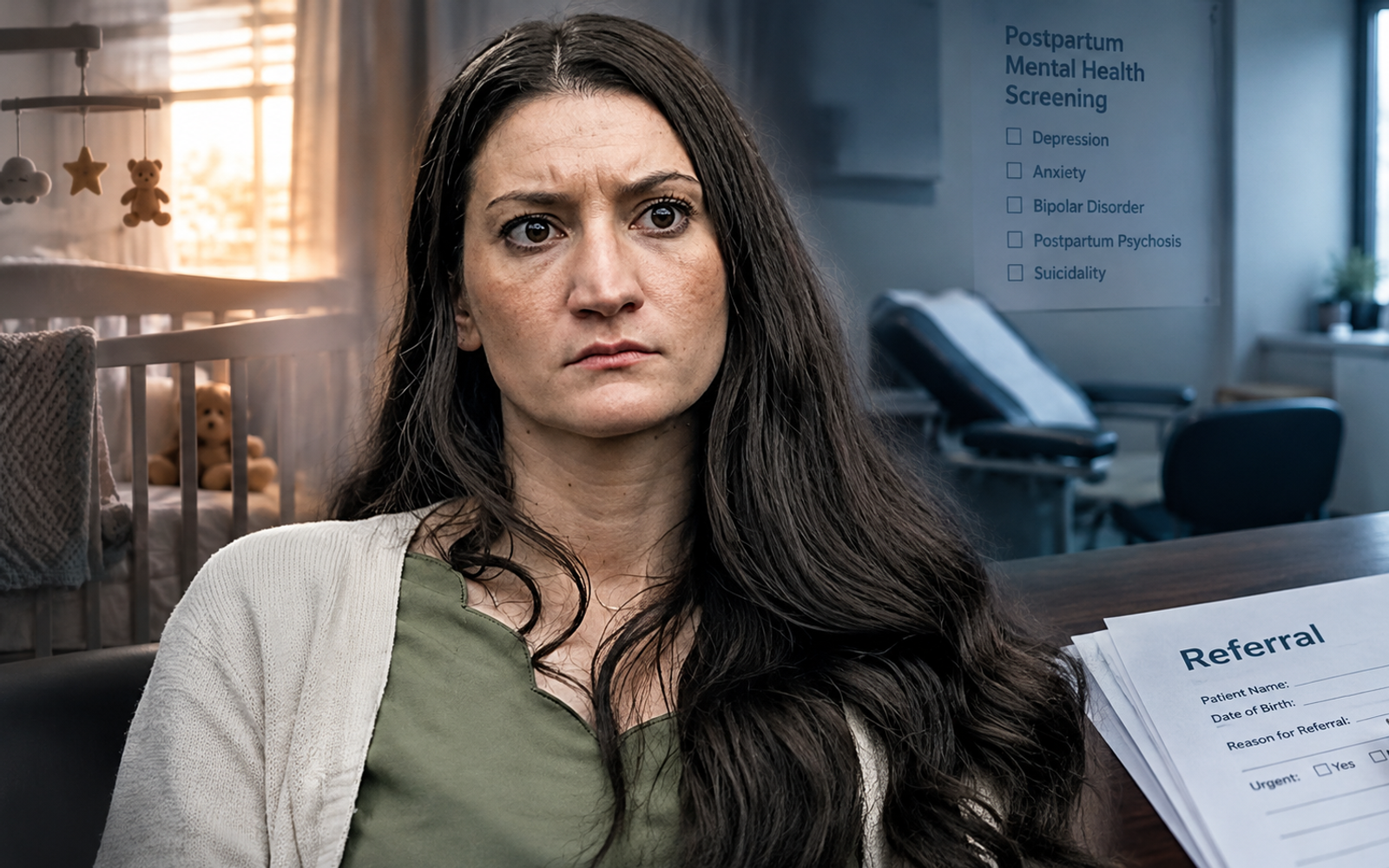
The American College of Obstetricians and Gynecologists maintains a clinical practice guideline on screening and diagnosis during pregnancy and postpartum that covers depression, anxiety, bipolar disorder, acute postpartum psychosis and suicidality. The instruments it recommends are short, validated and cheap to administer. A decade of policy work has gone into getting them into routine obstetric appointments, and the screening step is no longer the weak link.
A screen flags risk. It doesn't diagnose, and it doesn't treat. Telling acute postpartum psychosis apart from postpartum depression calls for a clinician with time to spend, because the two require different responses and the window between them is measured in days. The tool catches the signal and then hands it to a system that frequently has nowhere to send it.
This is where the wellness industry has moved in with apps, mood trackers and subscription support groups. They're cheap, they scale, and they ask nothing of the health system. They also can't staff a perinatal psychiatry unit, and the countries that have done best on severe maternal mental illness have put money into community perinatal mental health teams rather than into tools that push the work back onto a patient at three in the morning.
Why Self-Care Advice Fails Here
The wellness vocabulary built around new mothers trades on practices with modest evidence and strong marketing. Sleep hygiene, breathwork and nervous system regulation all have a real place in ordinary stress physiology, and the nervous system regulation argument is more defensible than the cold plunge it replaced. None of it was designed for a person who has stopped sleeping, is hearing things, or has become convinced her children would be safer dead.
Sleep sits at the center of how clinicians think about postpartum psychosis. Loss of sleep is both an early warning sign and one of the few triggers that can actually be interrupted, which is why the clinical response to acute risk is often a protected night of sleep under supervision rather than a set of habits. Telling an exhausted mother to prioritise rest is close to useless without somebody taking the baby for eight hours.
Advice that places the burden on the person who is unwell does something worse than fail. It creates delay. The stretch between a first symptom and a first appointment is where outcomes get decided, and a wellness recommendation can fill that stretch with activity that feels like progress.
The Gap Is Wider Elsewhere
This is an American case in an American court, and the failure it puts on display isn't American. In wealthy systems the constraint is the supply of clinicians who can manage acute perinatal illness. In places with fewer of them, and in places where a psychotic episode still carries criminal exposure before it carries a diagnosis, families end up doing the diagnostic work themselves with no vocabulary for it. The mistrial drew global coverage because the story is legible everywhere, not because the problem is local.
The comparison worth drawing isn't between countries with better and worse law. It's between systems that treat a positive screen as the start of a pathway and systems that treat it as the end of a form. That distinction survives translation, which is why the same argument shows up in health policy debates from Manchester to Nairobi.
The One Change Worth Arguing For
The fix with the strongest case behind it is administrative and unglamorous. A positive perinatal mental health screen shouldn't end with a phone number and an instruction to call. It should end with a booked appointment, made while the person is still in the room, attached to a named clinician. A referral is a suggestion. An appointment is a commitment, and the point is that the system makes it rather than the patient.
For anyone close to a new parent, the signal to watch isn't sadness. It's an abrupt change across a day or two, someone who seems confused, euphoric, or certain of things that aren't true, paired with sleep that has stopped entirely. That combination warrants a call to a clinician the same day, not a wait for the six week check.
Judge Sullivan's ruling on a second trial will be argued on legal grounds, and the eleven jurors who voted to acquit won't be part of it. What repeats regardless of his decision has nothing to do with the law: a woman whose illness was legible to the people around her, a system that owned the screening tool but not the guaranteed next step, and three children who are gone. The appointment that never got scheduled is the only piece of that any health system could have changed.
Comments (0)
No comments yet. Be the first to share your thoughts.