Nisei Week at 84: The Festival That Refuses to Be a Museum
The 84th Nisei Week opens Saturday in Little Tokyo, still debating who gets to define Japanese American culture.

By Saturday morning, the corner of First and Central in Little Tokyo will be hard to walk past without feeling it in your chest. The taiko drummers start early, and their sound is less music than weather, a low pressure system rolling down the block ahead of the crowds. That thump is the opening signal for the 84th Nisei Week Japanese Festival, which runs from August 15 through August 23 and turns this stretch of Downtown Los Angeles into the densest concentration of Japanese American culture anywhere in the country.
But the drums are only the surface. Underneath sits one of the oldest ethnic festivals in the United States, launched in 1934 by second generation Japanese American business owners who wanted to prove they could be fully Japanese and fully American at a moment when California law and public opinion said otherwise. The name itself was the argument. Nisei means second generation, born on American soil, and the young organizers of that first week chose it as a banner, not a description.
Eighty-four years later, the festival that began as a Depression-era publicity campaign has outlived every institution that tried to erase it. It suspended operations during the war years, when most of Little Tokyo's residents were incarcerated in camps across the interior, and it came back anyway, because the people who returned treated it as proof of life. That history isn't decoration. Exhibits on the Go For Broke soldiers of the 442nd and the 100th Infantry Battalion sit alongside the food stalls and the car show, unapologetically.
The Coronation That Keeps Changing
The clearest sign that Nisei Week is a living argument rather than a static display arrives on Saturday night. Seven candidates, each sponsored by a community organization, will take the stage at the Los Angeles Theatre Center for the coronation, and one of them will become the 84th Nisei Week Queen. The program dates back to the festival's first years, with photographs of the 1935 court showing young women in kimonos and pageant gowns that now read as artifacts from a different century.
And the program has been arguing with itself ever since. The pageant has weathered decades of internal debate over who belongs on that stage, from questions about mixed-race contestants to what counts as authentic cultural knowledge. Each generation of candidates has forced the festival to update its answer, and the fact that the question keeps getting asked is what has kept the institution from fossilizing.
Those debates mirror what's happening across Japanese America, where the community is older, more dispersed, and far more mixed than the 1930s organizers could have imagined. The Queen and Court program functions as a public opinion poll in pageant form, a yearly referendum on what the community wants its face to look like. That it still draws seven candidates a year, in an era when most local pageants have collapsed, says something about how much meaning the title still carries.
The Homecoming Machine
Nisei Week has always been part festival, part family reunion. Japanese Americans travel from across California and beyond to walk the same blocks their grandparents walked, and Little Tokyo itself has spent the last century shrinking and re-growing around them. The neighborhood that once held the largest Japanese American population in the country now survives as a compact historic district, and the festival is the annual engine that fills it.
So the timing of this year's edition matters. The festival arrives as Los Angeles is still recalibrating its relationship to its own history, with heritage neighborhoods across the city fighting the same gentrification pressures that have remade Chinatown and Boyle Heights. Little Tokyo has held the line better than most, partly because events like this make the neighborhood unignorable for nine days a year. It's a different kind of homecoming than the ones the two homecomings that defined July tracked, but the gravitational pull is the same.
The programming has kept pace with the crowds. Beyond the parade and the coronation, this year's schedule stacks tea ceremonies, calligraphy workshops, and kimono fittings against a car show, a craft fair, and a street food scene that has become a destination in its own right. The analog crafts matter more than they did a decade ago, because the festival is now teaching a third generation the skills its elders assumed would pass down naturally.
There's a wider current underneath all of it. Japanese pop culture is enjoying a global moment, from anime soundtracks to the baseball stardom of Shohei Ohtani, and that wave has washed over Little Tokyo as well. Some of the younger faces in the crowd arrive because of a film, a band, or a jersey rather than a family tree. The festival doesn't police the difference between those reasons, and that openness is why it keeps gaining newcomers instead of just retaining regulars.
What the Drums Are Actually For
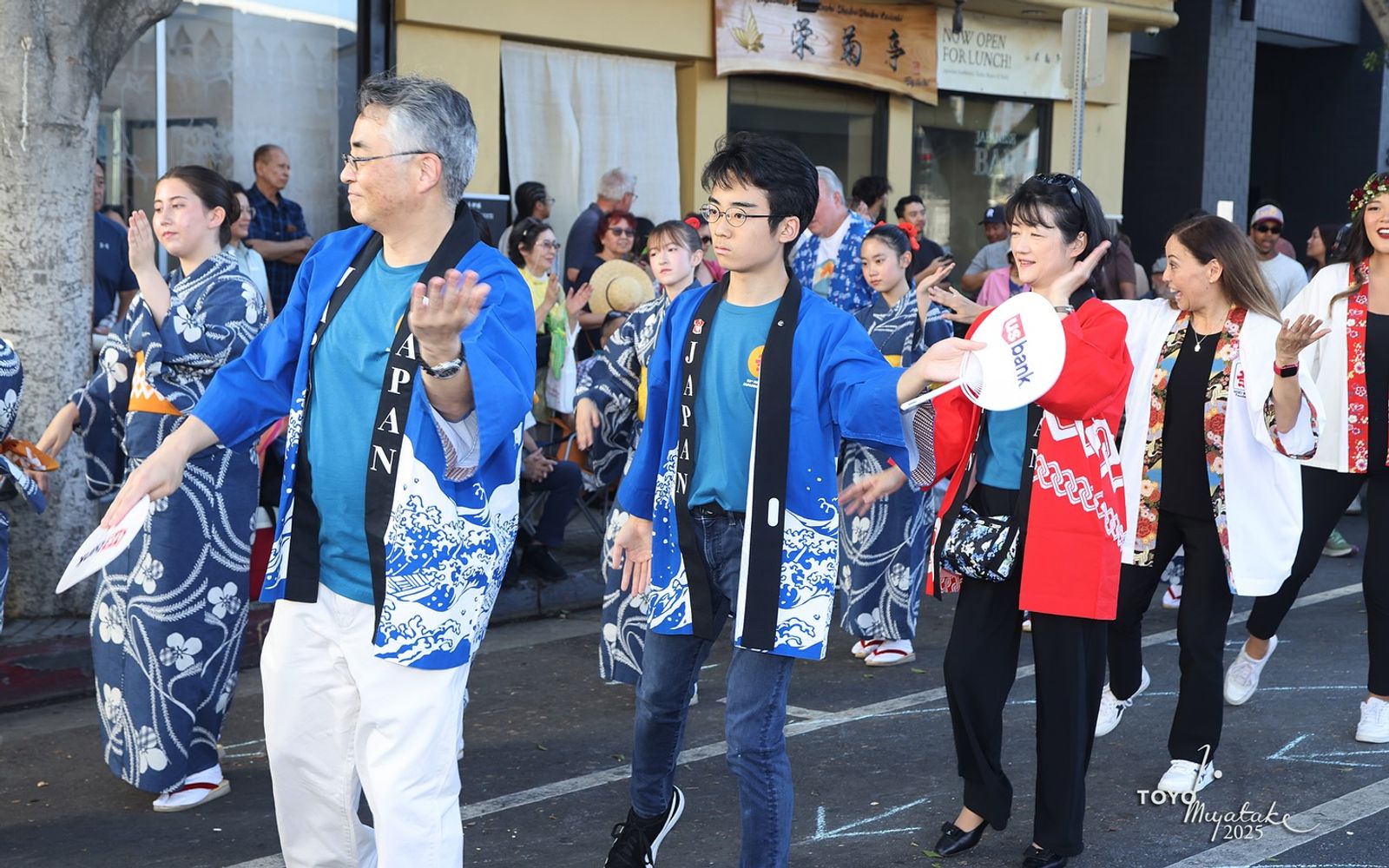
Sunday's Grand Parade, which steps off at 4 p.m. and runs through the heart of Little Tokyo, is the festival's public face, with dancers, musicians, floats, and the newly crowned court moving down streets lined several rows deep. It's free, no registration required, which isn't a small detail for a city where almost everything cultural now costs something.
Accessibility is the festival's quiet radicalism. Nisei Week has stayed free at its core even as Los Angeles has become one of the most expensive cities on Earth, and that choice keeps the audience generationally mixed in a way that ticketed events can't manage. Grandparents who remember the 1950s festivals stand next to teenagers who found the schedule on Instagram, and the drums hit both of them the same way.
That mix is the festival's actual product. Most heritage celebrations eventually choose between authenticity and attendance, between keeping the old ways pristine and welcoming whoever shows up. Nisei Week has spent 84 years refusing that choice, running the tea ceremony and the car show side by side, arguing about the pageant in public, and treating every change as an addition rather than a dilution.
The taiko drummers will be back next August, and the August after that, because the festival's real talent is the opposite of preservation. It keeps making room. For the candidates on that coronation stage, for the families returning to the same block, for the tourists who wander in off First Street with no idea what they've walked into, the door stays open, and the low thump keeps pulling people toward it.
Comments (0)
No comments yet. Be the first to share your thoughts.