Five Cryptos That Might Not Explode in 2026
Predictions are easy. Being right is harder. Here’s what the on-chain data actually says about the next big thing.

Last Thursday, a single wallet moved 23,947 ETH, about $72 million, from Binance to a new address. The transaction fee was $1.87. Within hours, the same wallet split the stack into smaller chunks and sent them to three different staking pools. One of those pools was Lido, which now holds 32% of all staked Ethereum. The other two were Rocket Pool and a lesser-known validator called Stakewise. The wallet’s owner didn’t announce anything. They didn’t tweet. They just rebalanced their exposure to Ethereum’s security budget in a way that suggests they’re planning to hold for years, not weeks.
That kind of quiet accumulation doesn’t make headlines. It doesn’t get shared on Crypto Twitter. But it’s the kind of on-chain behavior that actually moves markets.
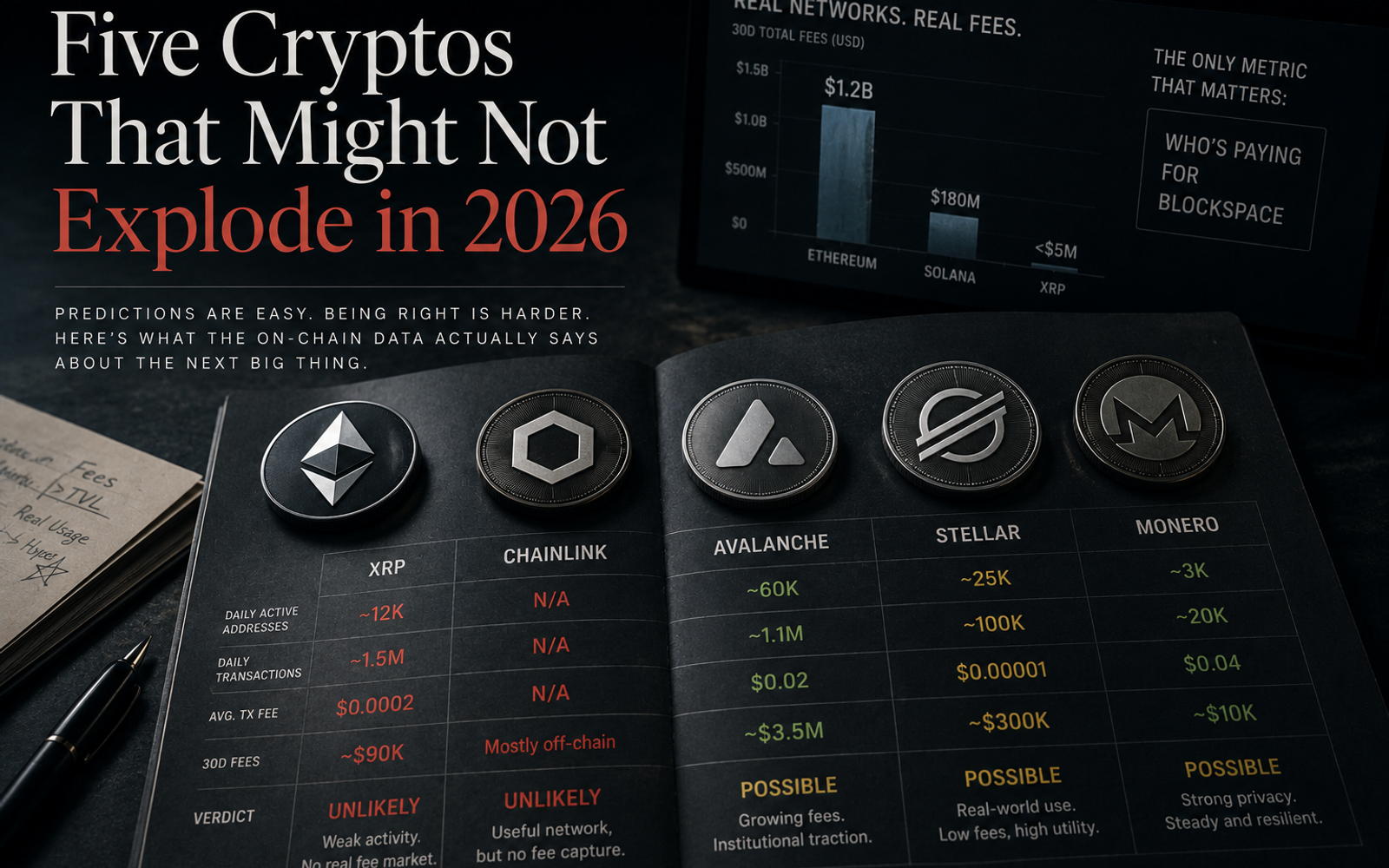
The only metric that matters is who’s paying for blockspace
Most lists of "next big cryptos" read like a catalog of wishful thinking. They cite total value locked, or TVL, as if it’s a measure of health. It’s not. TVL is a vanity metric. It can be inflated with yield farming, wash trading, or even just a single whale moving funds between pools. What matters is who’s paying real money to use the network. That’s measured in fees.
Ethereum’s fee market is still the gold standard. In the last 30 days, it generated $1.2 billion in fees. Solana, often touted as the next Ethereum, generated $180 million. That’s not a rounding error, but it’s not a replacement either. Solana’s fees are low because its blockspace is cheap. That’s great for users, terrible for investors. A network that can’t charge for its own blockspace is a network that can’t sustain itself without constant subsidy.
Then there’s XRP. Its price has been ticking up lately, but its on-chain activity tells a different story. Daily active addresses peaked in 2018 at 40,000. Today, it’s around 12,000. The network processes about 1.5 million transactions per day, but most of those are payment channel opens and closes, not actual value transfer. XRP’s fee market is almost nonexistent. The average transaction fee is $0.0002. That’s not a network. That’s a rounding error with a logo.
Chainlink is another name that keeps showing up on these lists. Its oracle network is undeniably useful. It secures billions in DeFi, and its nodes are run by some of the most reputable entities in crypto. But here’s the uncomfortable truth: Chainlink doesn’t have a fee market either. Most of its revenue comes from enterprise contracts, not on-chain activity. The LINK token is not a claim on network fees. It’s a coordination token for node operators. That’s a fine model, but it’s not the same as a network that prints money every time someone uses it.
The quiet rise of the also-rans
If you want to find the cryptos that might actually move in 2026, look for networks that are quietly building real economic activity. Not hype. Not speculation. Real usage.
Take Avalanche. Its subnets have been gaining traction with institutions. The Evergreen Subnet, launched by Ava Labs and T. Rowe Price, is a permissioned DeFi environment for asset managers. It’s not open to retail. It’s not trying to be the next Uniswap. It’s a walled garden for people who move real money. That’s not exciting, but it’s sustainable. Avalanche’s fee revenue has been growing steadily, even as its price has stagnated. In the last 30 days, it generated $3.5 million in fees. That’s not Ethereum levels, but it’s enough to keep the lights on.
Stellar is another network that doesn’t get much attention. Its focus on cross-border payments is boring, but it’s working. MoneyGram uses Stellar for remittances. Circle’s USDC is natively issued on Stellar. The network processes about 100,000 transactions per day, with an average fee of $0.00001. That’s not a typo. Stellar’s fees are so low they’re almost free. That’s not great for investors, but it’s great for users. And in the long run, users matter more than speculators.
Then there’s Monero. It’s the only privacy coin that has consistently delivered on its promises. Its ring signatures and stealth addresses work. They’re not perfect, but they’re good enough to make transaction tracing difficult. Monero’s fee market is small but stable. It generates about $10,000 in fees per day. That’s not much, but it’s enough to keep the network secure. The real story with Monero isn’t its price. It’s the fact that it’s one of the few cryptos that actually solves a problem people care about. Privacy isn’t a feature. It’s a need.
The uncomfortable truth about 2026
Most of the cryptos that will be called "the next big thing" in 2026 are already being hyped today. That’s not an accident. It’s how markets work. The people who write these lists aren’t trying to predict the future. They’re trying to front-run it. They want you to buy the narrative so they can sell the news.
The real opportunities won’t come from the usual suspects. They’ll come from networks that are quietly building real economic activity, not just speculative bubbles. They’ll come from protocols that charge for their blockspace, not ones that give it away for free. And they’ll come from teams that focus on users, not influencers.
But here’s the thing. Even if you find the right network, even if you get in early, even if the price goes up 10x, it won’t matter unless you actually use it. Crypto isn’t a get-rich-quick scheme. It’s a tool. And like any tool, it’s only as valuable as what you do with it.
The wallet that moved $72 million last Thursday didn’t do it for the memes. They did it because they believe Ethereum will still be here in 2026. The question is, what will you be using by then?
Comments (0)
No comments yet. Be the first to share your thoughts.