Summer Anime Has No Business Being This Weird
This season's new shows are refusing to be normal. Ghost in the Shell is back and better than it has any right to be, Bleach is finally ending, Kyoto Animation returned with their most anticipated original in years.

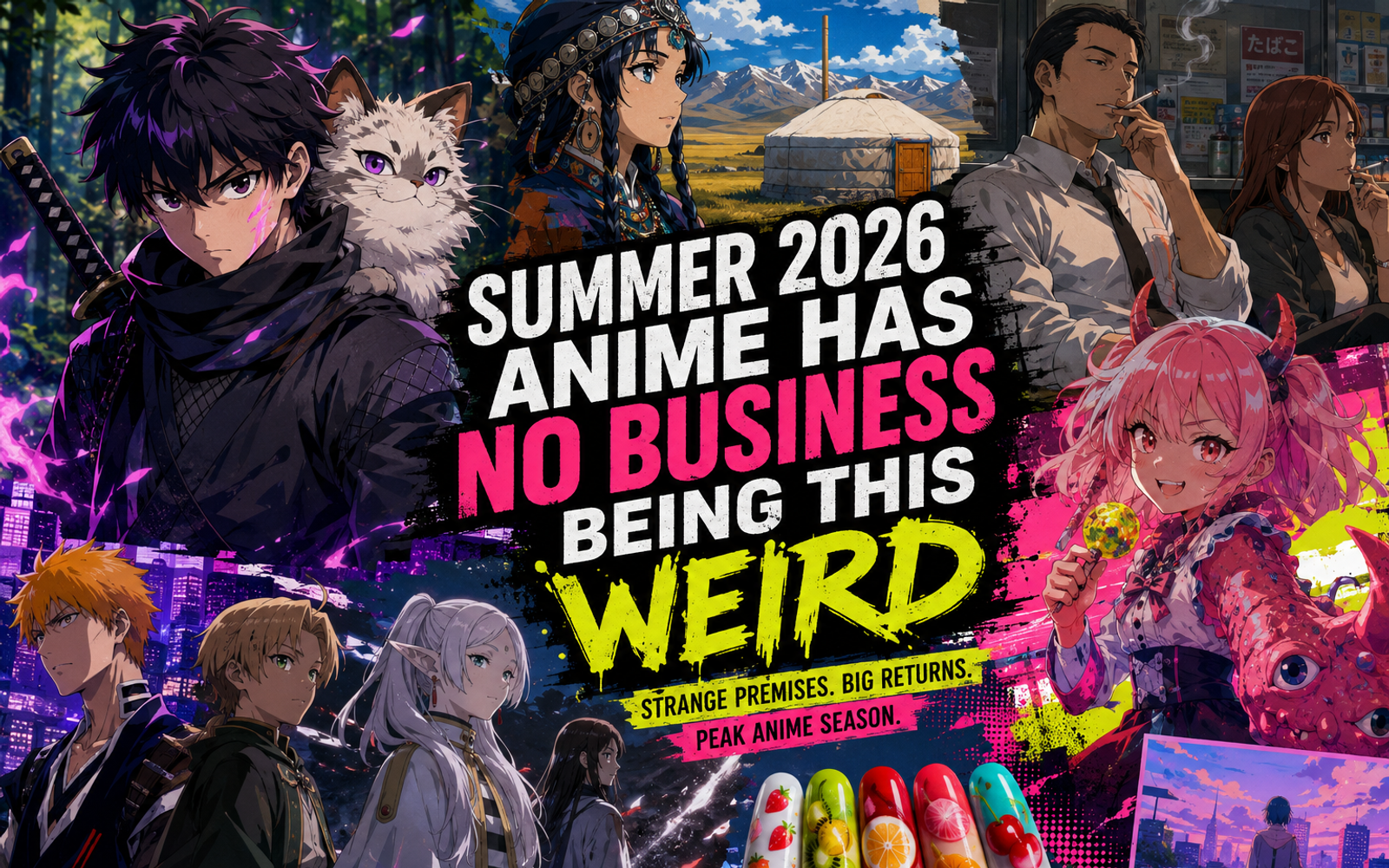
Black Torch premiered July 4 on Crunchyroll with a premise that sounds like someone lost a bet: a teenage shinobi who can speak to animals ends up spiritually fused with a powerful demon cat named Rago, and now they share a body and a world of problems. The hook is absurd. The execution is not. Studio 100Studio adapted Tsuyoshi Takaki's Jump Square manga with the kind of animation confidence that makes a weird premise feel inevitable rather than accidental, and SiM handled the opening theme the way SiM always does, which is aggressively and correctly.
This is the season in miniature. The premises are refusing to be normal, and that refusal is not a bug. It is the whole point.
The question is no longer whether anime has gone mainstream. It is whether mainstream is ready for where anime is actually going.
The Season of the Weird Premise
The new shows this summer are staking out unusual ground and committing to it without apology. Jaadugar: A Witch in Mongolia follows a young witch navigating a setting that anime almost never touches, the Mongolian steppe, with a visual identity built around landscapes and folk tradition rather than the city block or the high school classroom that has served as the default backdrop for so much of the medium's recent output. The specificity of the setting is the point. It is doing something that feels genuinely fresh because it is built on research and craft rather than genre formula.
Smoking Behind the Supermarket with You is a workplace romance about two adults choosing, deliberately, to keep their relationship small and quiet. No dramatic confessions, no misunderstandings stretched across twelve episodes, no third-act catastrophe. The show is about two people who like each other being careful and tender about it. That sounds ordinary until you realize how rare it is, and the slice-of-life execution is precise enough to make a quiet story feel significant.
Kaiju Girl Caramelise takes the category of monster transformation narratives and routes it through romantic comedy, with a teenage girl who turns into a kaiju when her emotions run hot enough. The concept is played partly for comedy and partly for something more earnest about the experience of feeling too much and not knowing where to put it. Both readings hold at the same time, which is harder to pull off than it sounds.
Sparks of Tomorrow, based on the light novel 20th Century Electrical Catalog, deserves its own paragraph. This is Kyoto Animation returning to the kind of deeply human, beautifully built storytelling that connects the way Violet Evergarden did. The announcement itself was announced back in 2018 before the devastating arson attack on KyoAni's studio in July 2019, which means this project has been quietly waiting for years while the studio rebuilt. Set in a transitional era Kyoto, following two young people dreaming of what lies beyond the horizon, early reviews describe animation that shares Violet Evergarden's breathtaking visual quality and the same emotional patience. It is streaming on Crunchyroll from July 6.
The Heavyweights Refuse to Yield
While the new shows are doing weird and interesting things, the continuation titles this summer are carrying their own weight, and in a couple of cases they are the most significant anime events of the year.
Mushoku Tensei: Jobless Reincarnation returned for Season 3 on July 5 on Crunchyroll with Studio Bind back behind it and the same creative team steering the adaptation. Whatever position you hold on the isekai genre's reputation, Mushoku Tensei is consistently treated as its high-water mark for production. Studio Bind was effectively built to make this show, which is why the backgrounds feel lived-in, the character animation has weight, and the world doesn't feel like a convenient backdrop for power fantasy. Season 3 picks up the Eris arc, continuing Rudeus's second life with the same level of craft that made the previous seasons stand out in a crowded field.
Saga of Tanya the Evil Season 2 is returning nearly nine years after the first season earned its audience. Studio NUT is back, Aoi Yuki returns as Tanya, and the alt-history war narrative picks up where it left off with the salaryman reborn as a ruthless child-soldier mage in a world where military magic and early 20th century warfare collide. The delay between seasons only seems to have built anticipation rather than drained it. It premiered July 8 on Crunchyroll.
Clevatess Season 2 arrived on July 8, continuing the dark fantasy series with a quick turnaround from its first season. The Elusive Samurai Season 2 is also back on Crunchyroll, following the breakout success of the historical action series. Skeleton Knight in Another World returned on July 4 for another season of comfortable isekai with a distinctive visual sensibility, a reliable presence in a season that already has plenty of loud debuts competing for attention. Black Clover Season 2 is also officially back after five years, returning from where the destructive end of the original series left off, with the Spade Kingdom Raid arc's aftermath still fresh.
Re:ZERO Season 4 Part 2, the Reclamation Arc, arrives in August on Crunchyroll. The Loss Arc opened in April, and this continuation takes Subaru to the Pleiades Watchtower deep within the Augria Sand Dunes on a mission to find the legendary Sage Shaula. The season is tracking the attempt to save Rem, Crusch, and Julius from what happened to them at Water Gate City, which gives the summer cour a clear emotional stakes framework rather than just continuing the plot.
Ghost in the Shell Is Back and It Has No Right to Be This Good
The most significant anime event of the summer is not a sequel and not a new IP. It is a reimagining of a franchise that already defined a genre, doing something that sounds nearly impossible in practice: making Ghost in the Shell feel new.
Science SARU's The Ghost in the Shell premiered July 7 on Prime Video globally and it is being described by early critics as one of the best anime of the year. The studio, known for Dandadan, Inu-oh, and The Colors Within, was announced as the production house back in 2024, and the decision to pair the Ghost in the Shell IP with Science SARU's experimental visual language seemed either inspired or reckless depending on who you asked. Early reviews suggest it was inspired.
The show is a more faithful adaptation of Masamune Shirow's original 1989 manga than any previous screen version has been, which matters because the manga has a different tone from Mamoru Oshii's 1995 film. The film is hard-edged and melancholy, philosophical in a way that pushed everything else to the background. The manga underneath it has more humor, more character texture, and a Major Motoko Kusanagi who feels less like an idea and more like a person. Science SARU's version is described as kinetic, colorful, and expressive in ways that feel completely fresh despite the franchise being technically over three decades old. The animation uses perspective shots and visual techniques to portray cybernetic consciousness that reviewers are calling genuinely inventive rather than familiar.
The series premiered at the 2026 Annecy International Animation Film Festival on June 22 before going wide on Prime Video. Anime Expo 2026 in Los Angeles screened it on July 5. The UK got early screenings on June 26. The rollout was treated as a significant cultural event, and the reception has validated that framing. The opening theme comes from King Gnu, and the overall jazz-inflected soundtrack has been highlighted as a specific strength of the production.
This is the franchise coming full circle in the most interesting possible way: back to the original manga's energy and sense of humor, filtered through a studio that has spent the last few years building one of the most distinctive visual voices in contemporary anime, and landing in a summer season already full of reasons to pay attention.
The Full Summer 2026 Watch List
Here is everything currently confirmed and airing for the Summer 2026 season, organized by category and streaming platform.
New Premieres
Black Torch / July 4 / Crunchyroll A teenage shinobi bonds with a powerful demon cat named Rago. Studio 100Studio, opening theme by SiM. Sharp shonen with a genuinely unusual premise.
The Ghost in the Shell (2026) / July 7 / Prime Video Science SARU's reimagining of the landmark cyberpunk franchise, faithful to the original Masamune Shirow manga. One of the most acclaimed premieres of the season.
Jaadugar: A Witch in Mongolia / July 2026 / Crunchyroll Young witch navigating a richly researched Mongolian setting. One of the most visually distinctive new shows of the season.
Smoking Behind the Supermarket with You / July 2026 / Crunchyroll A quiet, precise adult workplace romance that refuses every genre shortcut.
Kaiju Girl Caramelise / July 2026 / Crunchyroll Romantic comedy about a girl who transforms into a kaiju when her emotions spike. Funnier and more emotionally honest than the premise suggests.
Sparks of Tomorrow / July 6 / Crunchyroll Kyoto Animation's long-awaited original, based on the light novel 20th Century Electrical Catalog. Set in transitional era Kyoto. Violet Evergarden tier ambition and execution, by all early accounts.
Tomb Raider King / July 6 / Crunchyroll Not connected to the video game series despite the name. A relic hunter navigates a world where ancient tombs have appeared across the earth. Built on the manhwa adaptation wave following Solo Leveling's success.
Black Clover Season 2 / July 2026 / Crunchyroll After five years, the shonen continuation picks up from the end of the Spade Kingdom arc. Anime Expo crowd reaction was loud.
Returning Sequels
Mushoku Tensei: Jobless Reincarnation Season 3 / July 5 / Crunchyroll Studio Bind returns for the Eris arc. The production standard remains the benchmark for the isekai category.
Saga of Tanya the Evil Season 2 / July 8 / Crunchyroll Nine years between seasons. Studio NUT and Aoi Yuki both back. Alt-history military magic warfare continues.
Clevatess Season 2 / July 8 / Crunchyroll Quick turnaround dark fantasy continuation.
Skeleton Knight in Another World Season 2 / July 4 / Crunchyroll Reliable comfort-watch isekai. Consistent visual identity and pacing.
The Elusive Samurai Season 2 / July 2026 / Crunchyroll Historical action series returns after a strong first season.
Re:ZERO Season 4 Part 2 (Reclamation Arc) / August / Crunchyroll Picks up from the Loss Arc premiere in April. Subaru and the Pleiades Watchtower.
Dragon Ball Super: Beerus / Summer 2026 A reconstructed retelling of Battle of Gods with newly drawn and added sequences rather than a straight sequel. Described as including "a large volume of newly added and redrawn cuts" with a reworked narrative.
Bleach: Thousand-Year Blood War - The Calamity (Part 4) / July / Disney+ and Hulu (US) The finale. Not on Crunchyroll. First three episodes had a limited theatrical run in North America June 25 to 29 before the streaming premiere. This closes the book on one of the longest comeback stories in anime.
Continuing from Spring
ONE PIECE: Elbaph Arc / Crunchyroll (ongoing weekly) That Time I Got Reincarnated as a Slime Season 4 / Crunchyroll (ongoing weekly) Daemons of the Shadow Realm / Crunchyroll (ongoing weekly)
Anime Leaks Into Everything
The cultural footprint of anime in 2026 is not contained to the shows themselves. It is showing up in music, fashion, gaming, and geography in ways that are getting harder to frame as a niche.
Fashion is taking the most visible cues. Designers in Seoul, Tokyo, and increasingly Lagos are integrating anime visual language into collections without the awkwardness that once accompanied that kind of cross-referencing. It is not nostalgia branding anymore. It is aesthetic fluency. The generation designing clothes now grew up watching this medium, and that shows in how naturally the references are embedded rather than worn as costume.
Music is moving similarly. Anime opening and ending themes are charting in markets where Japanese pop had almost no presence five years ago. The SiM opening for Black Torch is getting streams from listeners who found it through the show. The King Gnu theme for Ghost in the Shell is pulling a different demographic entirely. Both things are true at the same time, and the streaming data reflects that anime soundtracks are functioning as genre-crossing discovery tools.
The geographic growth numbers are no longer anecdotal. Crunchyroll confirmed it is expanding simulcast into Taiwan this summer as part of a wider push into South and Southeast Asian markets. In West Africa, specifically in Lagos, Nairobi, and Johannesburg, viewership data has been climbing sharply enough that platform programming is beginning to account for those audiences rather than treating them as incidental. The anime community in those cities is large, young, and vocal online in ways that are starting to affect what gets subtitled faster, what gets promoted, and eventually what gets made with those audiences in mind.
Gaming remains the largest parallel pipeline. The crossover between anime fandom and gaming has always been substantial, but the 2026 season has more direct tie-ins, mobile game collaborations, and shared fandoms between anime titles and live-service games than any previous summer in recent memory. Every major new show launches with at least a tracker community, usually a wiki, and increasingly some form of interactive component that extends engagement beyond the weekly episode.
Which Is Actually Must-Watch This Summer
If you have limited time and need a shortlist rather than a full seasonal commitment, here is the honest version of the prioritization.
Ghost in the Shell (2026) is the prestige watch. Prime Video, weekly, one episode in and critics are already calling it one of the best of the year. Even if you have no prior connection to the franchise, the Science SARU visual identity alone makes it worth the time.
Bleach: Thousand-Year Blood War - The Calamity is the event watch. This is a finale, and it is going to produce the kind of shared cultural moment that only happens when a decades-long story ends. Disney+ and Hulu in the US, not Crunchyroll.
Mushoku Tensei Season 3 is the reliable watch. If you are caught up, it continues the adaptation with the same quality. If you are not caught up, this is the season to start from the beginning because the whole thing is available and the new cour gives a reason to get there now.
Sparks of Tomorrow is the wildcard watch. KyoAni returning with an original after years of sequels, a project that has been in development since before the studio's darkest moment, with early reviews comparing the emotional register to Violet Evergarden. The risk is that the hype sets expectations the show cannot meet. The upside is that it might be one of the best things airing this year.
Saga of Tanya the Evil Season 2 is for anyone who watched the first season and wondered if more was coming. Nine years later, it is. The wait has clearly not diminished the creative team's investment.
The rest of the list is real and worth your time for the right viewer. Black Torch for anyone who wants a new shonen with an actual strange premise. Jaadugar if you want something visually specific and unhurried. Smoking Behind the Supermarket if you want a quiet adult romance that respects your patience. The summer has depth well past the headline titles.
The season has too much going on to follow everything. Pick what fits the time you have, add the rest to a watchlist, and do not feel obligated to keep up with all of it. The shows will still be there. The best ones will still be worth watching in September.
Frequently Asked Questions
Where is Bleach: Thousand-Year Blood War - The Calamity streaming?
The Calamity is streaming on Disney+ and Hulu in the United States, distributed by Viz Media. It is not on Crunchyroll, which is where the previous cours initially aired for some international markets. North America also got a limited theatrical run for the first three episodes from June 25 to 29 ahead of the streaming premiere. If you are outside the US, availability depends on your territory. Check Disney+ and local Viz Media distribution partners first before assuming it is unavailable in your region.
Who made the new Ghost in the Shell anime and where can I watch it?
The 2026 Ghost in the Shell series is produced by Science SARU, the studio behind Dandadan, Inu-oh, and The Colors Within. It is directed by Mokochan, with series composition by EnJoe Toh and character design by Shuhei Handa. The music is handled by Taisei Iwasaki, Ryo Konishi, and Yuki Kanesaka, with King Gnu providing the opening theme. It streams globally on Prime Video from July 7, 2026. The show is a fresh adaptation of Masamune Shirow's original 1989 manga rather than a continuation of any previous anime or film, so prior knowledge of the franchise is helpful but not required.
Is Mushoku Tensei Season 3 worth watching if I haven't seen the first two seasons?
Season 3 is not designed as an entry point. It picks up directly from where Season 2 left off and assumes familiarity with Rudeus, his world, and the ongoing storylines around the people in his life. If you have not seen the previous seasons, the better move is to start from the beginning. The good news is that Crunchyroll has both seasons available in full, and the production quality is consistent throughout. Getting caught up is genuinely worth it if you are interested in the isekai genre at its most technically accomplished.
What is Sparks of Tomorrow and why is it significant?
Sparks of Tomorrow is a Kyoto Animation original anime based on the light novel 20th Century Electrical Catalog. It is set in a transitional era Kyoto and follows two young people dreaming of what lies beyond the world they know. The project was first announced in 2018 but was indefinitely delayed following the devastating arson attack on Kyoto Animation's studio in July 2019. It is significant for two reasons: it is KyoAni returning to the kind of emotionally ambitious original storytelling that made Violet Evergarden one of the most acclaimed anime of the last decade, and it carries the weight of being a project that survived the worst period in the studio's history to actually make it to screens. It is streaming on Crunchyroll from July 6, 2026. Early reactions are comparing the animation quality and emotional tone to Violet Evergarden.
What is Saga of Tanya the Evil about and do I need to watch Season 1 first?
Saga of Tanya the Evil follows Tanya Degurechaff, a ruthless child-soldier mage in an alternate history where magical combat exists alongside early 20th century military warfare. The catch is that Tanya is a reincarnated Japanese salaryman who was denied peaceful death by a being called Being X, which she refuses to worship, and has been placed in increasingly dangerous situations as a result. Yes, you need to watch Season 1 before Season 2. The setup, the character dynamics, and the ongoing conflict with Being X are all established there. Season 1 is available on Crunchyroll. It is worth watching. The combination of genuine alt-history military strategy and Tanya's completely unhinged expression when things go wrong is unlike anything else in the medium.
How many new anime are premiering this summer in total?
Crunchyroll alone announced 41 confirmed new premieres for Summer 2026 in their June 17 lineup reveal, with additional titles still listed as to be announced at the time of publication. When continuing series from Spring and returning sequels are included, AniCue is currently tracking 60 Summer 2026 anime in total across all platforms. The season also includes significant titles on Prime Video (Ghost in the Shell), Disney+ and Hulu (Bleach), Crunchyroll (the majority of new and returning shows), and Netflix for some regional titles. Following every show is not realistic for most viewers, which is why prioritization lists like this one exist.
Is Black Clover Season 2 a good entry point for new viewers?
No. Black Clover Season 2 continues directly from the events of the original series, which ran from 2017 to 2021 and covered the story through the Spade Kingdom Raid arc. Season 2 picks up from the aftermath of that arc's destructive conclusion. If you are new to the franchise, the original series is available on Crunchyroll and covers well over 100 episodes of material before Season 2 begins. The show has a reputation for a slow start that pays off, so give it more than a few episodes before forming a verdict. If you are already caught up, Season 2 after a five-year gap was one of the more anticipated continuations of the summer.
What is the difference between anime streaming on Crunchyroll versus Prime Video and Netflix this season?
The platforms have different licensing agreements with Japanese studios, which means a show's availability on one platform in one country does not guarantee the same in another. Crunchyroll has the largest concentration of Summer 2026 simulcasts and is generally the best single subscription for following the broadest range of seasonal anime. Prime Video is where Ghost in the Shell (2026) exclusively streams, and the platform has been positioning itself more aggressively as a destination for anime after securing high-profile titles in recent years. Bleach's final season is on Disney+ and Hulu in the US specifically through Viz Media's distribution deal. Netflix carries a smaller selection of anime overall but tends to hold regional exclusives in some markets. For most viewers trying to cover this season's highlights, Crunchyroll plus Prime Video gets you the largest portion of what matters.
Comments (0)
No comments yet. Be the first to share your thoughts.