The 86% of Bloggers Who Earn Nothing (And How to Join the Other 14%)
The dirty secret of blogging in 2026: 86% of bloggers never make a cent. But 2% earn six figures. This is how they do it.

Three weeks ago, a creator in Kumasi posted a breakdown of her first month on a self-hosted blog. Seventeen visitors. Zero subscribers. Four hours spent wrestling with a theme she'd downloaded at 2 a.m. after her third power outage of the week. She asked a simple question in the caption: "Is this even worth it anymore?"
She's not alone. The 2026 Blogging Income Survey, tracked by Productive Blogging, shows that the median blogger takes 49 months, just over four years, to earn a full-time living. And the brutal headline that has stopped a thousand side hustles cold: 86% of bloggers earn exactly zero dollars.
Not one cent. Not a single affiliate commission. Zero.
The other 14%? They split into two camps. The vast majority trickle in pocket money, a few hundred bucks a year from a stray AdSense click. And then there's the 2%. The ones who clear $100,000 or more annually. The ones who don't ask whether blogging is dead because they're too busy watching their Stripe notifications ping with recurring revenue from Lagos, London, and Lagos again.
Here's the part nobody tells you. The difference between the 86% and the 2% has almost nothing to do with writing talent. It has everything to do with the system you build before you publish your first post.
The Blog You're Building Is the Wrong Thing
Most guides tell you to "start a blog" as if the blog itself is the destination. Pick a name. Buy hosting. Install WordPress. Write some posts. Wait for the money to arrive. This is the fastest route to joining the 86%.
The people who cross $100K don't start a blog. They start a content business that happens to use a blog as its engine. The distinction matters more than any hosting plan or theme choice you'll ever make.
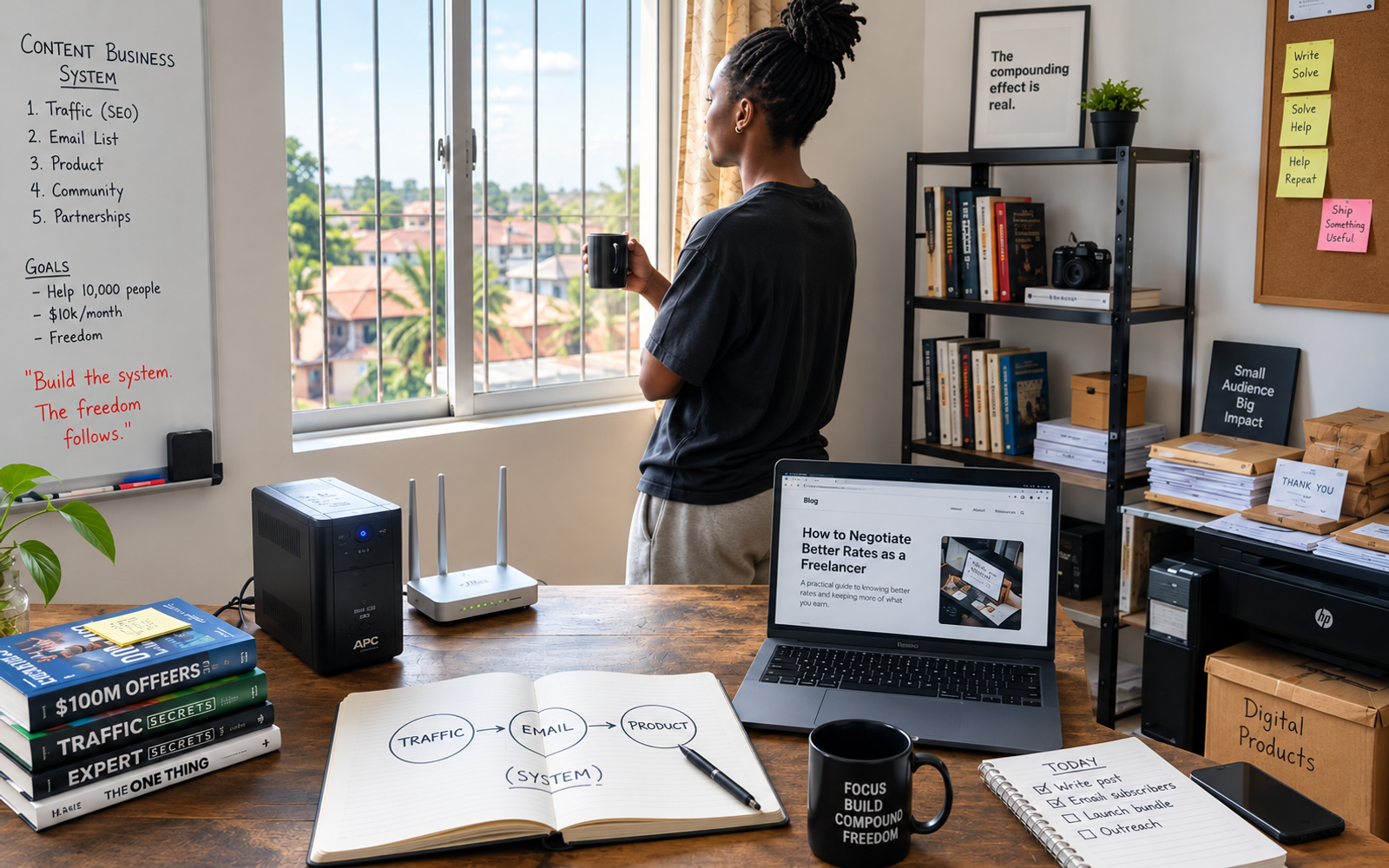
A blog is a format. A content business is a system with three moving parts: a traffic source you control (SEO or email), a monetization trigger that fires predictably (a digital product, a membership, a high-ticket service), and a repeat loop that turns one visitor into ten, then a hundred, then a thousand.
Look at the numbers. According to the Africa Creator Economy Report, the continent's creator sector hit $3.1 billion in 2026, projected to grow nearly six-fold to $17.8 billion by 2030. Nigeria's skit-makers and streamers are pulling in brand deals that would have been unthinkable five years ago. But here's the quiet truth underneath that boom: the Nigerians and Ghanaians who actually stack cash aren't the ones with the slickest videos. They're the ones who built a monetization bridge before they built an audience. They knew what they were selling before they knew who they were talking to.
Pick a Niche That Has Buyers, Not Just Browsers
A blog about "personal finance" is a battlefield. A blog about "how to negotiate medical bills as a freelancer in Nigeria" is a goldmine. Specificity is the only moat that matters in 2026.
Here's the test. Type your niche into Google with "buy" after it. "ERP software for small manufacturers buy." "Yoruba language books for diaspora kids buy." If the search results show products, courses, or services that cost real money, $50, $200, $1,000, then you have a niche with commercial intent. If the results show Wikipedia articles and Reddit threads, you have a topic people read about but don't pay for. Find something else.
The sweet spot? A problem people have at work or in their personal finances. Something that keeps them up at night. A small business owner in Accra who can't figure out how to price her services. A developer in Nairobi who wants to land remote contracts but keeps losing bids to cheaper candidates. A parent in Johannesburg trying to decode the new school curriculum changes. Solve that one specific thing better than anyone else.
The Monetization Grid That Separates Hobbyists From Earners
The 2% don't put all their revenue in one basket. They build a grid. Over here, a $27 PDF guide that answers the single most painful question in their niche. Over there, a $97 per quarter membership for people who need ongoing support. In the corner, affiliate commissions for tools they actually use. And running underneath it all, paid sponsorship from brands that want access to their specific audience.
A creator in Lagos running a blog about the rising cost of household logistics could monetize that audience four ways before they hit 5,000 monthly visitors: a spreadsheet template that helps people compare delivery service prices, a WhatsApp group where members share courier discounts, affiliate codes for last-mile delivery apps, and a sponsored post from a logistics startup that just raised seed funding.
Start with the $27 product. The one you create once and sell forever. The one that doesn't require you to trade time for money. That single asset is what turns a blog from a cost center into a revenue engine.
The Infrastructure Trap (and How to Set It up in One Afternoon)
Self-hosted WordPress remains the standard. It's cheap, flexible, and you own every piece of it. A decent hosting plan runs $8 to $15 per month. A domain costs $12 per year. Total upfront investment: about $30. Less than a dinner out.
The temptation to over-engineer is enormous. Buy the $200 theme. Subscribe to the $40-per-month SEO tool. Hire a logo designer. All of this can wait. What cannot wait is the email capture form placed above the fold, a single opt-in incentive that solves one urgent problem, and a welcome email that lands within 60 seconds of someone subscribing. That's it. Everything else is noise until you prove people will actually read.
And yes, 43% of African creators report power outages as their primary operational constraint, according to the same Africa Creator Economy Report. A UPS backup and a mobile hotspot are not luxuries. They're business infrastructure lines in the budget column from day one.
Write for One Person, Not a Crowd
The blogs that earn money sound like a conversation over tea, not a university lecture. The ones that don't sound like they were written by a committee in a boardroom.
Pick one person you know, a friend, a former colleague, a cousin who keeps asking how you do this, and write directly to them. Use the words they use. Answer the questions they ask. If they say "I keep overpaying for shipping," don't write "cost optimization strategies for last-mile logistics." Write "stop paying 30% extra for delivery (the three-line contract clause that fixes it)."
Then run that piece through a simple search check. Did more than one person search for that exact phrase this month? If yes, you have a topic that earns its keep. If no, you have a journal entry. Both are valid. Only one pays the hosting bill.
The Six-Month Kill Switch
Here's the hardest part. After six months, look at the numbers coldly. If you have written 30 posts and still have less than 500 monthly visitors, something in your system is broken. Either the niche is too shallow, the content isn't answering real search queries, or the monetization trigger is too weak. Change one variable. Don't change all three. Iterate for another three months.
The data from the Blogging Income Survey shows that bloggers who last longer than two years have a staggering income advantage over those who quit in the first six months. Which means the single most important skill in this entire operation isn't writing or SEO or social media.
It's stubbornness. The willingness to keep showing up while the 86% fade into maintenance mode, then silence, then a domain name that expires.
A creator in Kumasi with seventeen visitors in month one could be a creator with seventeen thousand by month eighteen. But only if she builds the system before she builds the audience. Only if she knows exactly what she's selling on the day she buys that domain. Only if she ignores the noise about whether blogging is dead and remembers that the written word, distributed by search engine and shared by trusted peers, has outlived every social platform that was ever going to kill it.
Frequently Asked Questions
How much does it cost to start a blog that actually makes money?
Around $30 for a domain and the first month of hosting. The expensive part is time — expect six to twelve months of consistent publishing before seeing meaningful income.
Which niche is most profitable for a new blogger right now?
Niche down more than you think you need to. B2B niches with recurring software affiliate programs (20-30% commissions) or service-based niches where readers have money problems tend to monetize fastest.
Do I need to be a good writer to earn from a blog?
Not in the literary sense. You need to be clear, helpful, and specific. Answer one question better than anyone else and the writing quality takes care of itself.
How long does it take to earn a full-time income from blogging?
Data from the Blogging Income Survey shows the median is 49 months. Some earn faster by launching a paid product before building traffic, but four years is the realistic benchmark.
Is Substack better than a self-hosted blog for making money?
Substack crossed 8.4 million paid subscriptions in early 2026, but you trade ownership for convenience. A self-hosted blog keeps full control of your list, content, and revenue.
Comments (0)
No comments yet. Be the first to share your thoughts.