The AI Vaccine Worked. Now Comes the Hard Part.
The first human trial of an AI-designed universal coronavirus vaccine is a genuine scientific achievement. Here is why I am holding my applause.

A few weeks ago, 39 volunteers in Southampton rolled up their sleeves for a shot that was, in one very real sense, dreamed up by a machine. The vaccine they received had no living virus inside it, no weakened pathogen, no protein fragment harvested from a petri dish. Its active ingredient was designed entirely by artificial intelligence, generated from computer simulations that sifted through genetic data from coronaviruses collected around the world, looking for structural features shared across the entire viral family. And this week, the results landed: the vaccine was safe, it caused no significant side effects, and it triggered immune responses against SARS-CoV-2, the original SARS virus from 2003, and even bat sarbecoviruses that scientists worry could jump to humans someday.
You have probably seen the headlines. AI-designed universal vaccine passes first human trial. World-first breakthrough. Hopes for broad protection against future outbreaks. All of that is technically true. The study, conducted by researchers at the University of Cambridge and the spinout company DIOSynVax, was published in the Journal of Infection. The funding came from Innovate UK. The vaccine candidate was tested at University Hospital Southampton. And the data does show something the field has been chasing for years: a single shot that teaches the immune system to recognize not just one coronavirus, but a whole constellation of them.
The Thing Everyone Is Celebrating
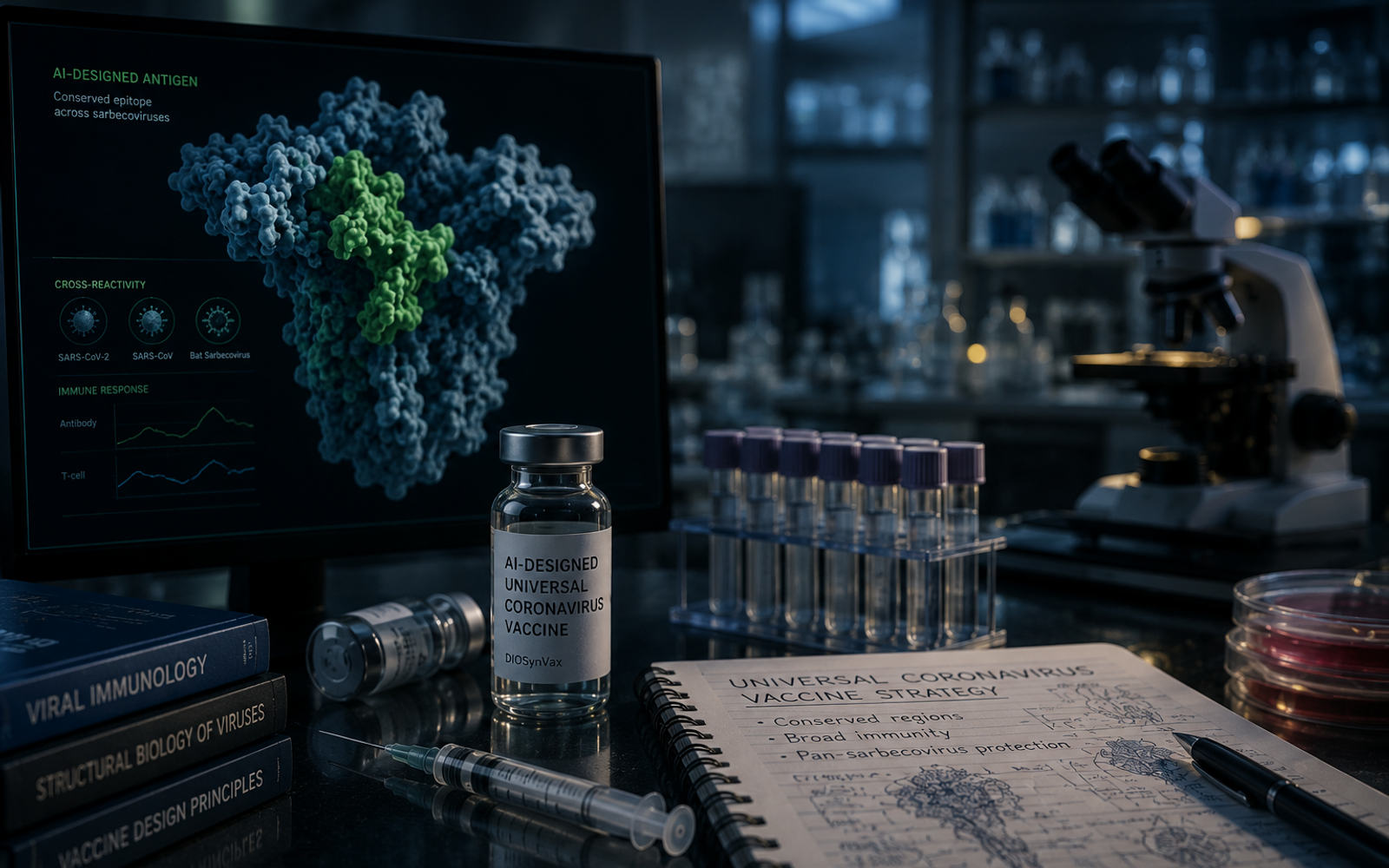
The vaccine is built around an antigen, a piece of the virus that the immune system learns to attack. Traditional vaccines hand the immune system a static image of one specific strain. When the virus mutates, that image becomes outdated, which is exactly what happened with the mRNA vaccines as Omicron and its descendants drifted further and further from the original Wuhan strain. The DIOSynVax approach is different. The AI analyzed the genetic sequences of known coronaviruses and identified regions that are structurally conserved across the family, parts of the virus that cannot mutate easily because they are essential for its function. The vaccine trains the immune system to target those stable regions instead.
That is elegant. It is also, from a computational biology perspective, genuinely novel. No vaccine whose active component was created entirely through computer simulations had ever been tested in humans before. That milestone matters. The 39 volunteers showed no safety signals that would stop the trial from progressing to Phase 2. And the immune response data, while preliminary, showed antibody and T-cell activity against multiple coronaviruses, not just the one circulating right now. If you have been following vaccine research for any length of time, you know how rare that is. Most universal vaccine candidates that look good in mice fall apart in humans.
What the Press Release Did Not Say
But here is where I ask you to slow down. The study was a Phase 1 trial, which means its primary goal was safety, not efficacy. That is standard. Nobody expected a 39-person study to prove the vaccine prevents infection. What you need to understand is what the immune response numbers actually looked like. According to the data collected during the trial, there was not a robust vaccine-induced increase in antibody responses beyond preexisting levels. In plain English, volunteers who already had antibodies from prior infection or vaccination did not see a dramatic boost from this shot. That is a problem. A universal vaccine that does not raise antibody levels meaningfully above what natural infection already provides is not a universal vaccine that will stop transmission.
The company and the researchers acknowledge this. They point out that T-cell responses, which are harder to measure but potentially more durable, did show broadening. And they are moving to Phase 2 with a larger group to test different dosing regimens, possibly with a booster strategy. That is the responsible thing to do. But you should know that the universal vaccine conversation has been haunted by exactly this pattern for years: promising T-cell data, modest antibody data, and then a Phase 2 or Phase 3 trial that fails to show protection against actual infection. I am not saying that will happen here. I am saying that if you read only the headlines, you would think we already have the pandemic-ending shot in hand. We do not.
The Long History of Universal Flu Vaccines
There is a parallel here that the press coverage has mostly missed, and it is worth sitting with for a moment. Researchers have been trying to build a universal influenza vaccine for more than a decade. The logic is identical: find the conserved parts of the flu virus, target those instead of the mutating head of the hemagglutinin protein, and produce a shot you take once every five or ten years instead of every fall. Billions of dollars have gone into that effort. The NIH launched a major universal flu vaccine initiative in 2018. Multiple candidates entered clinical trials. And almost all of them have struggled.
The problem is not designing the antigen. The problem is that the immune system, left to its own devices, does not particularly want to attack the conserved regions. It prefers the variable ones. Those are the parts it sees first, responds to most strongly, and remembers best. Training it to focus on the boring, stable parts of a virus requires either a very clever adjuvant, a very specific delivery system, or a dosing schedule that basically forces the immune system to pay attention. None of that is impossible. But it is much harder than the AI design step, which is the part everyone is celebrating this week.
The AI Halo Effect
I need to talk about the artificial intelligence piece directly, because it is producing a kind of halo effect that obscures what the technology actually contributed. The AI in this case was used to analyze genetic sequences and predict which structural features of the coronavirus spike protein were most conserved across different strains. That is a legitimate and valuable application of machine learning. It saved researchers months, possibly years, of trial and error in the lab. But the AI did not design the vaccine the way a human architect designs a building. It generated a shortlist of candidate antigens. Human researchers at Cambridge and DIOSynVax made the judgment calls about which ones to synthesize, how to formulate them, what delivery platform to use, and what adjuvant to pair them with. The AI was a tool, not a creator.
That distinction matters because the phrase AI-designed vaccine creates an expectation of infallibility. It suggests the machine has solved a problem that human intelligence could not. And maybe someday that will be true. But right now, the hardest parts of vaccinology, the parts that have tripped up universal vaccine efforts for decades, are still deeply human problems. How do you sustain immune memory over years, not months? How do you design a vaccine that works equally well in an 80-year-old and a 20-year-old? How do you induce mucosal immunity in the nose and throat, where coronaviruses first take hold, rather than just circulating antibodies in the blood? Those questions do not yield to pattern recognition algorithms. They require decades of immunological insight, and often, a fair amount of luck.
The AMR Elephant in the Room
I would be remiss if I did not mention what else happened in health news this week, because it puts the vaccine story in a different light. The World Health Assembly adopted an updated Global Action Plan on Antimicrobial Resistance, covering 2026 to 2036. This is the decade the world has shown about for years, the one where routine infections could become untreatable, where a simple scratch or a urinary tract infection could land you in the ICU. The WHO released new target product profiles for urgently needed antibiotics. The economic projections are staggering. Drug-resistant infections could kill 10 million people a year by 2050, more than cancer does today.
I bring this up because the contrast is instructive. A universal coronavirus vaccine is a beautiful piece of science. It addresses a threat that dominated global consciousness for three years and left an indelible mark on how we think about infectious disease. Antimicrobial resistance is a slower, quieter crisis. It does not produce dramatic spikes in daily death tolls. It does not shut down cities or dominate news cycles. But it is, by any honest measure, a more consequential threat to the average person walking into a hospital today. And it receives a fraction of the attention, a fraction of the funding, a fraction of the AI-driven innovation that COVID vaccines attracted.
What You Should Actually Watch
So where does that leave you, reading this on a Monday morning, trying to figure out which health stories deserve your attention this week? Let me offer a few guideposts. The DIOSynVax vaccine is real progress. You should know about it. You should understand that the AI component is genuinely novel and represents a step forward in computational vaccine design. But you should also hold the story at arm's length until Phase 2 data arrives, ideally from a trial that measures actual infection rates, not just antibody titers in a lab.
What you should pay more attention to, in my view, is the infrastructure question that neither the AI vaccine nor the AMR action plan fully addresses. We do not lack for brilliant ideas in biomedicine. We lack the systems to test them efficiently, manufacture them at scale, and distribute them equitably. The DIOSynVax vaccine was tested in 39 volunteers in a single UK hospital. That is where every promising candidate starts. But the gap between a Phase 1 result and a vaccine that actually changes population-level health outcomes is enormous, and it is filled with boring, expensive, unglamorous work: contract manufacturing, supply chain logistics, cold chain storage, community engagement, regulatory harmonization across countries.
You might remember that the first COVID vaccines went from sequence to authorization in under a year. That was not because the science was faster than usual, though it was. It was because governments poured unprecedented resources into manufacturing and distribution before the trials were even finished. They built the factory while the Phase 3 was still enrolling. They signed purchase agreements at risk. They created regulatory pathways that did not exist before. None of that happened by accident. It happened because the world decided, collectively, that the threat was urgent enough to warrant skipping the usual bureaucratic steps.
The Bet We Are Making
Here is what I keep coming back to. The universal coronavirus vaccine, if it works, would mean we never have to chase variants again. No more annual boosters tailored to whatever mutation emerged in Brazil or South Africa or India over the winter. No more desperate scramble to update mRNA sequences every few months. One shot, maybe two, and you are covered against the whole family of sarbecoviruses, including ones that do not even exist yet. That is the promise.
The bet the researchers at Cambridge and DIOSynVax are making is that the immune system can be trained to prioritize conservation over variability. It is a bet against decades of evolutionary biology, which suggests that the immune system evolved to chase the moving target, not to memorize the static background. It might be right. The T-cell data is genuinely encouraging. The computational approach is more sophisticated than anything that came before it. But I have watched enough universal flu vaccine candidates fail to feel easy about the odds.
You should also know that DIOSynVax is not stopping with coronaviruses. The company has a pipeline that includes candidates for seasonal flu, pandemic influenza threats, and hemorrhagic fever viruses. The same AI platform that designed the coronavirus antigen can theoretically be applied to any viral family. If this approach works, it changes the entire vaccine development paradigm. If it does not, we learn something important about the limits of computational immunology.
The Real News This Week
The most important health news this week was not the AI vaccine. It was the fact that 39 people volunteered for a clinical trial knowing the shot might not work, knowing they might get a placebo, knowing they would have to come back for multiple blood draws and follow-up visits. Clinical trial volunteers are the invisible infrastructure of every medical advance, and we do not talk about them enough. They take the risk so the rest of us do not have to. They show up for science at a time when trust in institutions is fraying and misinformation is rampant. That is the story that does not fit neatly into a headline.
The DIOSynVax vaccine will move to Phase 2. The world will watch. I will be watching too, with genuine hope and calibrated skepticism. If it works, it will be one of the most consequential biomedical advances of the decade. If it does not, the AI platform will still have value as a screening tool, and the researchers will go back to the drawing board with better data. That is how science works. It is slow. It is iterative. It does not lend itself to press releases.
You asked what to watch this week. Watch the Phase 2 enrollment. Watch how the company handles the antibody question. Watch whether governments start placing manufacturing bets before the efficacy data is locked. Those signals will tell you more about whether this vaccine changes the world than any headline about the AI breakthrough ever could.
--- *Disclaimer: This article is for informational purposes only and does not constitute medical advice. Consult a qualified healthcare professional before making any changes to your health regimen, supplements, or medications.*
Comments (0)
No comments yet. Be the first to share your thoughts.