The Flag Went Up. Now What?
Juneteenth gets its flag raising in 2026. The ceremony matters more than you think, and less than you hope.

The flag went up on a Tuesday morning.
Madison City Hall, if the schedule holds. June 2, 2026. A small crowd, some elected officials, a camera crew from the local news. Someone said a few words about freedom and progress and the long arc bending. Miss Annie Weatherbe Flowers got named as the reason we're even having this conversation, the person whose work planted Juneteenth where it now stands, rooted in our culture across the nation. News Conference: Juneteenth Flag Raising June 2, 2026
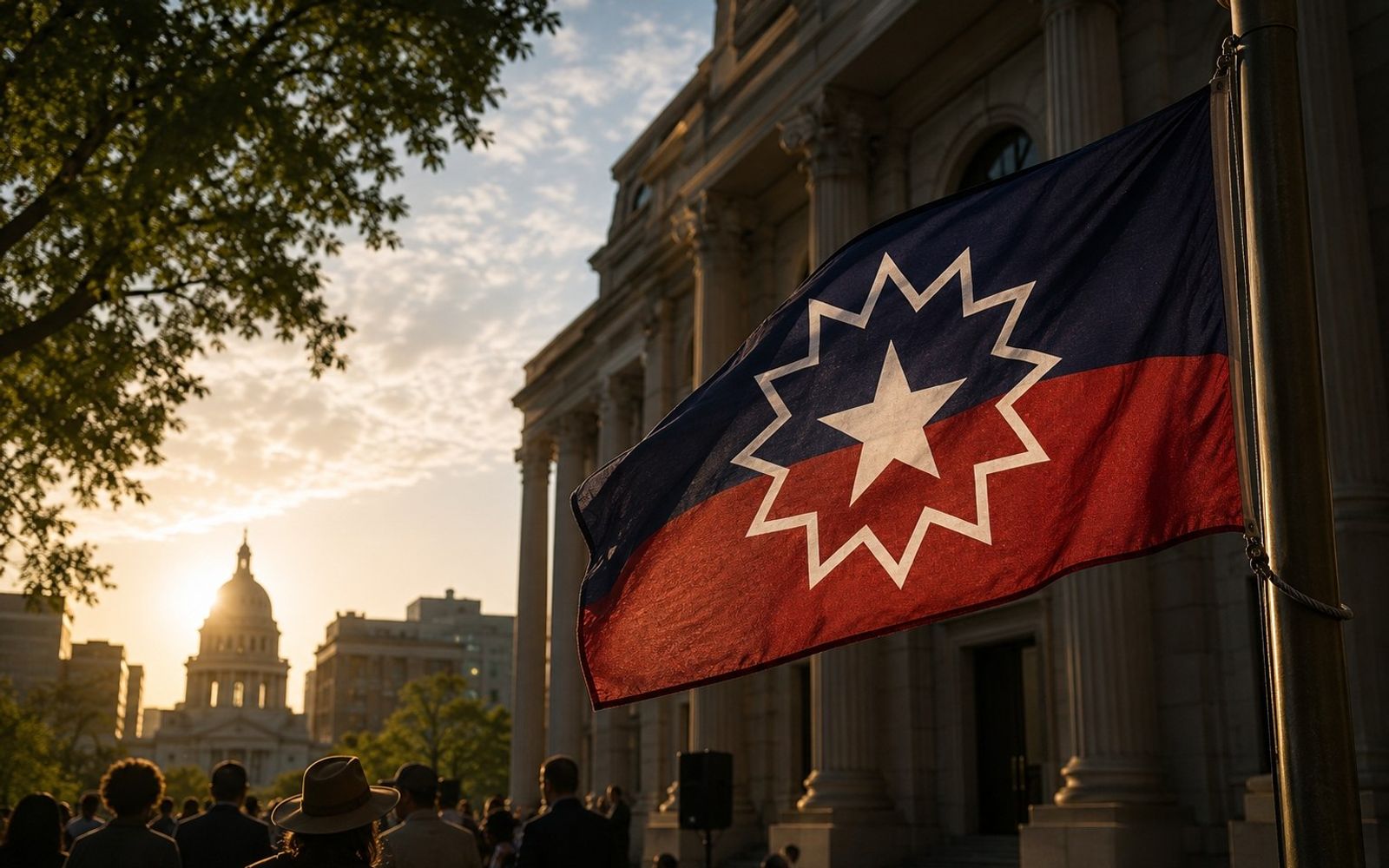
And then the flag. Red, white, blue. A bursting star in the middle. The same one that flies over statehouses and schoolyards and the occasional suburban front porch now, during that particular week in June.
I watched the video. Or rather, I watched a version of it, the press conference feed that the city channel put up. The audio was slightly blown out on the podium mic. Someone coughed right as the speaker hit the phrase "emancipation proclamation." It was mundane. It was bureaucratic. It was, somehow, exactly right.
But here's what got me. Not the ceremony itself. But the fact that this ceremony exists at all.
Juneteenth has been celebrated by Black Americans since 1866. The first one was a year after General Gordon Granger read General Order No. 3 in Galveston, Texas, telling enslaved people they were free. Two and a half years after the Emancipation Proclamation. Two months after the Civil War ended. That gap matters. The delay between the law and the news. Between what was written in Washington and what actually landed in Galveston. Between official freedom and lived freedom. That gap is the whole story.
And for 155 years, that story was mostly told in backyards and church basements and community centers. Not at City Hall. Not with a flagpole and a press conference and a scheduled time slot on the municipal calendar.
So the fact that it's now a city hall event in 2026. That tells you something. About how fast a thing can move, once it starts moving.
The flag has a designer, and a history
L.J. Graf designed the Juneteenth flag in 1997. She was an activist, a teacher, a person who understood that symbols carry weight. The star in the center is Texas, the place where it all broke open. The burst around it is a nova, a new beginning. The red, white, and blue aren't accidental. The flag echoes the American flag on purpose. This is not a separatist symbol. It's an incorporative one. We are here. We are part of this. Our freedom is American freedom.
That's the argument the flag makes, visually, every time it goes up.
And it's gone up a lot in the last five years. Juneteenth became a federal holiday in 2021. That was fast. Faster than any federal holiday in modern memory. Martin Luther King Jr. Day took 15 years of advocacy. Juneteenth took less than a year from the moment the conversation went national. The bill passed the Senate unanimously. Unanimously. In 2021. Think about that for a second. A Congress that couldn't agree on voting rights, on policing reform, on basically anything with a pulse, came together on Juneteenth. Juneteenth 2026 | Twinkl USA
And that unity was real. And it was also, maybe, a little too easy.
Because here's the thing about holidays. They let people feel good without doing much. You fly the flag, you post the graphic, you go to the cookout, you say the words. And then July comes, and the structural stuff is still sitting there, untouched. The wealth gap. The health gap. The education gap. The incarceration numbers that haven't budged. The voting restrictions that got tighter, not looser, in the years immediately following the holiday designation.
So what does it mean to raise this flag in 2026?
It means we've made real progress on the symbolic front. The culture war over whether Juneteenth should be acknowledged at all is functionally over. The people who complained about "critical race theory" and "woke holidays" lost that argument. The flag flies. The day is recognized. The cookouts are corporate-sponsored now.
But the gap between the symbol and the substance. That's still there. That's the same gap that existed between the Emancipation Proclamation and General Order No. 3. Between the law and the news. Between what the country says and what the country does.
Boston will raise its flag too
The event listing shows a Juneteenth flag raising in Boston on June 18, 2026. City Hall Plaza. Free admission. Kid friendly. History, meetup, community. Juneteenth Flag Raising Boston
Boston is a particular place for this. It's the city of abolitionist monuments and school desegregation battles and some of the most stubborn racial inequality in America. The Boston Public Schools system is still deeply segregated, by any measure you want to use. The wealth gap in Boston is among the worst in the country. White households in the city have a median net worth of about $247,000. Black households have about $8. That's not a typo. It's not a rounding error. It's a structure.
And the flag will go up anyway.
Which is not nothing. I want to be clear about that. The flag going up is real. It matters that children see it. It matters that the city acknowledges the history. It matters that Miss Annie Weatherbe Flowers' work got the national recognition it deserved. People fought for this. They bled for it. They organized and agitated and refused to let the story die. The flag is a monument to that fight.
But monuments don't fix things. They mark things. They say: this happened. This mattered. We remember.
And then you go home, and the rent is still due, and the school is still underfunded, and the health clinic is still closing. The flag doesn't change any of that.
So the question isn't whether the flag should fly. It should. The question is what we owe each other after it stops waving.
The timing slots into something larger
June 2, 2026. That's the press conference date. Two and a half weeks before the actual holiday on June 19. The early timing is strategic. It lets the flag sit there, in the public square, for the entire month. A visual reminder. A conversation starter. A thing people walk past on their way to work and maybe glance at and maybe think about for three seconds before their phone buzzes.
But the flag is also going up in a specific cultural moment. Look at what else is happening this week. Kim Petras released a new track. HorsegiirL is out here doing whatever horsegiirL does. Skrillex is still Skrillex. The Pitchfork Selects playlist dropped. Beastie Boys' Mike D is lining up a debut album. Stormzy is remembering a killed Grammy winner. Idris Elba told the world not to make James Bond woke, which is a sentence that means something specific about where we are right now.
And John Lithgow and Lesley Manville won Tony Awards. That's the other headline. The culture is doing what it always does. Moving in every direction at once. Being silly and serious and commercial and political and completely incoherent.
Into that noise, the flag goes up.
And it doesn't compete. It doesn't need to. It's operating on a different register. The music and the movies and the awards shows are the bloodstream of the culture. The flag is the skeleton. It doesn't move much, but without it, nothing holds its shape.
The word "emancipation" carries a longer tail
The reason Juneteenth matters, the reason it caught fire the way it did in 2020 and 2021, is that it tells a specific story about freedom. Not freedom as an idea. Freedom as a process. A delayed, messy, incomplete process.
General Order No. 3 said enslaved people were "absolutely free." But the document also told them to stay where they were and work for wages.
Freedom with conditions. Liberation with a leash. That's the part that doesn't make it onto the commemorative posters.
The people in Galveston didn't wait. They left. They walked. They found family. They built communities. They took the word "absolutely" and made it real through action, because the paper alone couldn't do it.
And that's the tradition the flag is picking up on. Not the paper. The action. The decision to make something real that the system only half-delivered.
So when the flag goes up in Madison on June 2, and in Boston on June 18, and in a hundred other cities across the country, it's not just a ceremony. It's a continuation. A statement that freedom still isn't finished. That the process is still open.
I wrote about this tension last year
I spent a column on the difference between holidays and policies. Between what we celebrate and what we fund. Between the budget line for the Juneteenth parade and the budget line for the public school that serves the neighborhood the parade goes through.
Someone wrote me an angry email. Said I was being cynical. Said I was ruining a good thing by asking for more.
Maybe. But I don't think wanting more is cynical. I think wanting the flag and the policy is the minimum.
Because here's the math. Juneteenth is one federal holiday and 28 state holidays. That's real progress. But the racial wealth gap hasn't narrowed. Black homeownership rates are roughly where they were in 1968, the year the Fair Housing Act passed. The gap between Black and white unemployment rates has been stubbornly consistent across administrations of both parties. None of these things are fixed by a day off.
And they won't be fixed by a flag, either.
But the flag is a start. A start is not a finish. A start is not a substitute for the rest of the work. But a start is a start. And you can't get anywhere without one.
The ceremony matters because it's public
One thing I've learned watching culture cycles for too long. Private belief is cheap. Public commitment is expensive.
A city holding a flag raising is a public commitment. It costs money. It costs staff time. It costs political capital if someone decides to complain about it. The fact that cities are doing it anyway, in 2026, after the initial wave of 2020 energy has receded and the news cycle has moved on to other things. That means something.
It means the flag is not a trend. It's an institution now. It's rooted, as the speaker at the press conference said. Rooted across our nation.
And institutions are hard to kill. They stick around even when the people who built them have moved on. They become part of the furniture. Part of the background. Part of what you expect to see.
That's the power of the flag raising. It makes Juneteenth visible. It makes it normal. It makes it just another thing that happens in June, like Pride and Father's Day and the first heat wave.
Read Also
Wearable Tech Walks the RunwayAnd normalization is a kind of victory. A quiet one. A boring one. The kind that doesn't make headlines because there's nothing controversial about it anymore.
But boring is durable. And durable is what lasts.
Miss Annie Weatherbe Flowers and the people who built this
The press conference mentioned her. Miss Annie Weatherbe Flowers. The name you probably don't know, unless you're deep in the Juneteenth advocacy world. She's one of the people who pushed this forward when it wasn't popular. When it wasn't a federal holiday. When it was just a community thing that some people in Texas did and most of the country had never heard of.
She kept showing up. Kept organizing. Kept calling city council members and state legislators and anyone who would listen. For years. Decades. That's the part that doesn't make the ceremony. The long slog. The meetings that went nowhere. The rejection letters. The polite nods from people who had no intention of doing anything.
And then, suddenly, everyone wanted a Juneteenth celebration. And Miss Annie Weatherbe Flowers was there, still showing up, still organizing, still making sure the flag went up the right way.
That's the real story. Not the ceremony. The people who made the ceremony possible by refusing to give up during the years when nobody was watching.
What to watch this week
The flag goes up on June 2. It will be on the local news. It will get a segment, maybe two. People will post about it. The algorithm will serve it to people who already agree.
And then June 3 will come, and something else will happen, and the flag will still be there. Flying. Visible. Waiting for the rest of the month.
That's the part I want you to pay attention to. Not the moment of the raising. The moment after. When nobody's watching. When the press conference is over and the camera crew has packed up and the elected officials have gone back to their offices. The flag is still there. Still red, white, blue. Still with the bursting star. Still making its argument about who belongs here and what freedom means.
That's the test of whether a thing is real. Not whether people show up for the ceremony. But whether it stays up when nobody's looking.
And so far, it's holding.
Comments (0)
No comments yet. Be the first to share your thoughts.