The Internet Made Mbappé a Dictator. Football Made It Believable
It started with a kebab. It ended up in stadium stands, on Spotify, and in IShowSpeed's confused face. The Dictator Mbappé meme is the funniest thing happening at the 2026 World Cup and the most honest.

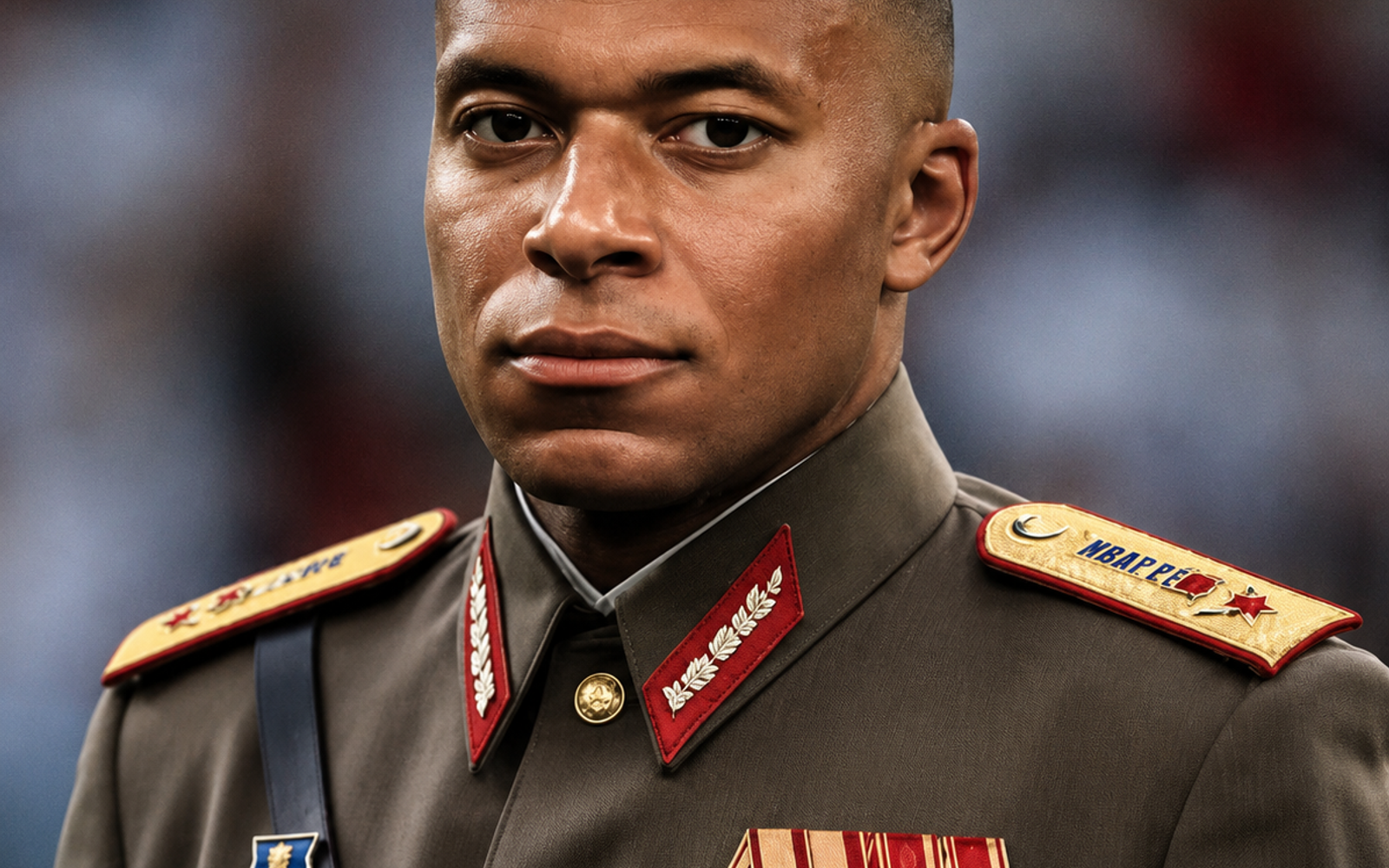
If you've been anywhere near social media in the last few weeks, you've seen it. Kylian Mbappé in a military uniform. Mbappé reviewing troops. Mbappé issuing decrees from behind a podium. Coaches getting "fired" at his command. Players being "exiled" to lesser clubs on his orders. IShowSpeed, arguably the loudest man alive, standing in a stadium in Kansas City completely baffled by a fan in a full military costume with "Mbappé 10 Dictator" stitched across the back.
The Dictator Mbappé meme is having its biggest moment at the 2026 FIFA World Cup. And unlike most internet jokes that burn bright and vanish, this one has been quietly building for two years. It has a song. It has merchandise. It has its own Know Your Meme page with a full timeline. It crossed from the internet into actual football stadiums.
More importantly, it's actually saying something true.
It Started With a Kebab. Genuinely.
All great myths start somewhere unexpected. This one starts in Marseille, with bread.
In March 2024, Mohamed Henni, a French influencer with over two million Instagram followers and a significant talent for winding people up, described his Klub kebab as being made with bread "as round as Mbappé's skull." Light banter. The kind of harmless joke that gets ten seconds of attention and disappears.
Mbappé's legal team did not see it that way. They sent Henni a formal legal notice demanding he remove the football star's name from the sandwich description.
Henni's response was the match that lit the fire. "He filed a complaint against me for that. For a kebab," he said publicly. "Mbappe, he's turned his name into a dictatorship."
That single word was all the internet needed. From that moment, an image was born: Kylian Mbappé not as a footballer, but as a man who controls everything around him, who silences critics, who cannot tolerate even the mildest joke at his expense.
The first edit of Mbappé as Mao Zedong appeared on Reddit shortly after. It got about 112 upvotes. Almost no one noticed. But the seed was planted.
The PSG Years Gave It a Foundation
The kebab incident landed so easily because the material was already there. Football fans had been quietly building a case against Mbappé's power long before Henni ever described his bread.
During his final years at Paris Saint-Germain, reports circulated regularly about Mbappé's extraordinary influence at the club, over transfers, over wages, over the composition of the squad itself. His 2022 contract extension, which kept him in Paris despite intense interest from Real Madrid, came attached to stories of demands that would make most boardrooms uncomfortable. Signing bonuses. Approval over signings. Loyalty payments. The specific details were disputed. The general shape of them was not.
Then there were the on-pitch moments. His PSG manager Luis Enrique publicly criticised him for ignoring tactical instructions. Footage circulated of him appearing to snatch the captain's armband. A general sense built up through dozens of small incidents that Mbappé operated by his own rules and that clubs arranged themselves around him rather than the other way around.
None of this necessarily made him a villain. Elite players have always wielded unusual power. But it made him an irresistible character for a very specific kind of internet joke, the kind that is only funny because everyone already suspects it might be slightly true.
Real Madrid Handed the Meme Its Best Evidence
The meme needed a second act. Real Madrid provided several.
In January 2026, the club parted ways with manager Xabi Alonso. The timing was brutal. Alonso had been considered one of the most exciting managerial talents in Europe, and the split came after a turbulent period of internal divisions within the squad. Reports from Spanish outlet COPE claimed the dressing room had fractured into two camps, one group unhappy with the club's direction, another rallying behind the manager. Mbappé was reportedly in the second group.
What handed the internet its moment was a video that circulated showing Mbappé appearing to refuse Real Madrid a guard of honour. That clip, combined with the Alonso exit, was enough. The meme erupted.
"Mbappé got Alonso fired" became the headline. Whether it was true or not barely mattered, and even the more measured reports suggest it probably wasn't. But there's a specific rule of the internet that the Dictator Mbappé meme discovered early: a rumour that fits a narrative perfectly will spread faster than a correction ever will. The Alonso incident added a coach to the list of people who had apparently crossed the Dictator and paid for it.
In early April 2026, a TikTok edit placing Mbappé at the centre of Real Madrid's chaos racked up 13.2 million views in two weeks. That video didn't just spread the meme. It professionalised it. After that, the format became a template anyone could use.
TikTok and AI Turned It Into Its Own Genre
The interesting thing about the Dictator Mbappé meme is how quickly it developed its own visual grammar.
The early edits were simple, stock images of Mbappé's face pasted onto historical dictators. Mao, Kim Jong-Un, Gaddafi. Crude but effective. Then creators started building actual narratives. Mbappé in a war room. Mbappé reviewing transfer lists like military intelligence dossiers. Players being summoned and then exiled depending on whether they served the regime's interests.
AI image generation turbocharged all of it. Suddenly creators could produce genuinely cinematic edits, Mbappé in full general's regalia, surrounded by medals, reviewing a list of opponents who had been eliminated from the World Cup. The production quality went up. The jokes got sharper.
Then came the music. In April 2026, content creator SurNevis released "Kylian Mbappe Dictador Anthem" on streaming platforms. It was absurd. It was also genuinely catchy, apparently, because the track passed a million listens on Spotify. A football meme had generated a minor hit song. That is not a normal thing.
By the time the World Cup started, something had shifted. The meme was no longer just a Twitter joke. It was a genre.
The 2026 World Cup Made It Inescapable
France's run at the 2026 World Cup did not hurt the meme's momentum. It accelerated it enormously.
Mbappé arrived in North America with a point to prove after a difficult first full season at Real Madrid. He responded the only way he knows, by being devastatingly good at football. Eight goals. Three assists. Eleven total goal contributions in a single tournament, the most by any player since Gerd Müller in 1970. France dispatched Iraq, Senegal, Norway, Sweden, Paraguay and Morocco on their way to the semifinals, with Mbappé at the centre of almost every important moment.
The better he performed, the bigger the joke got. Because the Dictator meme runs on the same engine as his football. Dominance. Every match France won became new evidence. Every opponent eliminated was another victim of the regime.
Fans started turning up to matches in costume. Real military-style outfits with "Dictator Mbappé" printed across the back. One fan wearing exactly that caught IShowSpeed's eye during the Argentina vs Switzerland quarterfinal. Speed, streaming live to millions, had genuinely never heard of the meme. His confusion, "What the hell? What does that even mean?", became its own moment. The Dictator had now claimed one of YouTube's biggest streamers as collateral.
Some of Mbappé's own teammates reportedly got involved too. In the French dressing room, a few players apparently began jokingly calling him "Mobut", a playful nod to former Congolese leader Mobutu Sese Seko. Even Didier Deschamps got pulled in, issuing a formal denial to the press that Mbappé acts like a dictator within the squad. A head coach, at a World Cup, publicly clarifying that his captain is not a tyrant. Football had become genuinely surreal.
Why This Meme Has Legs Every Other Football Joke Doesn't
Football memes usually survive about one news cycle. Dictator Mbappé has now lasted two years, one club transfer, one managerial sacking, one World Cup, a Spotify anthem, and IShowSpeed's very public confusion about all of it.
The reason is simple. The joke is actually about something.
Most player memes are purely aesthetic, a funny face, an awkward celebration, a moment of bad luck. They're funny because they're embarrassing, and embarrassment has no staying power once the moment passes. Dictator Mbappé is different because it's built on a genuine cultural observation about where football power actually lives now. The idea that elite players, not owners, not coaches, not club presidents, are the real decision-makers in the modern game is not a joke. It's uncomfortable. It's contested. And Mbappé, more than almost any other current player, embodies that shift.
The meme gives fans a way to talk about that discomfort without having a serious argument about it. It lets them say what they're actually thinking, that maybe one man has too much influence over too many outcomes, while still laughing about it.
That is why it survives every debunking. That is why a rumour about Alonso spread faster than the correction. The joke is not really about Mbappé being a bad person. It is about football fans processing something that genuinely makes them uneasy, through the only tool the internet reliably provides: a very good edit and an increasingly good song.
The Dictator didn't ask for this meme. He may not even like it. But he plays football like someone who controls everything around him. And the internet noticed.
Frequently Asked Questions
Who started the Dictator Mbappé meme?
It traces back to French influencer Mohamed Henni, who publicly called Mbappé a dictator in 2024 after receiving a legal notice over a kebab sandwich he'd named after the footballer. The earliest visual edit appeared on Reddit shortly after, but the meme didn't go mainstream until TikTok picked it up in early 2026.
Did Mbappé ever respond to being called a dictator?
Not directly or publicly. He hasn't addressed the meme by name. His manager Didier Deschamps issued a denial during the 2026 World Cup, insisting Mbappé's public image doesn't reflect how he actually behaves within the France squad. A rumour that Mbappé personally disliked the meme spread in April 2026 and triggered a Streisand Effect, causing another surge in Dictator edits almost immediately.
What is the Dictator Mbappé Anthem?
In April 2026, content creator SurNevis released "Kylian Mbappe Dictador Anthem" on streaming platforms. It's a satirical track built around the dictator persona and has crossed a million listens on Spotify, making it one of the rare cases of a football internet meme actually crossing over into music.
Is the Dictator Mbappé meme meant to be negative?
It started as criticism, using the dictator framing to mock his legal action against Henni. Over time it evolved into something more ironic, even affectionate in places. Many fans now use it to celebrate his dominance rather than criticise his character. The meme has become flexible enough to carry different meanings depending on context, which is largely why it has lasted this long.
Will the Dictator Mbappé meme survive after the World Cup?
Almost certainly. Unlike most football memes tied to a single moment, this one is built around a character, a fictional version of Mbappé that fans can apply to any new situation. As long as he keeps playing at this level and making decisions that attract attention, the internet will keep finding new ways to update the narrative. The Dictator doesn't retire just because the tournament ends.
Comments (0)
No comments yet. Be the first to share your thoughts.