The Personal Branding Playbook Has Flipped. Here's What Works in 2026.
Micro-influencers and niche experts are winning where polished generalists lose. Three tactical moves for everyday builders.

A fashion house in Milan scans Instagram for leather craftsmanship. They find a creator with 4,200 followers. She lives in Nairobi. She posts about stitching techniques in Swahili and English. She has never accepted a sponsored post. They send her a contract anyway. Why? Because her audience buys what she recommends, and their trust runs deeper than any algorithm can manufacture. A few blocks over, a creator in Lagos with 320,000 followers and a perfectly curated feed struggles to land a single paid collaboration. Something shifted. The metrics that defined success in 2023 don't move the needle in 2026.
The Old Metrics Are Misleading You
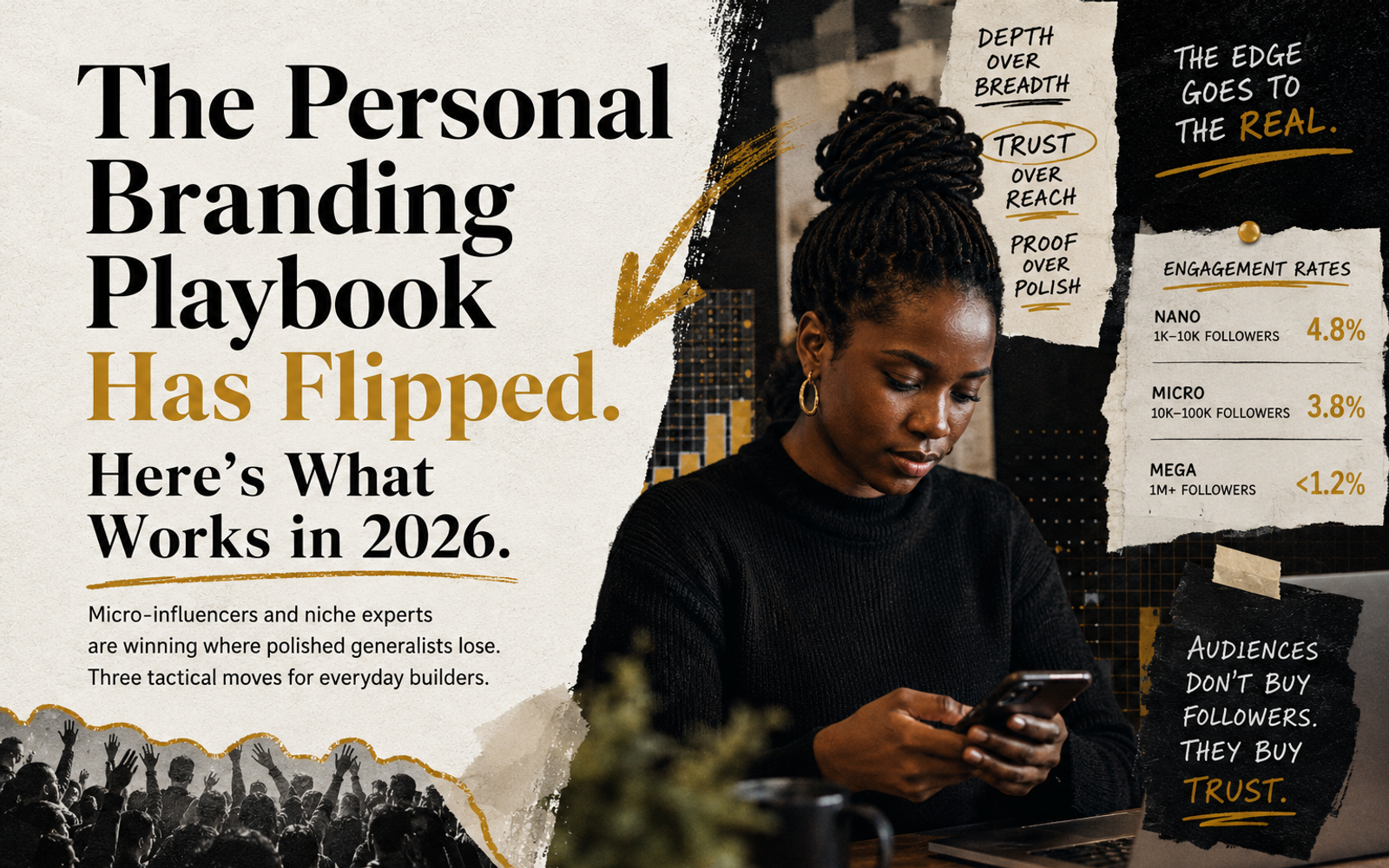
Follower count has become a vanity number. Industry data shows that creators under 100,000 followers now drive 76% of total engagement. Mega-influencers with millions of followers? Their engagement rates hover below 1.2%. The math isn't subtle. A creator with 15,000 followers who posts about one thing well can move product faster than a celebrity who posts about everything vaguely. What changed? Audiences got tired. They got skeptical. They learned that a polished feed often hides a hollow core. The personal branding game in 2026 rewards depth over breadth, specificity over reach, and proof over polish. The Leadership Visibility analysis of personal branding in 2026 confirms that authenticity and digital footprint now outweigh presentation. The facade is done.
The Death of the Generalist Influencer
Read Also
Wearable Tech Walks the RunwayFor years, the playbook was simple. Pick a broad niche. Post consistently. Grow your follower count. Monetize. That playbook now loses money. The Authority Exposure news analysis describes the death of the "influencer" as the market knew it. The term itself carries baggage now. It signals performance, not passion. Audiences can smell a brand deal from a mile away, and they flinch. Instead, the winners in 2026 are the ones who never called themselves influencers in the first place. They're accountants who post tax tips for freelancers. They're mechanics in Kumasi who film engine repairs and explain why a part failed. They're bakers in Berlin who show the burn marks alongside the perfect croissants. The niche isn't a constraint. It's a filter. It repels the wrong people and attracts the right ones. And when the right ones trust you, they don't haggle on price. Think about what that means for your own brand. Are you trying to speak to everyone? You're probably connecting with no one.
The African Creator Economy Proves the Point
This isn't a Silicon Valley story. The shift toward niche trust over broad reach is playing out most visibly in markets where creators never had the luxury of pretending otherwise. According to the Lionesses of Africa analysis of personal branding shifts in 2026, the emerging consensus is that identity is equity. In markets like Nigeria, Ghana, Kenya, and South Africa, creators built audiences on WhatsApp groups and Telegram channels before they ever touched Instagram. Their communities came first. The platform was secondary. A creator in Accra who runs a thread on Twitter Spaces about fintech regulation doesn't need a million followers. She needs the 400 people who attend every session, who ask questions, who share the thread, who trust her enough to act on her recommendations. That trust is capital. It compounds. And it doesn't require a blue checkmark or a studio lighting kit. The Diglancers analysis of African creators securing international brand deals shows that brands are increasingly bypassing the big accounts to find creators with real community heat. The old gatekeepers are losing their grip.
Three Moves That Actually Work in 2026
Here's what the shift looks like in practice. Stripped of theory. Ready to execute.
shrink your lane. If you help "small businesses grow online," you're competing with 40,000 other people. If you help "bakery owners in Lagos who want to stop running Instagram ads and start using WhatsApp for sales," you're one of maybe five people. Pick a narrow enough lane that you can be the best in it. Then own it so completely that nobody else wants to compete.
show the process, not just the product. A graphic designer who posts finished logos gets likes. A graphic designer who posts the three failed drafts before the final logo, and explains why each one failed, gets clients. The 2026 audience rewards vulnerability when it serves a purpose. Not confessional vulnerability for its own sake, but the kind that teaches. That reveals craft. That demystifies a skill. That kind of posting builds authority because it proves you know what you're talking about.
measure depth, not reach. Track how many people respond to your posts with thoughtful comments rather than emojis. Track how many DMs you get asking for advice. Track whether your audience can complete the sentence "The person I follow posts about ______." If they can't finish that sentence in one or two words, your brand is too diffuse. Narrow it. The David Solomon article on NovaRift touched on something similar: sometimes the most valuable move is saying the quiet thing out loud. In personal branding, the quiet thing is that your niche needs to hurt a little. It needs to exclude some people. If nobody is annoyed by your brand, nobody is devoted to it either.
The Trust Premium Is the Only Premium That Matters
Here's the uncomfortable truth the data keeps confirming. Audiences in 2026 have less attention and more skepticism than any previous cohort. They've been sold to by influencers who didn't use the products. By brands that greenwashed. By gurus who never built anything real. They're inoculated against the hard sell. The only advantage left is trust, and trust can't be hacked. It can't be bought with a bigger ad budget. It can't be faked for long. Trust is built slowly, one interaction at a time, and it compounds like interest. The creator who answers every DM, who admits when she doesn't know something, who recommends a competitor's tool when it's the right call, who posts consistently for three years without a single viral post, that creator wins the long game. The viral poster burns hot and fades. The trusted creator builds an asset that appreciates.
The Edge Goes to the Real
A quick look at the numbers confirms the direction. Nano-influencers with 1,000 to 10,000 followers average engagement rates above 4.8%. Micro-influencers with 10,000 to 100,000 followers hover around 3.8%. Mega-influencers with over a million followers? Below 1.2%. The gap isn't small. It's a chasm. A creator with 5,000 followers who posts three times a week about one specific topic can generate more meaningful engagement than a celebrity with two million followers posting daily. That math changes everything. It means the barrier to entry for personal branding is lower than it's ever been, but the barrier to building trust is higher. Anyone can start posting. Not everyone can earn the attention of an audience that actually buys what they recommend.
The Trap You Need to Avoid
The biggest mistake builders make in 2026 is treating personal branding as a marketing exercise. They hire a content strategist. Commission a photoshoot. Write a polished LinkedIn bio. And wonder why nobody cares. The problem is that personal branding isn't a marketing problem. It's an identity problem. You can't manufacture authenticity. You can only uncover it. The question isn't "What content will perform best?" The question is "What do I know that other people need to learn, and am I willing to say it out loud even if it's unpopular?" A cobbler in a market stall in Kumasi who posts daily videos about shoe repair and leather care has a stronger personal brand than most executives with ghostwritten LinkedIn posts. Why? Because the cobbler has skin in the game. He works with his hands. He shows his work. He is his brand. There's no gap between who he is and what he posts. That gap is what kills most personal branding efforts. The audience senses the gap. They can feel it. And in 2026, they have zero tolerance for it.
Comments (0)
No comments yet. Be the first to share your thoughts.