The Boring Company's $3B Says Less Than It Looks
A UAE-led $3bn tunnel round is being read as proof that patient capital is back. The deal structure points somewhere narrower.

You have a deck that shows revenue in year four and a build timeline that runs to 2033, and every investor meeting ends with the same polite note about capital intensity. Then news lands that a tunneling company raised $3 billion before it has a single Loop carrying paying passengers outside one American convention corridor, and it's easy to read that as proof you're playing the wrong game.
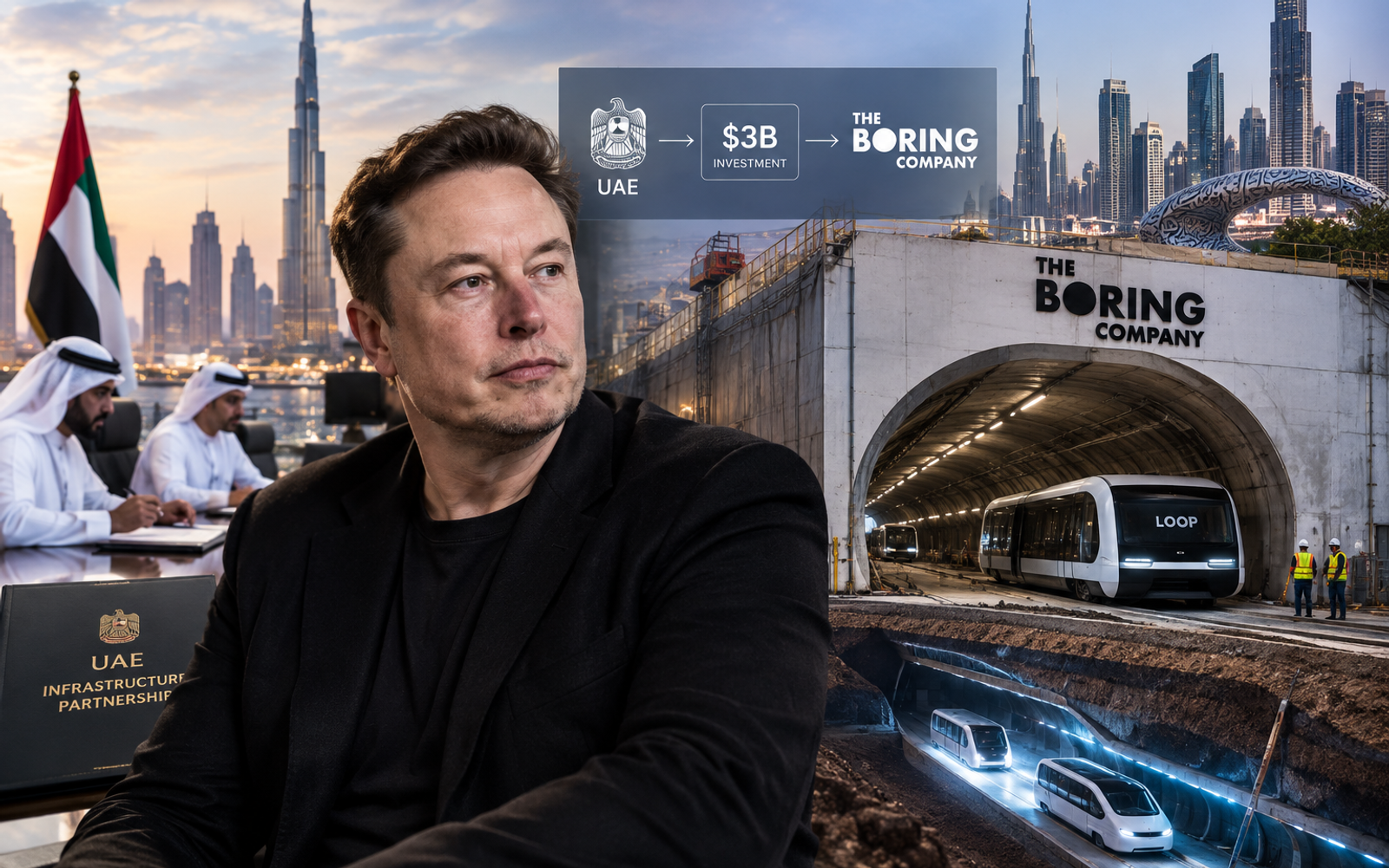
More useful than the size of the round is its shape. The Boring Company's Series D, announced in the second week of September at a $23 billion valuation, says less about capital-hungry startups in general than about one company's relationship with one government that badly wants its product built.
What the $3 Billion Actually Bought
According to Reuters, the round was led by the United Arab Emirates and affiliated investment entities, with Human Capital, Vy Capital, Valor Equity Partners, Sequoia Capital, Andreessen Horowitz, Temasek, Shamal Holding and Baron Capital participating alongside other new and existing investors. The proceeds tie to a partnership covering more than 150 kilometers of underground infrastructure across the UAE, roughly 93 miles, building on the Dubai Loop agreement the company reached with Dubai's Roads and Transport Authority. That's a national programme, not a product launch.
Then note that the round came in under target. The Wall Street Journal reported in July that the company was hunting as much as $4 billion, and it closed at $3 billion, as TechCrunch reported. Even with the most recognisable founder alive, in a strong stretch for mega-rounds, the ask got trimmed. That detail matters more to you than the headline number does.
When the Buyer and the Backer Are the Same Government
The popular reading of this deal is that sovereign capital has now blessed underground transit as a global default, which would make every tunnel-adjacent business more fundable. Sovereign funds aren't pricing a global default. They're pricing alignment with a national plan, and the UAE has spent years stating its intention to move people and freight beneath its cities.
Here the entity writing the cheque is also the entity awarding the tunnel contract, which makes this closer to a prepaid infrastructure order with an equity component attached. Sequoia and Andreessen Horowitz appear on the cap table, but the anchor sets the terms and the American firms travel with it. You can call that a venture round. It behaves like procurement with a shareholder register.
The demand picture outside the Gulf is also less settled than the tone of the coverage suggests. CNBC reported that Nashville fast-tracked its project, that a partisan fight followed, and that a Vanderbilt University survey in March found most residents didn't want the tunnels in their city. Whether those residents are right isn't the point. A city that still needs convincing is a different customer from a country that has already committed.
Why This Round Says Nothing About Your Chances
Ask yourself one question before you take encouragement from any mega-round. Can you name the institution that has signed to pay you? If you can, another company's $3 billion tells you something about your category. If you can't, that round is entertainment, and treating it as momentum is how founders spend eighteen months pitching a story no buyer has agreed to fund.
The valuation arithmetic tells its own story. Reuters notes the company was valued at $5.7 billion in 2022 after a $675 million round. Four years later it sits at $23 billion, roughly four times the price, on a revenue base that still rests on one convention corridor and a handful of hotel stops. Operating performance doesn't produce that multiple. A signed national contract does.
It's tempting to read one enormous round as the top of a rising tide, because that's how the last cycle felt. Rounds getting done at this scale cluster around a handful of names with unusual access to capital, whether that's a government partner, a founding team with an existing track record, or a category the market has already decided to believe in. Your position relative to that group probably hasn't shifted this month, and no headline will shift it on your behalf.
So the useful work isn't studying the round. It's auditing your own structure. Who is your anchor customer, what have they committed in writing, and how much of your next twelve months of revenue depends on a single relationship? The discipline that answers those questions looks a lot like the judgment operators lean on when the tools get cheaper, and nothing like a fundraising playbook.
The One Piece of the Deal You Can Copy
There's a smaller, portable version of this, and it's the pre-commitment. The Boring Company negotiated its Dubai agreement with the Roads and Transport Authority before it raised the money to build, then raised against an arrangement with a known customer. You can run that sequence at almost any scale, and it's the only part of this story worth imitating.
Read Also
The Cape Is the New Coat, Here’s WhyIf your buyers are city councils, utilities, hospital groups, mining operators or national agencies, your first serious meeting shouldn't be with a fund. It should be with the procurement office, because a letter of intent, a pilot purchase order or a paid feasibility study turns an intention into an asset an investor can underwrite. It also tells you whether the problem is real before you sink two years into solving it.
There's a second habit worth stealing, which is how the company framed its ask. It didn't sell a finished network. It sold machines and a method, its Prufrock boring units and a delivery timeline, into a buyer that had a problem the method addressed. If you're selling into institutions, lead with the specific operational cost you remove and what that cost is today.
Gulf funds deserve attention because their deployment capacity dwarfs what most venture partnerships can write, and infrastructure is where they prefer to put it. The same playbook works with a county government in Kenya, a state transport body in India, or an industrial buyer in Germany working under a decarbonisation mandate. Strategic buyers show up everywhere, and they respond to specifics rather than to a market-size slide.
Where This Leaves the Builder With the 2033 Timeline
For the builder with the long timeline and the empty pipeline, $3 billion changes nothing about your odds. It went to a company that had already arranged its buyer, accepted a round smaller than it asked for, and handed its lead investor a role that doubles as its largest customer. Those are strong terms for a tunnel network and a weak trade for anyone measuring success by the headline number. What you can borrow is the order of operations: get one institution to commit in writing first, then let that commitment, rather than a narrative, set what your business is worth.
Comments (0)
No comments yet. Be the first to share your thoughts.