The $1 Trillion Mobile Money Shift Banks Can't Ignore
Mobile money crossed $1 trillion in African transactions. The battle over who turns that volume into profit is just beginning.

Sub-Saharan Africa's mobile money platforms processed more than $1 trillion in transactions in 2025, according to GSMA industry tracking, and the corridor keeps accelerating. Forecasts put Africa's mobile payments market at $198.8 billion in transaction value for 2026, a 22% jump that follows five years of compounding at 27.8% annually, with growth settling toward a 16.8% compound rate after that. The volume matters less than what sits behind it. The largest expansion of financial access in modern history is being built almost entirely outside the licensed banking system, by telecom companies, payment startups, and increasingly by crypto settlement rails no central bank chartered.
The Trillion Dollar Corridor Banks Didn't Build
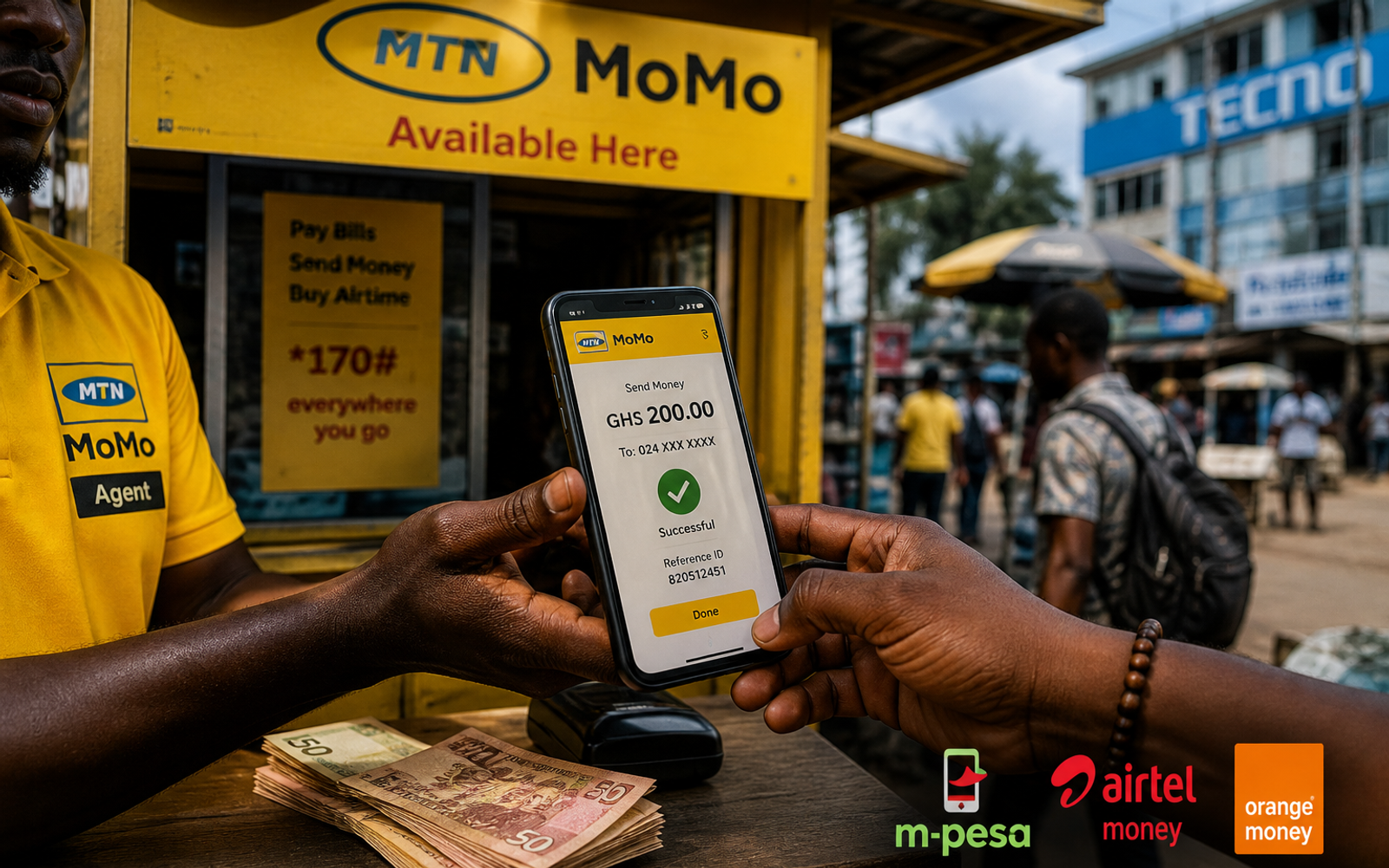
The GSMA counts 1.1 billion registered mobile money accounts in Sub-Saharan Africa, more than half of the world's total. M-Pesa, MTN MoMo, Airtel Money and Orange Money anchor that network, each processing billions of dollars a year and functioning as de facto banks for customers who may never have held a debit card. Market forecasts put the African mobile money market at $9.18 billion in 2025, rising to $67.18 billion by 2034, a compound annual growth rate of 25.3%. South Africa's broader fintech market runs a similar curve from the formal end of the spectrum, moving from $1.14 billion in 2025 toward $4.02 billion by 2034 at 14.61% growth.
Those numbers describe two disruptions happening at once. In East and West Africa, mobile money replaced cash as the primary medium of exchange for hundreds of millions of people, and the banks never captured the customer relationship in the first place. In South Africa, a mature banking market with deep branch penetration, fintech is forcing incumbents to compete on product speed and pricing for the first time. The shared result is that the customer's primary financial interface is no longer a bank branch or even a bank app. It's a phone number.
The World Bank's Findex research has tracked this shift directly, showing mobile money as the main driver of account ownership gains in Sub-Saharan Africa over the past decade. The distinction that matters is that most of those accounts were opened outside banks, on telco rails, which means the traditional industry watched its most important growth market develop without ever controlling the onboarding.
The Profitability Reckoning Arrives
The clearest sign that the model has matured is Flutterwave's trajectory. The payments company announced in June that it had surpassed 1 billion transactions and $40 billion in cumulative payment value, and CEO Olugbenga Agboola told Bloomberg Next Africa that the company is on track to achieve profitability. That statement would have been unremarkable in most markets, but for a decade the African fintech story ran on growth at any cost, with revenue treated as a rounding error next to user counts.
The capital market has stopped subsidizing that approach. African tech startups raised $260 million in the second quarter of 2026, down 40% from the same period last year, according to funding trackers. The concentration is even more telling. In July, 47 startups raised $102.2 million across disclosed deals, and the top ten recipients took $88.85 million of it, roughly 87 cents of every dollar invested on the continent. Venture capital has effectively decided that the corridor's economics belong to a small number of scaled operators, and everyone else needs to prove they can reach profitability without another round.
The same repricing played out in Europe and Latin America between 2023 and 2025, where consumer neobanks that raised at growth valuations spent two years proving they could earn a return on deposits. Africa's version arrives later but with a cleaner setup, because the transaction volume is real and the cost base was digital from day one. Total African tech funding reached $4.1 billion in 2025, a 25% recovery from the funding winter of 2023-2024, but the 2026 numbers show that recovery is narrow rather than broad. The discipline now shows up in the details: Series A rounds closing on audited accounts and functioning board structures, investor participation up 7% even as diligence standards tighten, and founder language shifting from market share to unit economics. Volume has won. The battle now is over who converts it into profit.
The Stablecoin Bypass
The most consequential development is where mobile money meets crypto rails. Sending $200 from Sub-Saharan Africa still costs nearly 9% in fees, among the highest remittance price tags in the world, because the correspondent banking network that settles cross border payments is slow, layered, and priced for institutional flows. A cluster of startups including Kotani Pay, Fonbnk and Accrue is building API layers that connect stablecoin settlement directly to M-Pesa, MTN MoMo and Airtel Money, settling in minutes instead of days and cutting fees by more than 90%.
This is the corridor's second structural bypass. The first routed around bank branches and card networks. The second routes around the global correspondent banking system, and it arrives as regulators are finally catching up. The EU's Markets in Crypto-Assets Regulation is now extending toward DeFi vaults, a move Cointelegraph reports will be difficult to enforce but that settles the direction of travel: stablecoin rails will be regulated, which paradoxically makes them safer for mainstream payment companies to build on. The IMF has taken up the question too, publishing work this year on digital payment innovations in Sub-Saharan Africa.
Interoperability is the next layer. The four dominant networks operated as walled gardens for years, and moving money between M-Pesa and MTN MoMo often meant a cash withdrawal on one side and a deposit on the other. Market analysts now cite interoperable infrastructure as the main growth driver, and regulators from Ghana to Ethiopia have been pushing networks toward shared switches. The regulatory question underneath it is the same one the corridor faces everywhere: who owns the rails, and who answers for them when something breaks. Bitcoin's four-year cycle just hit a wall, and the corridor story is part of what comes next, because the use case here is settlement utility rather than price speculation.
Banks Are Renting Their Licenses Now
The incumbent response has been less dramatic than the disruption narrative implies, and more rational. In South Africa, where fintech is growing at 14.61% annually, the most visible pattern is collaboration between established banks and fintech operators. Incumbents supply the licenses, compliance infrastructure and balance sheets. Startups bring distribution and product velocity. The same logic runs through the telco model across the continent, the fintelco structure in which a Safaricom or MTN owns the customer relationship and a regulated partner provides the banking wrapper.
That division of labor is the actual disruption. Banks still hold the deposits, but they are being demoted from customer owners to regulated back offices, and the customer's loyalty now sits with the phone number and the payments app, not with the banking license underneath. For banks, the strategic question is no longer how to defend the branch network. It's how to avoid becoming a commodity utility in a system where the interface, the data and the relationship all belong to someone else.
What banks keep is the liability side. Deposit funding remains cheap and sticky, which is why the partnership model works: the fintech gets distribution, the bank gets the deposit base to lend against. The risk for incumbents is that this arrangement slowly trains customers to think of the bank as invisible plumbing, which makes the next competitor easier to adopt and the bank harder to defend.
The Infrastructure Trade
The investment consequence is a shift toward the plumbing. The next generation of African fintech winners, on current funding patterns, will look less like consumer super apps and more like settlement, risk, identity and treasury pipelines that every other sector builds on. That matches the global picture. The fintech market is projected to grow from $394.88 billion in 2025 to $1.13 trillion by 2032 at a 16.2% compound rate, and the fastest-growing layer within it is infrastructure rather than consumer applications. The geography is broadening as well, with Bloomberg's 2026 African startups to watch list running from Egypt to Mauritius, but the capital data says the center of gravity remains the payment corridors of East and West Africa.
Agentic AI is the new cost lever inside that infrastructure. Digital co-pilots and AI agents were valued at roughly $7.84 billion in 2025 and are projected to reach $52 billion by 2030 at a 46.3% compound rate, and financial institutions are the most natural early buyers because compliance, reconciliation and credit scoring are structured, high-volume tasks agents handle well. The same dynamic mapped in our analysis of the AI spending wave applies here in reverse: the value of enterprise AI shows up in cost reduction, and for African fintech specifically, compressing the cost of serving small ticket customers is the single biggest lever toward profitability.
The unresolved variable is margin per transaction on the interoperable rail. If stablecoin settlement compresses cross border fees toward zero, and if venture funding stays as concentrated as July's data suggests, the trillion-dollar corridor consolidates into the hands of four telco incumbents and the banks that rent them licenses. That outcome would be efficient, but it would also mean the disruption ends with a new oligopoly rather than an open market. Whether the corridor's economics can support a genuine middle tier of profitable specialists, or only the scaled operators, is what the next year of transaction data will settle.
Disclaimer: This article is for informational purposes only and does not constitute financial advice. Past performance is not indicative of future results. Consult a qualified financial advisor before making investment decisions.
Comments (0)
No comments yet. Be the first to share your thoughts.