Your Next Employee Costs $24K. No Healthcare.
Agility Robotics just went public at $2.5B. Here's what the humanoid robot boom means for small business owners, not just VCs.

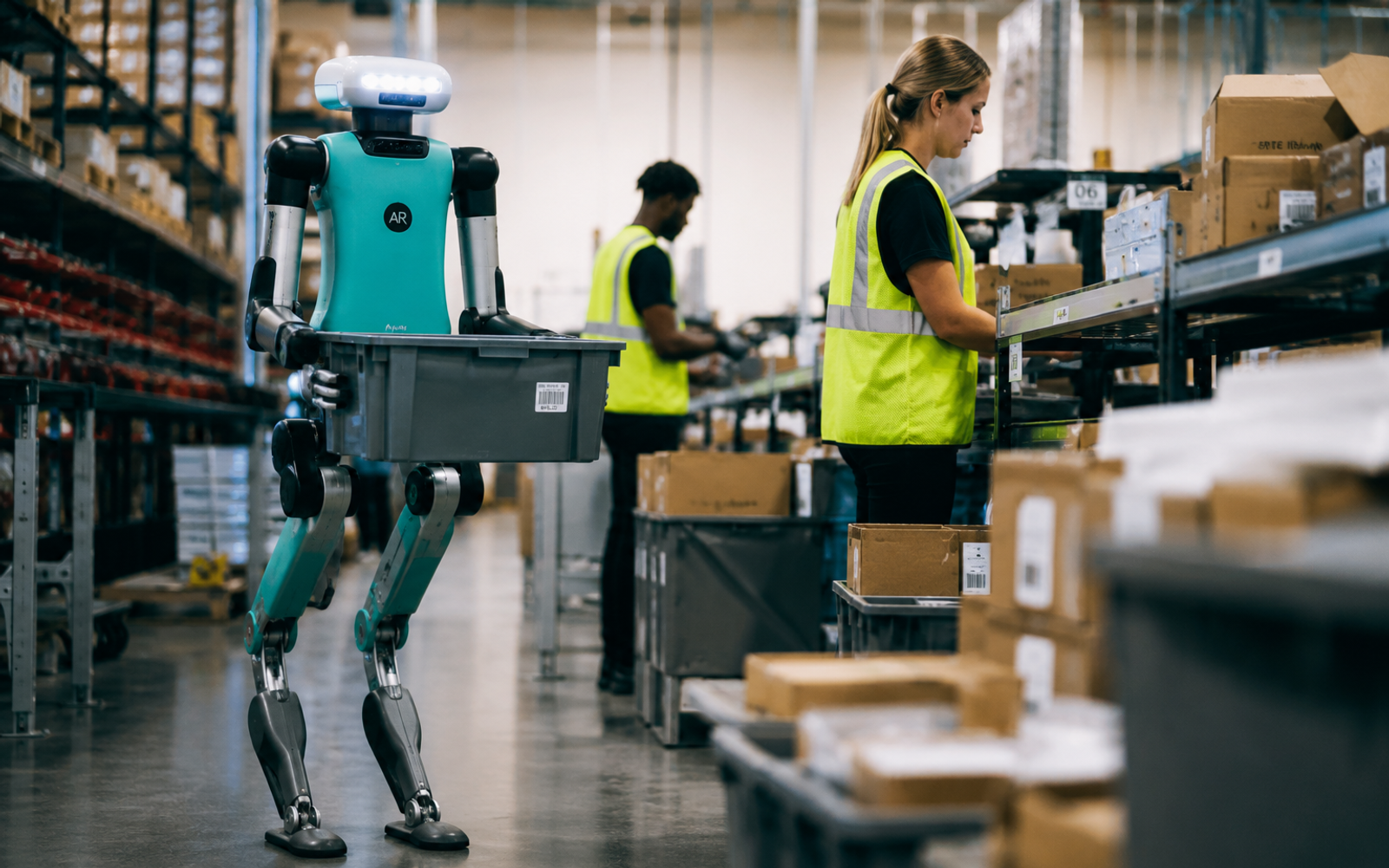
Walk into any warehouse in Ohio or Oregon right now and you might see something that looks human but isn't. It has two legs. Two arms. It lifts boxes, sorts parcels, and moves down aisles without bumping into the people working nearby. It never asks for a break. Never scrolls Instagram during a shift. Never calls in sick on a Monday.
That machine is called Digit. It's built by Agility Robotics. And on July 2, 2026, Agility became the first pure-play humanoid robotics company to trade on a public stock exchange. The vehicle was a SPAC merger with Churchill Capital Corp XI, valuing the company at roughly $2.5 billion. According to Reuters, the deal generated more than $620 million in proceeds, including about $200 million from institutional investors.
This is not a sci-fi story. This is the single most consequential entrepreneurship news of July 2026, and it matters to you even if you have never touched a circuit board.
The SPAC Route Was the Smart Play
Agility could have waited for a traditional IPO. Instead, they chose a SPAC. Why? Speed and certainty. A SPAC merger lets a company lock in valuation and funding months before listing, bypassing the roadshow roulette that has killed many tech IPOs in a volatile market.
Here's what you need to understand. A SPAC is essentially a blank-check company that already sits on the public market.
It merges with a private company, which then inherits the public listing. The trick is finding a SPAC sponsor who believes in your story enough to put their reputation on the line.
Agility's sponsor was Michael Klein, a veteran dealmaker who has taken multiple companies public through SPACs. That relationship gave Agility something most startups don't have: a credible path to public markets without the headline risk of a traditional IPO.
For you, the lesson isn't about SPAC mechanics. It's about fundraising creativity. When the standard route feels blocked, look for unconventional vehicles. Revenue-based financing. Rolling funds. Strategic corporate partnerships. The Maruti Suzuki startup bet playbook shows how large corporates are now acting as quasi-VCs for smaller innovators. If Agility can find a $2.5 billion path through a SPAC, you can find creative ways to fund your next twelve months.
The Numbers That Should Make You Pay Attention
Agility has sold roughly 100 robots as of mid-2026. That's it. One hundred machines. On that base, the company carries a $2.5 billion valuation.
You might read that and think "bubble." Think again.
The pre-order pipeline tells a different story. According to Forbes, Agility has secured over $300 million in pre-orders. That means customers are paying deposits for robots that haven't shipped yet. Logistics firms. Manufacturers. E-commerce warehouses. They are betting that Digit will pay for itself within eighteen to twenty-four months.
Do the math. A warehouse worker in the United States costs roughly $35,000 to $45,000 per year including benefits, insurance, and turnover costs. A Digit robot costs about $150,000 upfront. If it runs three shifts with minimal downtime, the ROI lands somewhere between twelve and eighteen months. After that, the robot is basically free labor.
This is the economic logic driving the entire humanoid robotics sector. Not curiosity. Not hype. Pure unit economics.
China Already Won the Volume Game
While Agility gets the cover story, China's humanoid ecosystem is moving at a different velocity entirely. Shanghai-based AgiBot shipped 5,168 units in 2025 alone and generated over $140 million in revenue. Hangzhou-based Unitree delivered another 4,500-plus. Together, Chinese manufacturers accounted for roughly 80% of global humanoid robot installations in 2025.
That gap is widening.
China now has over 140 humanoid robot manufacturers and more than 330 distinct models launched in the past year. Their cost advantage is structural: cheaper components, government subsidies, and a supply chain ecosystem that the rest of the world cannot replicate overnight.
For an entrepreneur anywhere outside China, the question becomes: where do you compete? You cannot out-build Shenzhen on price. But you can out-specialize. Agility is betting that safety, reliability, and integration with existing warehouse software will matter more than raw shipping volume. That is a bet on trust over price.
Same logic applies whether you sell software in Lagos, logistics in Nairobi, or manufacturing components in Johannesburg. Find the dimension where incumbents cannot follow you.
Where Africa Fits in the Robotics Story
You might assume robotics is irrelevant to African markets. Labor is cheaper here. Why automate?
That assumption is already outdated. In South Africa, warehouse automation adoption jumped 34% in 2025 as companies struggled with electricity instability and labor disputes. In Kenya, startups are building autonomous last-mile delivery robots for Nairobi's traffic-choked streets. In Ghana, the University of Ghana's robotics lab has spun out two companies focused on agricultural automation for cocoa and cashew inspection.
Africa will not build the next humanoid robot. Not yet. But African entrepreneurs will be early adopters and adapters. The cost of a Digit robot today is prohibitive for most African businesses. But within five years, as production scales and prices drop, the economics will shift. The businesses that understand robotic integration now will have a five-year head start on competitors who treat it as a Western problem.
The Real Bottleneck Nobody Is Discussing
Agility's SPAC news dominated headlines, but the quiet constraint in this industry is software talent. Building the hardware is hard. Building the brain that lets a robot navigate a chaotic warehouse floor, recognize damaged boxes, and avoid running over a human foot? That is exponentially harder.
The company has partnered with NVIDIA for its simulation and training infrastructure, but the bottleneck remains the pool of engineers who understand both robotics and real-world operations. According to industry estimates, the humanoid robotics sector needs roughly 50,000 specialized engineers globally. Currently, fewer than 8,000 exist.
For any developer reading this: that is your signal. If you spend the next two years building skills in robotics middleware, simulation environments, or industrial AI, you will have employers competing for you. The personal branding playbook has flipped for this exact reason. When demand for a skill set outpaces supply by a factor of six, the people who can credibly demonstrate those skills command premium rates.
What You Do About It This Week
You do not need to build a robot. You do not need to learn C++ or ROS 2 overnight. But you should do three things.
audit your business for tasks that are repetitive, predictable, and physically contained. Those are the tasks that robots will replace first. If your operation depends on humans doing those tasks, you have eighteen to thirty-six months to figure out your transition.
watch the pre-order data for Agility and its Chinese competitors. When Digit's price drops below $100,000, the calculation changes for small and medium businesses. That will happen sooner than most people expect.
talk to your customers. The biggest unknown is not whether the technology works. It's whether consumers will accept being served by a machine. Early data from Japan and South Korea suggests high acceptance. Data from Europe is mixed. Nobody has run the study in Accra, Nairobi, or Lagos yet. That is research you could design and own.
A company worth $2.5 billion started from a university lab in Oregon with a weird idea: what if we built a robot that could walk up stairs and carry boxes? That idea is now public, funded, and shipping. The next one could start anywhere. Including wherever you are reading this right now.
Frequently Asked Questions
What does Agility Robotics' Digit robot actually do?
Digit is a humanoid robot designed for warehouse and logistics tasks like lifting boxes, sorting parcels, and moving goods along supply chains. It can walk on two legs, navigate dynamic environments, and work alongside human employees.
How much does a humanoid robot like Digit cost?
Current pricing for Digit is around $150,000 per unit, though pre-order customers likely receive volume discounts. Industry analysts expect prices to fall below $100,000 within three to five years as production scales and competition increases.
Why did Agility Robotics choose a SPAC instead of a traditional IPO?
SPAC mergers offer faster execution and more certainty on valuation compared to traditional IPOs. Agility locked in its $2.5 billion valuation and raised over $620 million without the unpredictability of a roadshow in a volatile public market.
Which countries are leading in humanoid robot production?
China dominates global production, accounting for roughly 80% of humanoid robot shipments in 2026. Companies like AgiBot and Unitree have shipped thousands of units, while the United States and Europe focus more on specialized, higher-margin applications.
Should small business owners in Africa care about humanoid robots?
Yes, as an early signal of where automation costs are heading. While current prices are too high for most African businesses, the trajectory suggests affordable robots will reach emerging markets within five years. Companies that plan for automation now will have a strategic advantage.
What skills should someone learn to work in the robotics industry?
Robotics middleware, simulation environments, industrial AI, and sensor integration are high-demand specialties. The industry needs roughly six times more specialized engineers than currently exist, making these skills extremely valuable for career switchers.
Comments (0)
No comments yet. Be the first to share your thoughts.