Biohacking in 2026 What Your Cells Actually Want
The wellness industry’s latest obsession is rewiring your biology—but most of it is noise, and some of it is dangerous.

You wake up, swallow a handful of supplements, and step onto a $12,000 cold plunge pod while your smart ring buzzes with real-time glucose alerts. This is not a Silicon Valley founder’s morning routine. This is Tuesday for millions of people in 2026, all chasing the promise of biohacking: the idea that you can outsmart your biology with enough data, gadgets, and sheer willpower. But here’s the uncomfortable truth: most of what passes for biohacking is either irrelevant, overpriced, or actively harmful. And the systems meant to protect you—regulators, medical boards, even AI-driven diagnostics—are failing in ways that should alarm anyone who cares about their health.
Take the case of Doctronic, the AI prescriber that Utah regulators shielded from scrutiny last month. Physicians requested safety data after reports of misdiagnoses; the company refused, citing ‘business confidentiality.’ The state sided with Doctronic, ruling that scientific interest ‘did not outweigh’ corporate secrecy. This is not an isolated incident. It’s the logical endpoint of a wellness industry that treats health as a luxury product rather than a public good. Meanwhile, the U.S. is preparing to leave Ebola-infected troops in Africa, a decision framed as pragmatic but rooted in the same cost-cutting mindset that defunded Ebola prevention programs years ago. The message is clear: when health becomes a commodity, the most vulnerable—whether soldiers or patients—pay the price.
The metabolic feedback loop you can’t hack
Your body’s metabolism is not a thermostat you can tweak with a $300 continuous glucose monitor and a ketogenic diet. Yet that’s exactly what the biohacking industry wants you to believe. The trend du jour is ‘metabolic health as a daily feedback loop,’ a concept that sounds scientific but often devolves into obsessive tracking of biomarkers that don’t actually predict long-term outcomes. Consumer lab memberships—now a $2.4 billion industry—promise to democratize health data, but they mostly democratize anxiety. A 2025 study in *Cell Metabolism* found that 68% of users misinterpreted their results, leading to unnecessary dietary restrictions or supplement use. The real metabolic hack? Sleep. Not the $5,000 Oura Ring kind of sleep tracking, but the old-fashioned, consistent, seven-to-nine-hours-in-a-dark-room kind. Researchers at the University of Chicago found that even one night of poor sleep disrupts insulin sensitivity as much as six months of a high-fat diet. Yet no one is selling a $20 sleep mask on Instagram, because it’s not sexy enough.
The other metabolic myth is that ‘early detection’ is always a win. It’s not. The rise of consumer liquid biopsies—blood tests that claim to detect cancer years before symptoms—has created a new class of ‘patients in waiting,’ people who spend years in limbo after a false positive or an ambiguous result. A 2026 meta-analysis in *JAMA Oncology* found that for every life saved by early detection, 10 people underwent unnecessary treatments, including surgeries and chemotherapy, for cancers that would never have become life-threatening. The biohacking industry loves to frame this as ‘empowerment.’ It’s actually a form of medical gaslighting, shifting the burden of uncertainty from doctors to patients.
What Dave Asprey got wrong about clean nicotine
Dave Asprey, the self-proclaimed ‘father of biohacking,’ has a new obsession for 2026: clean nicotine. His pitch is simple: nicotine improves focus and longevity, and if you’re going to use it, you might as well avoid the toxins in traditional tobacco. The problem? There’s no such thing as ‘clean’ nicotine when it comes to long-term health. A 2025 study in *Nature Cardiovascular Research* found that even nicotine gum and patches—marketed as safe alternatives—increase arterial stiffness in users over 40, a precursor to heart disease. Asprey’s response? ‘The data isn’t conclusive.’ That’s the biohacking playbook in a nutshell: when the science contradicts the trend, dismiss the science.
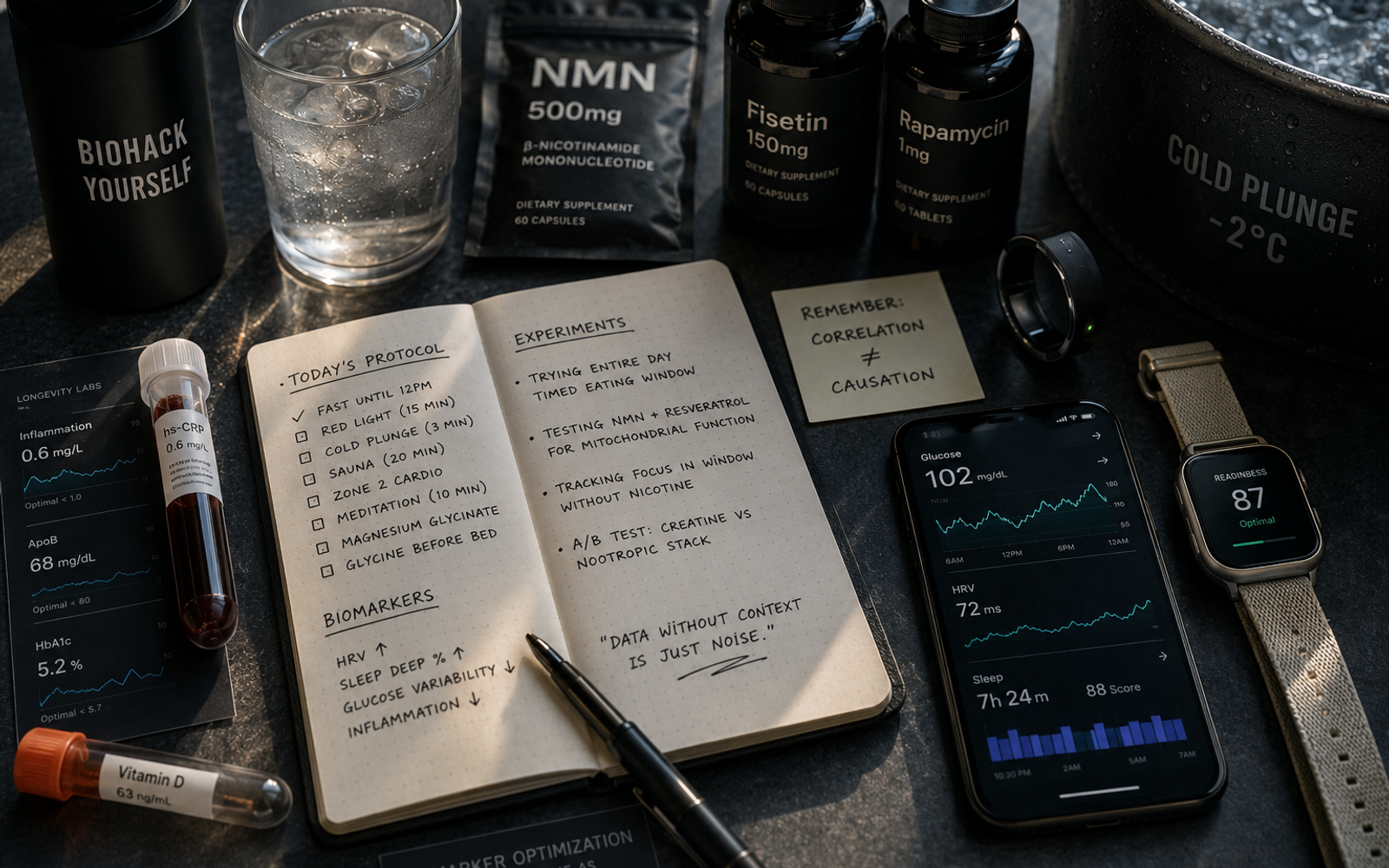
Nicotine is not the only supplement being repackaged as a biohack. The industry is awash in ‘longevity molecules’—NMN, rapamycin, fisetin—that promise to slow aging at the cellular level. The reality is far messier. A 2026 review in *Aging Cell* found that most of these compounds have only been tested in mice or in vitro, with no long-term human data. The few that do show promise, like metformin, are already available as cheap generics. But generics don’t come with a $200-a-month subscription or a celebrity endorsement. The supplement trap is simple: if it’s truly effective, it’s already a drug. If it’s not a drug, it’s probably not effective.
The other side of the biohacking coin is the luxury wellness experience, a trend that’s less about health and more about status. Cryotherapy chambers, hyperbaric oxygen pods, and infrared saunas are now standard in high-end gyms and private members’ clubs. The evidence for these treatments is thin, but the price tags are not. A 2026 investigation by *The Lancet* found that most ‘biohacking retreats’ rely on anecdotal evidence and cherry-picked studies to justify their $10,000-a-week fees. The real benefit? Social signaling. You’re not buying health; you’re buying a membership to an exclusive club where the currency is perceived vitality.
The AI prescriber paradox
AI-driven diagnostics are the biohacking industry’s latest darling, promising to democratize expertise and personalize care. The reality is more complicated. Doctronic isn’t the only AI prescriber facing scrutiny. A 2026 report by the *BMJ* found that AI diagnostic tools are 30% more likely to misdiagnose patients of color due to biased training data. The industry’s response? ‘We’re working on it.’ That’s not good enough. Health is not a beta test. When an AI prescriber gets it wrong, the consequences aren’t a bug report—they’re a human life.
The other paradox is that AI is making healthcare more impersonal at the same time it’s promising hyper-personalization. A 2026 survey of 5,000 patients found that 72% of people who used AI prescribers felt less connected to their doctors, not more. The biohacking dream is a world where algorithms know your body better than you do. The nightmare is a world where no one does.
So where does that leave you? If you’re going to biohack, do it with your eyes open. Track your sleep, not your ketone levels. Eat whole foods, not supplements. And for god’s sake, don’t trust an AI prescriber that won’t show its work. The most radical biohack of 2026 isn’t a gadget or a molecule. It’s the willingness to admit that health isn’t something you can optimize like a stock portfolio. It’s something you live, day by day, in a body that’s far more resilient—and far more fragile—than the wellness industry wants you to believe.
Comments (0)
No comments yet. Be the first to share your thoughts.