The iPhone Duo Hinges on Samsung, Not Siri
Apple's first foldable is a $1,999 engineering problem, and the hardest part is a sheet of glass made by its biggest rival.

There's a number that decides whether a folding phone works in your hand, and it isn't the screen size or the chip inside. It's the radius the display has to accept every time you close it, roughly the width of a pencil lead, repeated tens of thousands of times across the life of the device. Apple's first foldable, the iPhone Duo, arrived on September 9 with a 7.6 inch inner display, a 5.4 inch cover screen, and a starting price of $1,999, and nearly every decision behind that price traces back to one mechanical problem: how do you bend a stack of glass, adhesive, and organic light emitting diodes, over and over, without any layer giving out?
Apple's answer ships on October 23, and it leans on materials and tooling the company doesn't own. Judge the Duo as a hinge and not as an AI feature, and the launch gets considerably more interesting.
What Apple Announced at Surprise and Shine
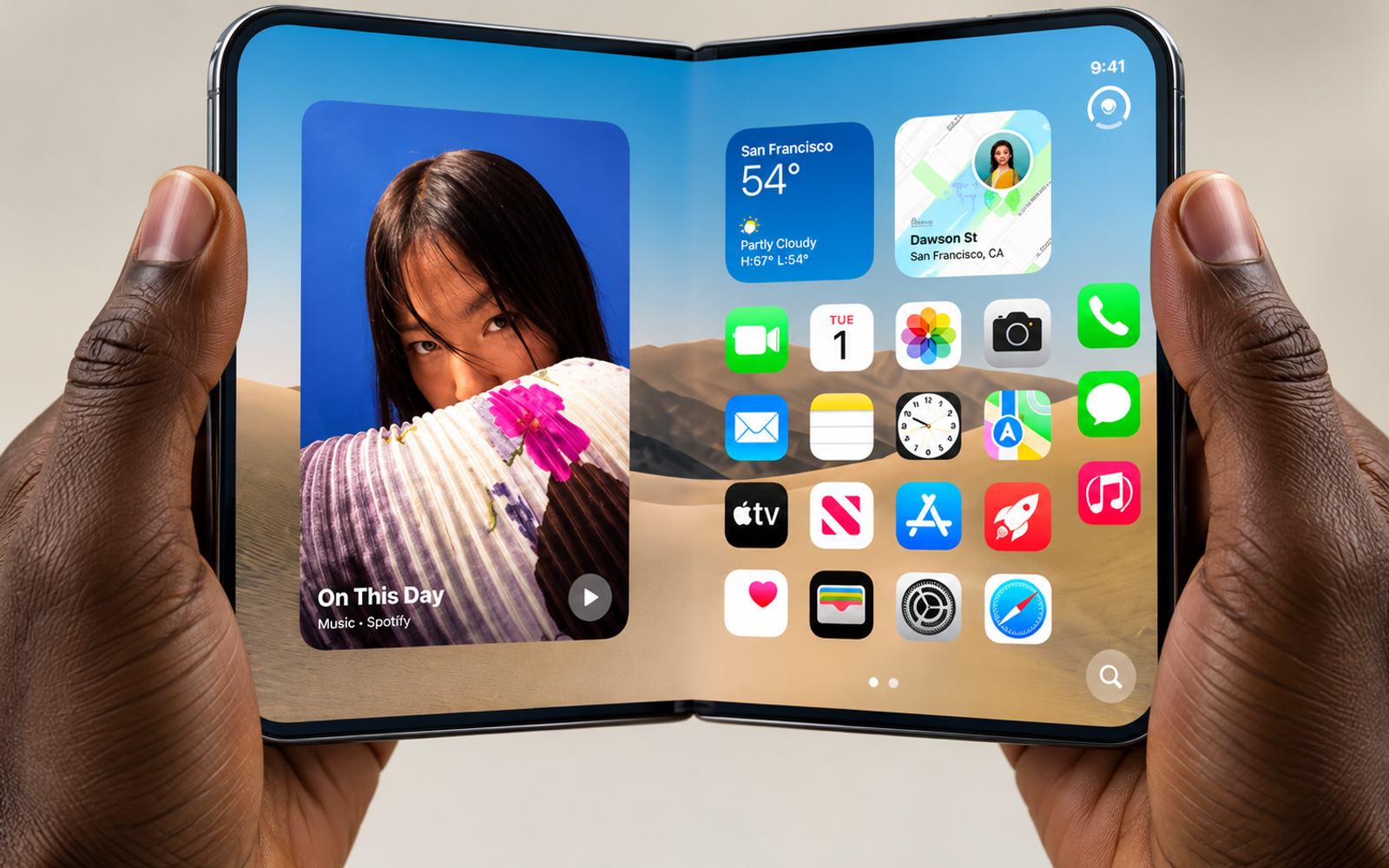
Apple's newsroom describes the Duo as its first foldable iPhone and the thinnest iPhone ever in the open position. The 7.6 inch inner display is the largest Apple has put on a phone, and it carries a nano-texture finish meant to cut glare. Closed, the 5.4 inch outer panel covers about 90 percent of the screen area of an iPhone 18 Pro, and both displays share the same aspect ratio, so an app scales proportionally between them instead of reflowing into a different layout. Pre-orders open October 16 at 5 a.m. Pacific, with devices reaching customers on October 23.
CNBC's live coverage put the entry model at $1,999 for 256GB, $700 above the iPhone 18 Pro Max, with storage running to 2TB. The same event brought a $100 increase on the iPhone 18 Pro line and a leasing program, following summer price increases on Macs and iPads as memory and storage costs climbed. Indian pre-orders open at Rs 2,99,900 for the base model, with the 2TB version listing near Rs 4,45,000, which puts the Duo in a different purchasing category from the phone it's meant to replace.
Apple spent most of the keynote on Siri AI, the A20 Pro chip, AirPods 5, and the Apple Watch Series 12. The foldable's genuine novelty is narrower, more mechanical, and located in a band of the device most buyers will never see.
Why the Hinge Is the Hard Part
Bend a layered object and the layers don't share the load equally. The outer surface goes into tension, the inner surface goes into compression, and somewhere between them sits a neutral plane where the material neither stretches nor squeezes. Strain at any layer rises with its distance from that plane and falls as the bend radius grows. Engineers get two levers, then: move the brittle layers toward the middle of the stack, or bend everything around a gentler curve.
Gentler curves are why the Duo doesn't close flat. Most book-style foldables use a teardrop hinge that leaves a wedge-shaped gap in the closed position, buying a larger bend radius at the cost of pocket thinness. The price shows up as part count. A teardrop hinge needs interlocking gears and cams to keep both halves synchronized and to hold the display under constant light tension, and every added interface is a place where clearance can develop or grit can enter.
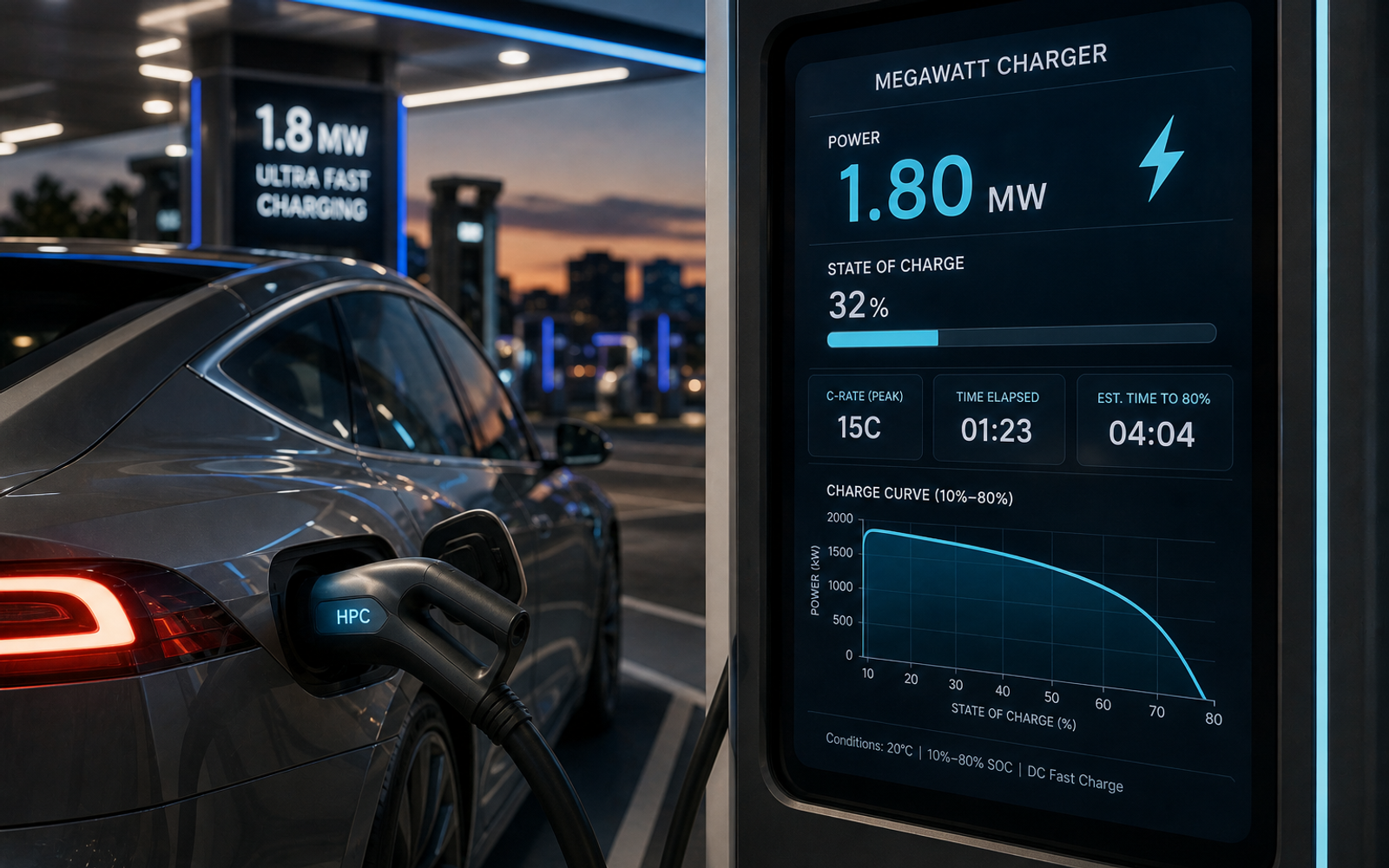
Think about the difference between bending a single sheet of paper and bending a paperback. The sheet curves because nothing has to slide. The book resists because its pages must shift against one another, and force it far enough and the cover takes a permanent crease. A foldable display behaves like the book, since the adhesive and polymer layers between the glass and the OLED have to shear smoothly across the fold, and materials that shear smoothly also creep. That's why creases deepen with fold count instead of fading, and it's the same gap between bench numbers and field behavior that opens up whenever a fast-charging spec leaves the test bench.
Thirty Microns of Glass and No Polarizer
The cover layer in a foldable is ultra thin glass, and in the Duo's case it sits around 30 micrometers thick, roughly a third the diameter of a human hair. Thinness is the whole point, because halving the thickness of the outermost layer halves the strain it sees at a given radius. The glass also has to be chemically strengthened enough to shrug off keys and sand while staying flexible enough to fold, and those two properties pull against each other in every formulation a materials team tries.
Behind the glass sits a polarizer-free construction the display industry calls color filter on encapsulation. A conventional OLED uses a circular polarizer to suppress reflections off the metal electrodes underneath, and that polarizer costs thickness while eating a meaningful share of the light the panel produces. Moving the color filter directly onto the encapsulation layer removes it, which cuts stack thickness exactly where thickness is most expensive and lifts brightness and power efficiency at the same time.
Trade press reporting on the supply chain says the Duo is the first shipping device to use Samsung's M16 OLED material set, a generation targeting brightness, color accuracy, and emitter lifetime. Lifetime matters more on a foldable than on a slab phone, because a half-folded Duo drives its top half as a viewfinder and its bottom half as a control surface, and both halves stay lit for long stretches while the phone stands on a table.
The Component Apple Couldn't Build Alone
Samsung Display supplies the Duo's foldable panel under what trade reporting describes as a three-year exclusive agreement, with a panel cost near $250 per unit, which would make it one of the most expensive single components inside the phone. Samsung has been manufacturing foldable panels since 2019, and the accumulated process knowledge around lamination, laser cutting, and thin film encapsulation isn't something a competitor buys its way past in a single product cycle.
Apple's instinct is to own its critical parts, and on the silicon side it does. The Duo runs the A20 Pro and ships with the C2, Apple's second-generation in-house modem. Johny Srouji, Apple's chief hardware officer, said in the keynote video that with the company's "fully integrated approach, it's optimized to improve everyday user experiences, including using AI algorithms to improve cellular reliability, like reconnecting faster in low coverage areas." CNBC reported that the C2 runs 50 percent faster than Apple's previous modem while adding 5Gmm support in the US and using 15 percent less energy.
Folding glass is a different class of problem. It's materials science with a decade of yield learning baked into it, closer in character to Apple's dependence on TSMC for leading-edge silicon than to anything the company can redesign in a lab. The strategic consequence is that Apple's most expensive phone now runs on the most advanced component of its most direct rival at the top of the market. Exclusivity cuts both ways, since Samsung Display gets guaranteed volume on its highest-margin panel while Apple gets a part it can't easily second source.
What Folding Buys You Beyond AI
iOS 27 on the Duo runs two full apps side by side, or two windows of the same app, and the device is the first iPhone to support the Apple Pencil, a capability Apple had reserved for iPads. Half-folded, the hinge becomes a stand, which turns hands-free FaceTime and the rear 48MP camera into a selfie setup no other iPhone can match. None of that needs a language model.
The AI layer is the part Apple can revise over the air, and the company has been shifting its AI story from model releases toward the cost of running inference, the same spreadsheet logic now shaping how every large platform prices its compute. The hinge and the display stack are the parts fixed at the factory, which makes them the parts worth judging the phone on.
There's a fair argument that the Duo's most useful feature isn't multitasking at all but posture. A phone that holds its own angle changes where and how you shoot video, take a call, or follow a recipe, in ways that never show up in a benchmark. That's a harder sell than a bigger screen, and it's a large part of why foldable adoption so far has skewed toward people who treat a phone as a second workstation rather than a communication device.
The Durability Claim Nobody Has Validated
Every foldable ships with a fold rating, usually 200,000 cycles, which works out to roughly 110 closures a day for five years. That figure comes from machines that fold a phone at a constant angle, in a climate-controlled room, at a steady rate. It doesn't model a pocket full of grit, a cold morning that stiffens the adhesive toward something closer to plastic, a partial fold with a thumb pressing into the crease, or a phone knocked half open on a cafe table. Fatigue damage accumulates differently depending on temperature and rate, and the viscoelastic layers inside a display stack respond to both.
Engineers can measure crease depth with a profilometer on day one and again after 200,000 cycles, but nobody has published a validated model that takes a mixed real-world load history and predicts where a specific stack will be in year five. Standards bodies have fold test methods, not life prediction methods. That gap is why the foldable category still carries a warranty question slab phones never had to answer.
The Duo enters the market on a durability claim Apple can't yet verify in the field, and the first meaningful data won't come from a test lab in Cupertino. It'll come from people who've owned the phone for two years and can see the crease in a certain slant of light. What the industry still lacks is the thing that would make those two years useful: a model that turns real-world folding into a number an engineer can design against before the next hinge is tooled.
Comments (0)
No comments yet. Be the first to share your thoughts.