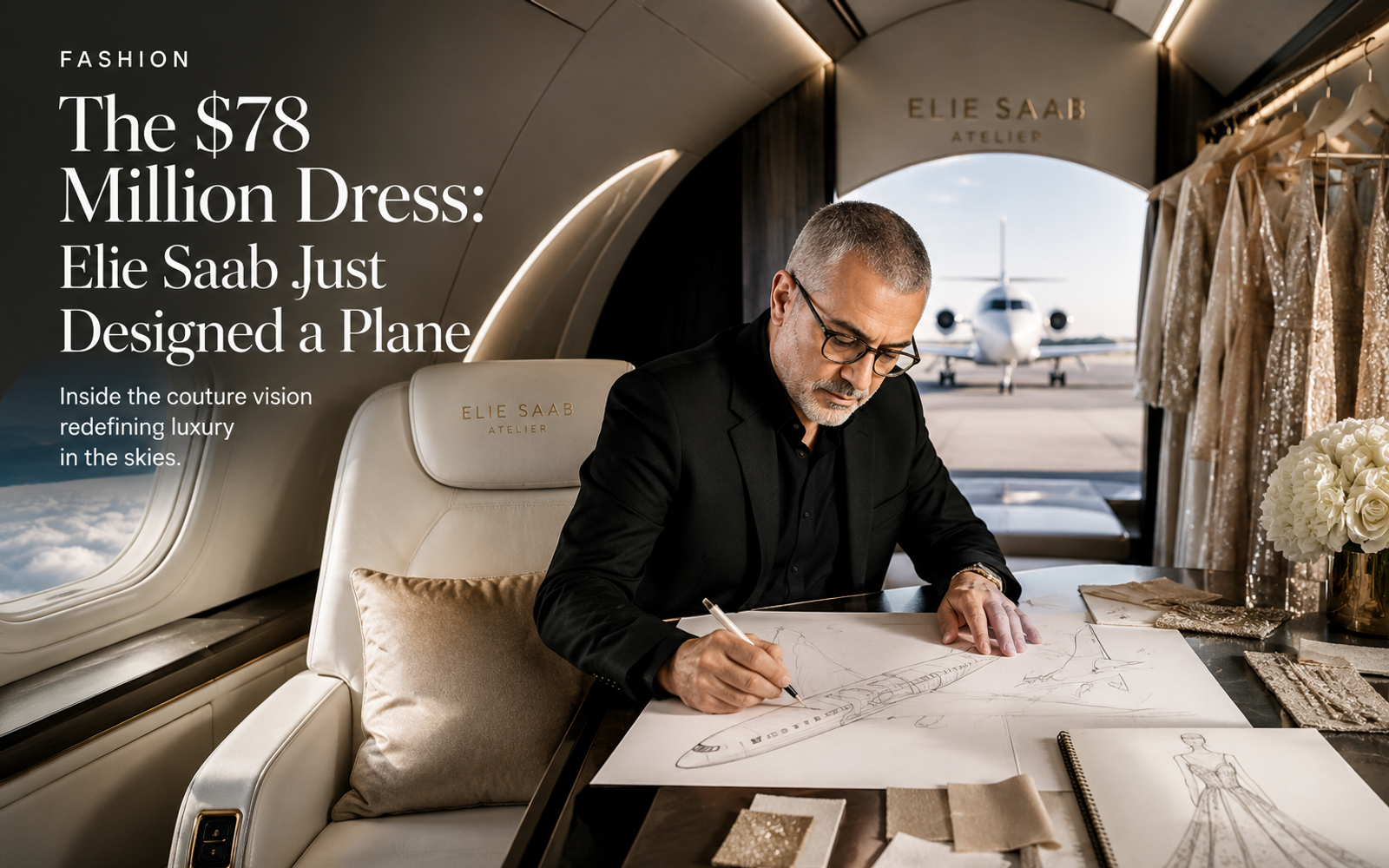
The $78 Million Dress: Elie Saab Just Designed a Plane
Elie Saab's cabin for the Bombardier Global 8000 isn't a stunt. It's the logical end of luxury's long game.

There is a seat in this cabin that nobody will ever sit in.
Not because it's broken. Because it's a chaise, technically. Upholstered in silk velvet the color of clotted cream, positioned just so beneath a window that Bombardier engineers had to widen by nearly four inches to accommodate Elie Saab's insistence on natural light hitting the passenger at a specific angle. The chaise is long enough to lie flat on, short enough that you wouldn't. It's an invitation dressed as furniture. A piece that exists to be looked at longer than it exists to be used.
This is the thing about the Bombardier and Elie Saab collaboration on the Global 8000 that got lost in the splashy Monaco unveiling last week. The fashion press ran the photos. The aviation press ran the specs. But nobody sat with what this actually means. A fashion house designing a private jet interior is not a crossover episode. It's not a licensing deal. It's not a stunt.
It's a thesis statement about where luxury is going.
The cabin as a garment you can walk through
Walk through the cabin yourself, if you can. You can't, probably. That's the point. Bombardier built exactly one of these for display and it's not touring. It sits in a hangar in Montreal and you need an invitation from someone who has an invitation from someone else. The exclusivity is the product.
But the design itself tells a story that's worth tracing. Elie Saab's team approached this the way they approach a couture gown. Not as a space to be decorated but as a body to be dressed. The cabin has a spine. The central aisle narrows at precisely the point where a standing passenger and a seated passenger might brush shoulders, and rather than widen the aisle to avoid that contact, Elie Saab leaned into it. The materials change there. The wall panels shift from gloss to matte. The lighting drops half a degree in warmth. It's a gesture.
This is what fashion brings to aviation. Not fabrics. Attention.
The aviation industry knows how to make a comfortable plane. Bombardier has been doing that for decades. Their Global 8000 is the fastest business jet in the world, certified by Transport Canada in November 2025, with a range that connects Dubai to New York nonstop. The engineering is solved. The question was never whether the plane could perform. The question was whether the experience could feel intentional.
Elie Saab answered that question by treating every surface as a material problem. The bulkheads are wrapped in a silk blend that Saab's atelier developed specifically for this project, tested for flammability, tested for acoustic absorption, tested for how it catches light at 41,000 feet where the UV exposure is different. The carpets are hand-tufted in a pattern that reads as solid from standing height but reveals itself as a geometric motif when viewed from above. Which you will never do. But somebody thought about it.
What the fashion giants get that the tech giants don't
This is the moment where I'm supposed to say that Elie Saab is the first fashion house to design a private jet interior. That's not true. Hermes collaborated with Dassault on Falcon cabin furnishings years ago. Fendi has done work with Gulfstream. Loro Piana outfits cabins for clients who buy their cashmere by the bolt.
But those were supplier relationships. A house providing materials. Elie Saab's deal with Bombardier is something else. It's a design partnership. Bombardier went to Saab and said, design the whole thing. Not the upholstery. The experience.
This distinction matters because it signals a shift in how luxury brands understand their own value. For a long time, fashion houses made clothes. Then they made fragrances and lipsticks. Then they made hotels. Then they made restaurants. Then they made yachts, or at least the interiors of yachts. Each step outward from the core product was met with some skepticism until the numbers came in and proved that people who buy a $12,000 gown will also buy a $300 candle and stay in a $2,000/night hotel room if both carry the same name.
The jet is the logical end of this expansion. Not because the margins are better. They might not be. But because a private jet is the most expensive single purchase a person can make outside of real estate. If you can own that customer's consideration, if you can be the brand they think of when they think of the ultimate personal space, you don't need to sell them many products. You just need to be present in their life at the moment of maximum expenditure.
Elie Saab said as much, quietly. In the press release announcing the collaboration, the house noted that this project reflects a "desire to accompany our clients in their daily lives wherever they are." The phrasing is careful. It doesn't say "we want to sell you a plane." It says "we want to be with you when you buy one."
The details that don't photograph
You can see the cabin in pictures. The pale oak veneers. The embroidered panels that reference Saab's couture embroidery techniques translated into architectural surfaces. The dining table that seats six but can be configured down to a writing desk for one. The master suite with its full-height wardrobes and en suite shower, which on a plane is a genuine engineering flex.
What the pictures won't show you is the sound.
Bombardier's Global 8000 is already quiet. The engines are mounted aft of the cabin, and the airframe design reduces wind noise significantly. But Elie Saab specified additional acoustic padding behind every panel, not because the plane needed it, but because silence is a luxury material. The cabin measures 22 decibels at cruising speed. That's quieter than a library. You can hear your own breathing. You can hear the fabric of your jacket shift when you move your arm.
This is the kind of detail that fashion people understand innately and aviation people have to be taught. A garment is not just its cut. It's the sound of the silk against itself. The weight of the hem. The way the shoulder seam feels when you raise your arm. An airplane cabin is the same. It's not just the materials. It's the fullness of the sensory experience.
The lighting system deserves its own paragraph. Bombardier's Soleil system is aviation's first circadian rhythm-based cabin lighting, integrated with the flight management system so it can simulate daylight progression across time zones. Elie Saab worked with Bombardier's engineers to program the color temperature curves, insisting on a warmer base tone than the aviation standard. The result is a cabin that feels like a room, not a tube. The light shifts gradually during the flight. You don't notice it happening. You just notice that you don't feel like you've been in a metal cylinder for fourteen hours.
The couture logic of limited production
Here's the part that matters most.
Elie Saab will not design many of these cabins. The collaboration is exclusive. Bombardier is offering the Saab-designed interior as an option on the Global 8000, but the house will personally oversee each installation. The atelier in Paris will produce the embroidered panels by hand. The silk will come from the same mills that supply Saab's couture collection. Each cabin will take months to complete.
This is couture logic applied at industrial scale. The whole point of couture is that it's not available. You can't buy a couture gown off the rack. You go to Paris, you get measured, you wait. The gown exists for you and only you. The price is irrelevant because the price is not the product. The unavailability is the product.
Bombardier understood this when they signed the deal. They didn't need Elie Saab to produce a high volume of interiors. They needed Elie Saab to produce an interior that their customers could not get anywhere else. The exclusivity lifts the entire aircraft. If you buy a Global 8000 with the standard cabin, you have a very nice plane. If you buy one with the Saab interior, you have a plane that nobody else has. The difference is not in the hardware. It's in the story.
Why this is fashion news, not aviation news
The fashion editors who skipped this story to write about the Olsen twins' summer styling missed something. This collaboration is more consequential for fashion than it is for aviation.
Here's why. The fashion industry has spent the last decade chasing the wrong kind of expansion. Brands opened stores in airports. They made clothes for yoga. They launched subscription boxes. They partnered with video games. They did all of this because the core apparel market was flattening and they needed growth somewhere.
But those expansions diluted the brand. A Louis Vuitton keychain is not a problem. A Louis Vuitton partnership with a fast-food chain would be, and the line between smart extension and brand erosion is thinner than most creative directors want to admit.
Elie Saab's Bombardier partnership is the opposite of dilution. It's concentration. It's taking the brand's most rarefied qualities and applying them to a product so exclusive that most of the brand's own customers will never encounter it. That's not a reach. That's a statement. The statement is: we are not trying to be everywhere. We are trying to be in the right place.
There is a risk here, of course. The risk is that the brand becomes associated with a lifestyle that is actively unappealing to the broader market. Private jets are not popular right now.
The carbon math is bad. The optics are worse. A brand that ties itself too closely to ultra-high-net-worth travel risks looking out of step with the values that younger luxury consumers claim to hold.
But Elie Saab's customer base isn't young. It's established. It's global. It's the person who buys a couture gown for the Cannes red carpet and then needs to get from Beirut to Paris in four hours. That person exists. That person is not worried about optics. That person is worried about whether the cabin lighting will make her look tired when she lands.
The quiet ambition
Vogue Arabia spoke to Éric Martel, Bombardier's CEO, at the unveiling. He said something that stuck. "From the outset, this collaboration was about more than designing a cabin. It was about redefining how our customers experience flight."
Redefining how customers experience flight is a big claim for a company that makes planes. But it's a modest claim for a fashion house. Fashion has been redefining how people experience their own bodies for centuries. The jump from body to cabin is not that far. It's the same skills. Proportion. Material. Light. Movement. The difference is only in the scale of the canvas.
What interests me about this collaboration is not the cabin itself. It's the door it opens. If Elie Saab can design a private jet interior, what else can they design? The house has already moved into furniture and home decor.
The Bombardier partnership suggests a larger ambition. Not just objects. Environments. Entire spatial experiences that carry the Saab signature from the threshold to the horizon.
This is where the smart money goes. Not into more products. Into fewer, more consequential ones. The brand that can design the cabin of a $78 million jet has proven something that no runway show can prove. They have proven that their aesthetic can hold space at the highest level of human aspiration. Not just aspiration. Attainment. The actual arrival.
The seat nobody sits in
I keep coming back to that chaise. The one that's too long to sit on and too short to sleep on. The one that exists purely as a visual anchor for the cabin's forward section. It's the most honest piece of furniture in the whole project because it makes no pretense of utility. It's there to be beautiful. That's its job.
There's a lesson there for every fashion house considering this kind of expansion. Don't pretend your product is useful. Usefulness is a trap. It invites comparison. It invites measurement. A private jet cabin will always be judged against other private jet cabins. But beauty is harder to compare. Beauty is subjective. Beauty is the thing that makes a customer choose your cabin over a competitor's even though both planes go the same speed and arrive at the same time.
Elie Saab understood that. They designed a seat that nobody will sit in because sitting is not the point. The point is knowing that you could. The point is the option. The possibility. The sense that every surface in this cabin was considered by someone who cares about how things look and feel and sound and smell and taste, not just how they perform at altitude.
That's the fashion difference. And it's worth more than any engineering spec.
The long game
Luxury brands have been testing the waters of experiential design for years. Hotels. Resorts. Restaurants. Spas. Each one a laboratory for whether the brand's aesthetic can survive outside the closet. Most of these experiments have been successful because the people who buy luxury goods also travel and eat and sleep. The brand follows the customer.
But the private jet is different. The private jet is not a place you go. It's a place you pass through. It's transitional.
It's the space between two real destinations, and for the ultra-wealthy, that space can add up to hundreds of hours a year. Those hours are currently squandered. Even the nicest private jet cabin is still a cabin. It's still a tube with seats in it.
Elie Saab's intervention suggests that the tube doesn't have to feel like a tube. It can feel like a living room. It can feel like a private salon. It can feel like a bedroom. It can feel like any room the passenger wants, provided the passenger has enough money to make the wish real.
This is not a business model that scales. It's not supposed to. But it is a business model that signals. And the signal it sends to the rest of the luxury market is this: the next frontier for fashion is not digital. It's not blockchain. It's not the metaverse, which nobody actually lives in. The next frontier is physical space at its most rarefied and most personal. The spaces that only a handful of people will ever occupy.
That's where the real luxury lives. Not in what everyone can have. In what almost nobody can.
The final detail
The cabin has a safe. Not unusual for a private jet. People carry things. Jewelry. Documents. Watches. But Elie Saab designed this safe too, and the lining inside is the same silk velvet as the chaise. The same clotted cream color. The same hand-finished edges.
It's a detail that almost nobody will see. The person who opens that safe will be too focused on what they're putting in or taking out to notice the lining. But it's there. Because the logic of couture demands that every surface be considered, even the ones that are hidden. Especially the ones that are hidden.
That's what fashion brings to aviation. Not a new way to fly. A new reason to look.
Comments (0)
No comments yet. Be the first to share your thoughts.