The Rotation Hiding Inside the S&P 500's 7,700 Record
Value is finally beating growth at record highs. That rotation may be the first sign the AI rally is changing character underneath.

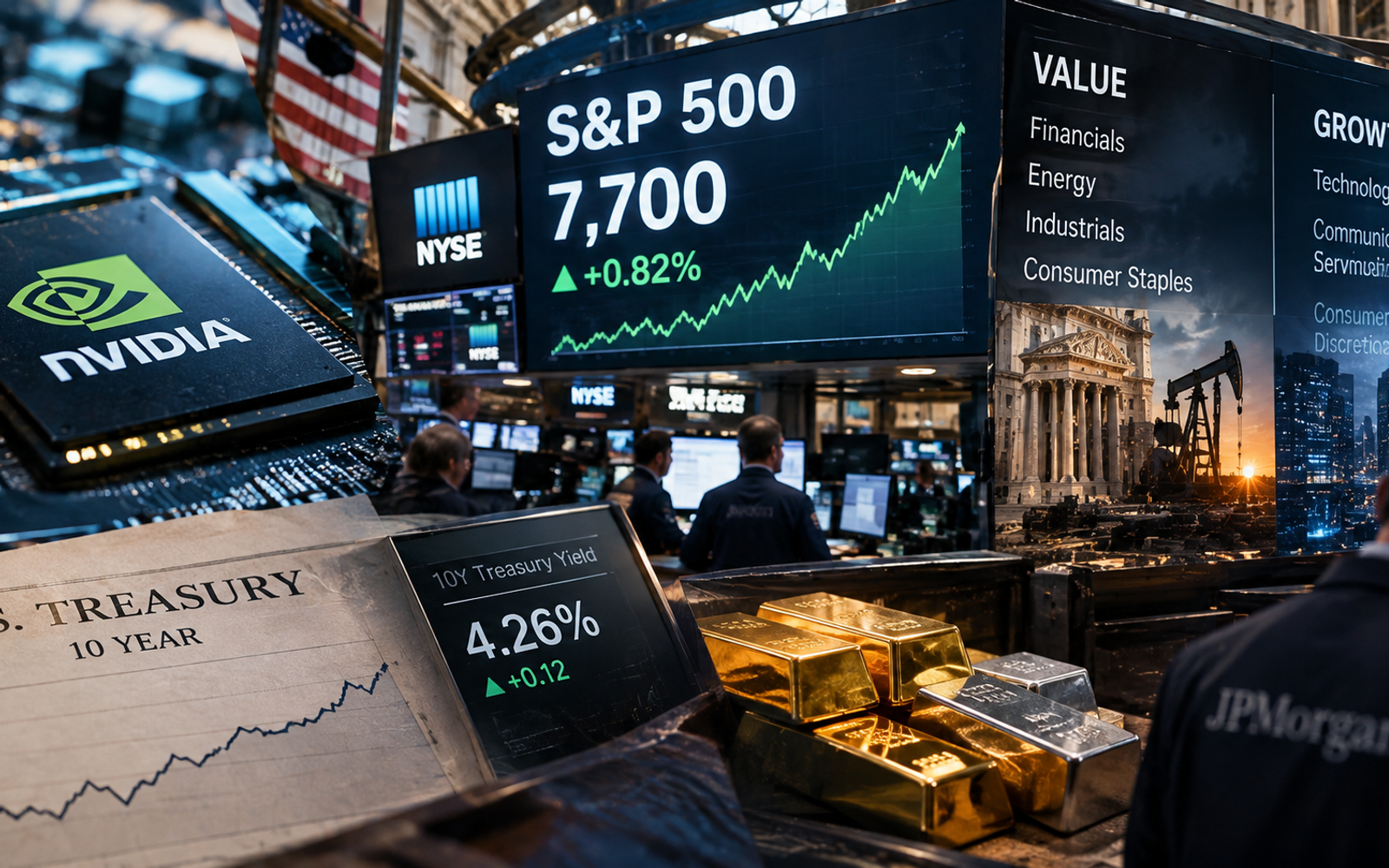
The S&P 500 crossed 7,700 for the first time last week, closing at its 27th record high of the year after a subdued inflation report on Wednesday reduced the odds of a September rate hike. The index climbed from the 7,000 mark first touched in late January to 7,700 in under seven months, a pace that has produced milestone headlines at roughly monthly intervals. The move's distinguishing feature was not the index level. Value stocks significantly outperformed growth through the same stretch, a rotation most record-setting coverage treated as a footnote.
The week ended just below the milestone rather than on top of it. Stocks slipped 0.2% on Friday as July retail sales came in soft, leaving the benchmark near records but short of another round number. CNBC's market outlook had framed the stretch as the next test for the rally, and the week delivered exactly that. The pullback was small, and Friday's close left the index within striking distance of another record. That it coincided with a value leadership and a deepening global bond sell-off is what makes the current tape worth a closer look.
The Milestone Math Leaves Out the Distribution
The year's milestone count is a study in mechanical repetition. The index has crossed eight 100-point thresholds since late January, from 7,000 to 7,700, and each crossing has drawn the same reflexive coverage powered by the same engine.
AI-related hardware names did the heavy lifting into the record, with data storage and memory stocks like Sandisk, Seagate Technology, and Micron flying higher, according to the Wall Street Journal's market coverage. More than 75% of S&P 500 companies that reported second-quarter earnings beat estimates, a beat rate that has kept the earnings narrative intact through a summer of otherwise mixed macro data.
Complacency is not fragility, but it changes the risk calculus. When the volatility index sits near multi-year lows while the index prints its 27th record close of the year, the marginal buyer is extrapolating the current path rather than hedging against alternatives. That path depends on a specific sequence: inflation staying contained, the Fed holding or cutting, and AI capital spending continuing to translate into earnings. Each link in that chain is visible in the tape, and so is the counterargument. The bond market has been pricing a different version of that sequence for weeks.
The Value Rotation Is the Real Signal
The value/growth divergence deserves more attention than a record close. Value significantly outperformed growth over the same stretch in which the index crossed 7,700, and the pattern has recurred with increasing frequency since the summer rally began. There are two ways to read value leadership at record highs. One is broadening: money finally rotating beyond the mega-cap AI names into cheaper sectors, which would make the advance healthier. The other is defensive: buyers seeking exposure to the same AI theme at lower multiples because the leaders have run too far, which is late-stage behavior dressed as breadth.
The defensive reading has history on its side. In prior AI-driven melt-ups, the rotation into value typically began when the momentum cohort stopped absorbing new money, not when that cohort was expanding. The memory and storage complex that powered last week's records is a useful example: Sandisk, Seagate, and Micron are cyclical hardware names with value characteristics, not pure growth stories. Money rotating into them can mean the market is broadening into a new AI leg. It can also mean the marginal buyer is settling for the cheapest way to stay exposed to a theme whose leaders have gotten expensive.
Institutional commentary is drifting in the same direction. JPMorgan's equity strategists have turned selective on European stocks as valuations get pricier, according to Bloomberg's market coverage, a cautious tone that sits awkwardly alongside equity records. The same tension appears in Asia, where Indonesian equities entered a bull run on the back of a new administration's pragmatism, per Bloomberg, while allocators debate whether that risk appetite is durable. Rotations into value and selectivity from large asset managers aren't crash signals on their own. They're the first sign that the marginal buyer is no longer chasing the leaders.
The Bond Market Is Selling What Stocks Are Buying
The most direct contradiction to the equity record is coming from fixed income. The global bond sell-off deepened last week, with yields rising across major markets on renewed inflation fears and on concerns about the volume of debt issuance tied to AI infrastructure spending. Rising yields are the mechanism by which the market prices the financing cost of the AI buildout, and they land hardest on the high-multiple growth names that carried the index to 7,700. Bitcoin holding near $64,000 while surging yields and firmer oil drained risk appetite from crypto, per CoinDesk's live updates, is the same cross-asset tension in miniature.
Corporate supply is the less discussed half of that story. The AI buildout isn't being funded by operating cash flows alone; it's being funded by issuance, and the market is starting to demand a premium for that paper. When the world's largest asset managers must absorb record supply at a moment when central banks are no longer stepping in as buyers, the price of that paper falls and yields rise. Equities have so far treated AI capital spending as pure upside. The bond market is quietly pricing its cost, and the two views can't both be right indefinitely.
Precious metals added a third data point. Tech led the equity tape last week while gold and silver also shone, per the weekly market recaps, a combination that usually means investors are buying momentum and insurance in the same breath. Hedging while chasing isn't contradictory behavior, but it does suggest the chase isn't as confident as the records imply. Idiosyncratic speculation also flared, with Reddit shares jumping after its latest earnings report, per the Wall Street Journal's market coverage, a reminder that retail appetite for momentum remains intact.
The Consumer Data Beneath the Record
The macro data that arrived alongside the milestone pointed the other way. July retail sales slid, a miss that landed the same week as the inflation prints and received far less attention than the record close. In the UK, job vacancies fell to a five-year low as smaller firms scaled back recruitment, a sign of softening demand that echoes across developed labor markets. The Fed held its policy rate at 3.50% to 3.75% at its most recent meeting, and the soft inflation prints reduced pressure to raise in September, according to the Wall Street Journal's market coverage.
That leaves the rally leaning on a specific expectation: the Fed will ease into a cooling economy. The market has cycled through versions of this hope all year, adjusting its timeline each time the data moved, a pattern covered in earlier NovaRift analysis of the July data and the hawkish Fed. The current setup is more forgiving on inflation and less forgiving on growth. If the consumer keeps softening, the equity market's interpretation of incoming data will flip, and the rotation into value will accelerate for defensive reasons rather than broadening ones.
The September meeting is where the near-term version of this argument resolves. A hold keeps the soft-landing narrative intact and records likely keep coming. A hike would land directly on the high-multiple names that carried the index to 7,700. The most recent statement left the door open in both directions, which is why the next inflation print matters more than the last record close.
Round Numbers Matter Less Than Participation
There is a mechanical reason milestones attract flows beyond psychology. Index funds, options desks, and momentum strategies all respond to threshold levels, and a break above a round number can generate a short burst of buying that has nothing to do with fundamentals. That effect is real but temporary. What outlasts it is participation: whether the median stock is making new highs alongside the index, or whether a narrow cluster of names is pulling the average upward while the rest drift.
Milestone coverage is partly self-fulfilling. Every threshold crossing generates a new round of headlines, which pulls in buyers who don't want to miss the next leg, which makes the next threshold more likely. The S&P 500's fourth consecutive quarter of growth, noted in Bloomberg's market coverage, feeds that loop by validating the trend for investors who track the quarterly scoreboard. None of that tells you whether the median stock is actually participating.
The value rotation is the one piece of evidence that participation is genuinely improving, which is why it deserves tracking rather than dismissal. A market that reaches 7,700 on broad participation can absorb higher yields. A market that reaches it on concentration can't. The distinction will show up in the next pullback, not in the next record. Nvidia's summer moves, including a single session that erased $300 billion after a strong jobs report, are a reminder of how quickly leadership stocks can reprice when the macro narrative shifts, as Nvidia's $300 billion single-session loss demonstrated.
The Unresolved Variable
Whether the record holds depends on one unresolved variable: which market is reading the next inflation and employment data correctly. The equity complex is pricing disinflation plus eventual Fed easing. The bond market is pricing sticky prices plus the financing burden of the AI buildout. Those positions are mutually exclusive, and the next two months of data will resolve them. Until then, the S&P 500 can keep printing records against a fixed-income backdrop that has rarely supported them for long.
Disclaimer: This article is for informational purposes only and does not constitute financial advice. Past performance is not indicative of future results. Consult a qualified financial advisor before making investment decisions.
Comments (0)
No comments yet. Be the first to share your thoughts.