State Funds Own $15 Trillion. Norway Ran the Stress Test
Sovereign funds hold $15 trillion, and increasingly they buy the same AI assets. Norway's own stress test models a 31% drawdown.

Norway's Government Pension Fund Global ended June worth 22,683 billion kroner, about $2.3 trillion, after posting a record $184 billion profit in the first half of 2026. Buried in the same disclosure is the more revealing figure. Of the fund's total value, 15,210 billion kroner is investment return, 5,509 billion is money the Norwegian state actually deposited, and 1,965 billion is currency movement. The largest sovereign wealth fund on earth is mostly a compounding claim on global equity prices, not a vault of saved oil money.
That single fund sits inside a category that crossed $15 trillion in assets in 2025, according to Global SWF's annual report, roughly 14% higher than a year earlier. Most of the increase came from rising markets rather than fresh government deposits, which means the growth of state capital is largely a leveraged expression of the same equity valuations that retail and institutional investors are already paying for. Understanding how these funds invest starts with understanding that their mandates, not their size, decide what happens next.
A Category Defined by Three Conditions
The funds themselves wrote the formal definition in 2008 and published it as an appendix to the Santiago Principles. Three conditions have to hold. A general government, central or subnational, owns the fund. The assets are invested in foreign financial markets. And the objective is financial. That definition deliberately excludes public pension funds, which belong to their policyholders, and central bank reserves, which are held rather than invested.
The mandates branch from there. Savings funds, sometimes called intergenerational funds, run decades-long horizons and exist because the commodity underneath them is finite. Norway, Kuwait and Alaska's Permanent Fund sit in this group. Stabilisation funds hold liquid assets to absorb a fiscal shock. Development funds invest at home as well as abroad, with industrial policy written into the charter. Reserve investment corporations manage a portion of a central bank's surplus. Saudi Arabia's Public Investment Fund, at roughly $930 billion, and Abu Dhabi's ADIA, close to $993 billion, sit at different points on that spectrum than Norway does.
Size stopped being the interesting variable years ago. Add public pension funds and central banks, and state-owned investors control something near $60 trillion, which makes them the largest single class of capital in global markets. What matters now is behaviour, and behaviour in a state fund is set by whichever mandate the government wrote into the statute.
The Mandate Decides Where the Money Goes
Norway's mandate is savings for future generations, and the finance ministry hands Norges Bank Investment Management a benchmark built on the FTSE Global All Cap index. That constrains everything the fund does. At the end of June, 72.1% of its value sat in equities spread across about 7,100 companies, 25.8% in fixed income, 1.6% in unlisted real estate and 0.5% in renewable energy infrastructure. NBIM owns roughly 1.5% of every listed company on earth. It doesn't pick the market. It is the market, minus whatever tracking error its risk budget permits.
Compare that with a development mandate. The Public Investment Fund is asked to build domestic capacity: giga-projects, a national AI champion, industrial assets that don't exist yet and therefore have no index to be measured against. The balance sheet logic is identical, but the objective is inverted. Norway's fund tracks value that already exists and charges a low fee for the privilege. A development fund is required to create value, which means accepting return profiles that look like failures on a quarterly benchmark and can only be judged over a decade.
The practical difference shows up in a drawdown. An indexed mandate keeps buying through a selloff because the benchmark rebalances on schedule and cash inflows have to be deployed. A development fund financing a domestic buildout faces a harder set of constraints, because the projects are illiquid, the commitments are political, and the money to service them often arrives in the same currency the country sells its commodity in.
How the Deployment Actually Works
Three channels carry the money. Index exposure is the core, and it's mechanical. Money arrives, it gets deployed at whatever the market clearing price happens to be, and the discipline resembles the mechanical dollar-cost averaging that quietly skims a few percent off retail returns each year, except performed at a scale that moves the closing auction. Direct deals and co-investments come next, where funds negotiate entry prices, take board seats and often partner with private equity firms on assets too large for one balance sheet. Private markets are the third, and the largest funds have become anchor limited partners in infrastructure, logistics and venture capital, partly because a trillion-dollar portfolio can't move the needle in liquid equities without becoming the position it's trying to buy.
The newest allocation is the one drawing attention. Sovereign-owned investors put about $15 billion into AI-related investments in 2025, led by Middle East funds including Abu Dhabi's Mubadala, the Kuwait Investment Authority and the Qatar Investment Authority, according to Bloomberg's reporting on the Global SWF data. That figure is small in absolute terms, but it points in one direction. Singapore's GIC has built one of the largest sovereign positions in Anthropic and extended it into the data centre capacity that runs the company's models. Mubadala is weighing a commitment in Japan's Akita Prefecture reported at up to $6.3 billion for a 500 megawatt facility.
Norway reaches the same exposure through the front door of the index instead of the back. NBIM's responsible investment report described screening every new company entering the benchmark with large language models on the day of purchase. Reuters carried the fund's own account of the process: "Within 24 hours of our investment, the AI tools flag new companies in the fund's equity portfolio with potential links to, for example, forced labour, corruption or fraud." The same report added: "In multiple instances, we identified and sold these investments before the broader market reacted to the risks, avoiding potential losses." That's an unusually concrete disclosure of how AI now sits upstream of a $2 trillion portfolio's stock selection.
Norway Already Published the Downside Number
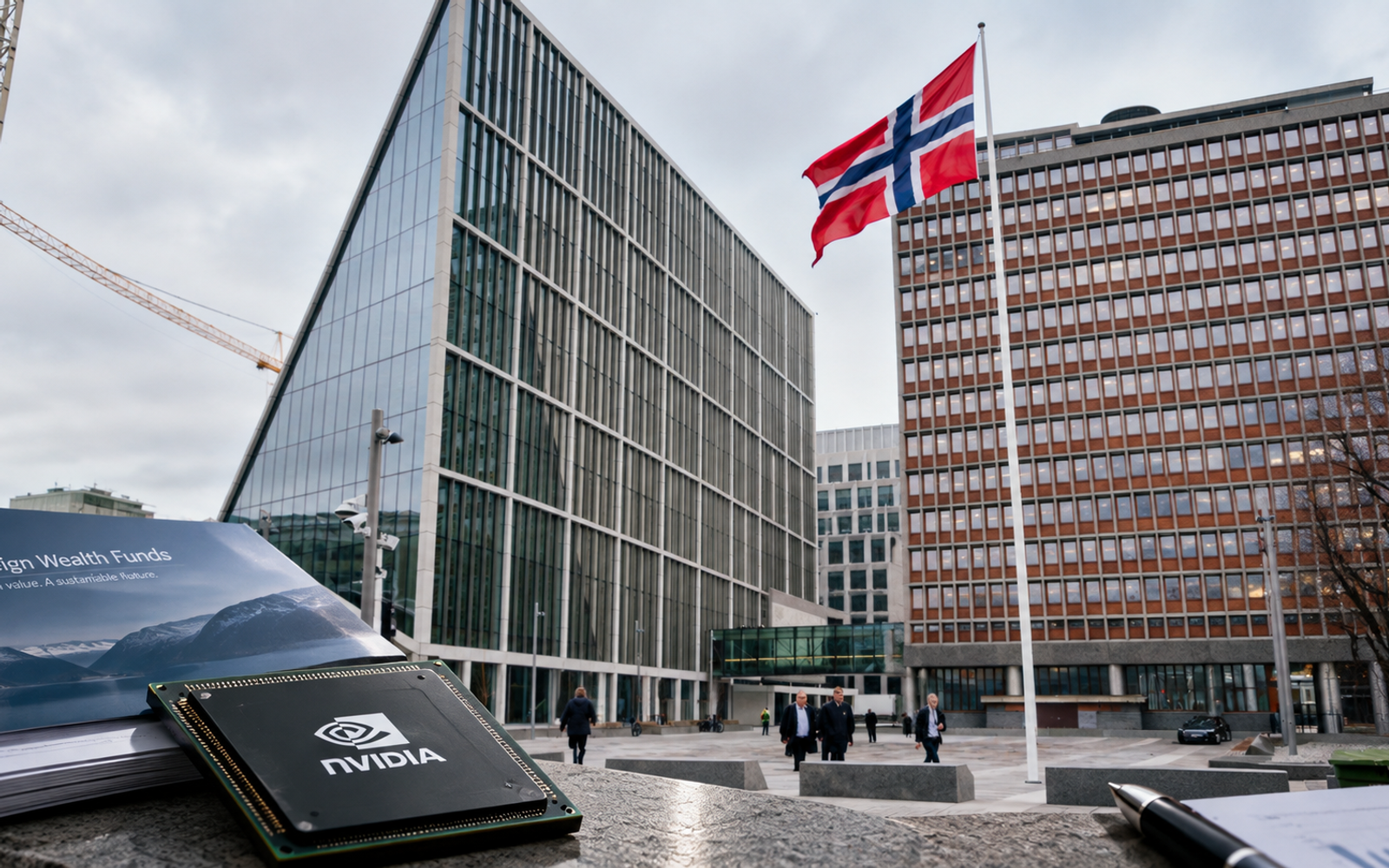
Nvidia ended June as the fund's largest single equity holding, worth about 612 billion kroner. That position came after NBIM trimmed all four of its largest US technology stakes during the second half of 2025, which Bloomberg reported at the time. Trimming and still holding that much of one company tells you where the benchmark sits, not where the managers' convictions sit.
In March, the fund published a hypothetical stress test. In an AI correction, its value could fall 31%, about 6.5 trillion kroner or $650 billion. That's the largest single downside number any major institution has attached publicly to the AI trade, and it comes from the risk department of a fund whose ownership structure makes it about as apolitical as large pools of capital get.
There's a structural reason the number exists without a policy response attached to it. NBIM can't walk away from the concentration because the benchmark it's measured against is set by Norway's Ministry of Finance, and reducing exposure means underperforming global equities on purpose. That isn't a trading decision. It's a speech a minister has to give. The same dynamic sits behind the concentration inside the S&P 500's record run, where index construction itself now produces a narrow bet on a handful of companies rather than a broad claim on the economy.
Read Also
Wearable Tech Walks the RunwayWhat the Market Still Hasn't Priced
The conventional read on sovereign wealth funds is that they're patient capital, a stabilising bid that shows up when everyone else sells. The data supports half of that. Norway's inflows continue through drawdowns, and equity allocations above 70% across funds this size do put a floor under liquid markets in a selloff. What the same data also shows is that these funds have become the marginal buyer of the physical layer of AI, the data centres, power contracts and semiconductor capacity that underwrite the earnings the index depends on. A buyer that doesn't check valuation supports higher prices for everyone who does, and it turns the eventual correction into a fiscal event rather than a portfolio event.
The funding side sharpens that point. Norway's transfers come from petroleum revenue routed through the state budget, insulated from quarterly market moves. Gulf funds are more directly exposed to the commodity itself. Crude fell to $98 a barrel as Saudi Arabia signalled a reopening of its East-West pipeline, a price that still funds a transfer but sits well below the fiscal break-even that has supported the kingdom's spending plans in recent years. A sustained move lower wouldn't force selling in public equities, since these funds hold through cycles. It would slow the direct deals and development commitments that have kept sovereign capital so visible in AI infrastructure.
What hasn't been tested is whether AI capital expenditure converts into cash flows quickly enough to justify the benchmarks that force this concentration. Norway's stress test modelled the downside without publishing a probability for it, and no other large fund has put a comparable number in public. The market is therefore pricing a $15 trillion pool of state capital as a backstop, while the largest member of that pool has already told everyone what a 31% hit looks like. Those two positions can coexist for a while. They can't survive an actual drawdown without one of them being revised.
Disclaimer: This article is for informational purposes only and does not constitute financial advice. Past performance is not indicative of future results. Consult a qualified financial advisor before making investment decisions.
Comments (0)
No comments yet. Be the first to share your thoughts.