Alibaba's 2.4-Trillion-Parameter Answer to Anthropic
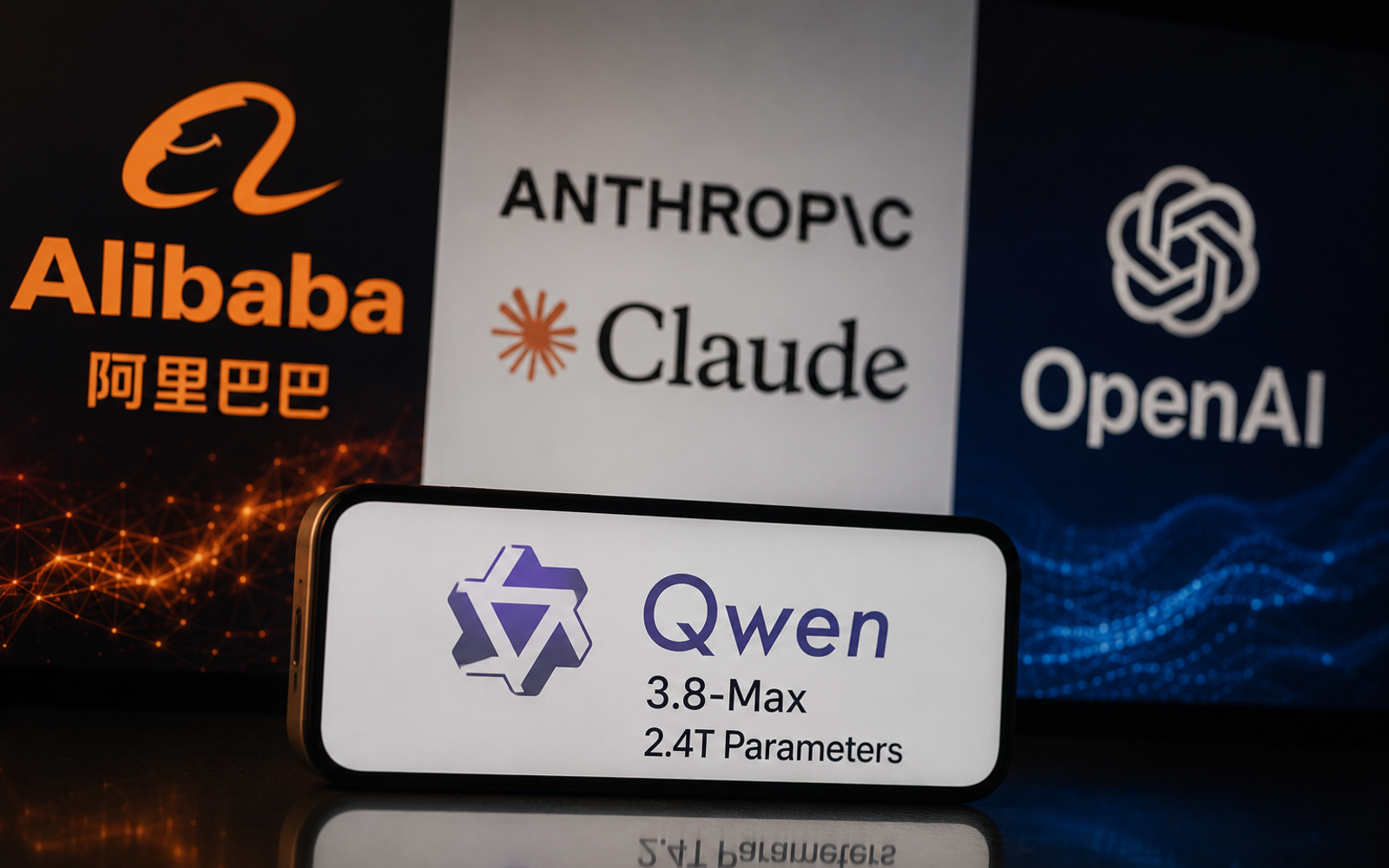
Alibaba's Qwen3.8-Max claims Anthropic-level performance on 2.4 trillion parameters, and its weights go public next week.

On Monday, August 3, Alibaba released the largest model its labs have ever shipped. Qwen3.8-Max is built on 2.4 trillion parameters, and the company says it performs on par with Anthropic's Fable line, ranking ahead of Moonshot's headline-grabbing Kimi K3 on several benchmarks. The weights go up for public download in the week starting August 10, which means anyone with the hardware can run a frontier-scale system without paying an API toll.
Hours earlier, in New York, Amazon's market value crossed $3 trillion for the first time, carried by a second-quarter report in which AWS brought in $42.2 billion, roughly $1.6 billion above analyst expectations. The two events belong to the same story. The AI demand that filled Amazon's cloud is the same demand Alibaba is trying to capture with the most aggressive open weight release of the year.
The Scale, and the Trick That Makes It Affordable
Two point four trillion parameters sounds like a number that should be impossible to train, and for most of the industry's history it would have been. The saving grace is that Qwen3.8-Max, like most frontier systems now, does not activate all of its weights for every request. It is a mixture of experts model, meaning the network is split into specialized sub-networks and a routing layer switches on only the handful most relevant to the current token. Think of a vast reference library where each query lights up only the shelves that answer it; the building holds millions of volumes, but any single reader consults a few dozen.
That split changes the economics at every stage. Training still requires updating all 2.4 trillion parameters across trillions of tokens, which is where the real compute bill lives. Inference, the part customers actually feel, is far cheaper, because a sparse model runs with only a fraction of its weights active at any moment. This is why Alibaba can claim frontier scale without pricing itself out of the market, and it is the same architectural logic that lets a 20-billion-parameter brain run on a phone while a much larger cloud sibling handles the heavy lifting.
Memory bandwidth becomes the binding constraint at this scale. A 2.4-trillion-parameter model can't fit on a single accelerator, so inference has to be sharded across a cluster of chips, with the routing layer deciding which experts live on which machine. That is a hard engineering problem in its own right: the model only feels fast if the network between accelerators keeps up with the router's decisions. It's the kind of infrastructure problem cloud providers are built to solve, and Alibaba frames its Qwen releases around its own hardware stack for exactly that reason. The training runs behind Qwen3.8-Max are the expensive half. The deployment story, the part that decides whether the model spreads, is all about making that sharded cluster boring and reliable.
The architecture also explains how Chinese labs have kept pace while US export controls block Nvidia's most advanced chips. DeepSeek's V4-Flash upgrade surfaced the same week, another sign that the playbook for labs operating under a hardware ceiling has become efficiency: distillation from larger teachers, sharper routing, aggressive quantization, and training runs tuned to squeeze every flop out of the silicon they already own. The chip shortage that isn't a shortage at all turned out to be a compute story with different winners and losers, and these labs built their strategy around that constraint.
Why the Weights Are Free
Open weight is not the same as open source, and the distinction matters here. Alibaba publishes the trained parameters so developers can download, fine-tune, and self-host them, but the release still carries usage restrictions and the training data stays private. The move is a deliberate funnel toward Alibaba Cloud, which sells the GPU time and managed inference that make a 2.4-trillion-parameter model usable in the first place. Releasing the model is like giving away a recipe that requires a commercial oven: the flour is free, and the bakery equipment is not.
Anthropic keeps Fable behind an API and sells access at premium rates. Alibaba's bet runs the other way: make the weights free, and let the demand for compute, storage, and tooling flow back to the cloud. It is the same logic that turned AWS into the most valuable part of Amazon, which is why the Alibaba announcement and the Amazon milestone landed within hours of each other rather than by accident. Qwen has been Alibaba's public AI family since 2023, powering the company's own apps and a growing developer ecosystem across Asia and beyond, and each generation has been a little more explicit about the cloud tie-in.
The download list says a lot about who wins from open weights. Enterprises in Asia that want to keep data inside their own infrastructure, government agencies building sovereign AI stacks, startups that can't absorb API bills at scale, all of them prefer a model they can host. Alibaba has watched this pattern across the Qwen generations and built the release pipeline around it, publishing sizes from small enough for a laptop up to the 2.4-trillion-parameter flagship.
The strategy has a second effect that matters for the whole market. Every developer who builds on Qwen3.8-Max becomes a potential customer for the cloud that hosts it, and also a proof point that open weight models can carry production workloads. That is the pressure Anthropic, OpenAI, and Google now face: a frontier-adjacent model with no license fee sitting next to their paid APIs. The pricing power of closed frontier labs erodes a little more each time one of these releases clears the bar. Closed labs have responded by cutting prices and bundling tiers, but the baseline keeps resetting toward what a self-hosted model costs to run.
What Parity Means Outside the Leaderboard
Alibaba's claim, that Qwen3.8-Max matches Anthropic and beats Moonshot's Kimi K3 on several benchmarks, used to take months to verify. Open weights collapse that timeline. Once the parameters are downloadable, thousands of engineers can run their own evaluations, and the claim gets stress-tested in public within weeks. According to Bloomberg's reporting, the release marks the latest Chinese push against US rivals, but the real test begins when independent teams get their hands on the weights.
Benchmark parity and deployment parity are different things. A leaderboard measures a model answering static questions under ideal conditions, with unlimited time and perfect hardware. Production AI has to hold context across long sessions, respond quickly enough to feel natural, stay reliable under load, and do all of it at a price the customer can stomach. A 2.4-trillion-parameter model, even with sparse activation, needs serious hardware to serve, and serving cost is where the cloud providers make their money. A frontier model priced per token is a metered utility, and open weights are the flat-rate alternative, which is why the cost question keeps coming up in every enterprise evaluation.
That gap is the thing to watch in the coming months, not whether Qwen3.8-Max wins a test but whether it earns its keep in real workloads. The open weight ecosystem has an advantage here that closed labs can't match. When a model fails in production, the failure is public, reproducible, and fixable by anyone, which is exactly how a young model family builds trust fast. CNBC's coverage of Alibaba's rally notes investors read the release as a direct challenge to the US front-runners, and the shares moved accordingly.
The Cloud Bills Behind Both Headlines
For anyone watching the economics rather than the leaderboards, this week's real story is the infrastructure underneath. Amazon crossed $3 trillion in market value on Monday, becoming the fifth company to reach that milestone after Apple, Microsoft, Nvidia, and Alphabet, according to CNBC. The trigger was AWS's second quarter: $42.2 billion in revenue, exceeding analyst forecasts by more than $1.6 billion, with AI workloads doing the heavy lifting.
Cloud providers are selling the same commodity from different storefronts. Alibaba's model release is a customer acquisition cost for its cloud. Amazon's earnings are the proof that the acquisition works at scale. When Anthropic needs to train a frontier model, it rents Nvidia GPUs from a hyperscaler. When a startup wants to deploy Qwen3.8-Max, it rents the same class of hardware from Alibaba Cloud. The model is the product, and the compute is the business.
The same week, Apple retired its iPhone Upgrade Program in favor of Apple Upgrade, a leasing scheme that turns hardware into a subscription, the consumer-side version of the same shift. Three companies, three layers of the stack, all reorganizing around recurring revenue in the AI era. Amazon's trillion-dollar milestone is the easiest headline to grasp, but the Alibaba release is the one with the longer reach, because it decides who gets to charge for the compute underneath.
The Question the Release Leaves Open
The lingering technical question is whether 2.4 trillion parameters trained under export control rules can keep improving once the easy efficiency gains are exhausted. Chinese labs reached parity through engineering discipline rather than unlimited access to the latest silicon, and the discipline carries real costs: distillation chains can amplify biases, aggressive quantization shaves precision, and sparse routing can behave unpredictably on edge-case inputs. Every one of those trade-offs becomes a public bug report the moment the weights are downloaded, which means the coming months will show whether open weight frontier models can hold their claims under real production traffic. No leaderboard can answer that question in advance, because the answer only appears when thousands of independent teams run the model on workloads its creators never imagined.
Comments (0)
No comments yet. Be the first to share your thoughts.