The $2 Trillion Rocket: What SpaceX's IPO Actually Unlocked
SpaceX's record-breaking IPO made Elon Musk the world's first trillionaire. The mechanics behind a $2.1 trillion valuation.

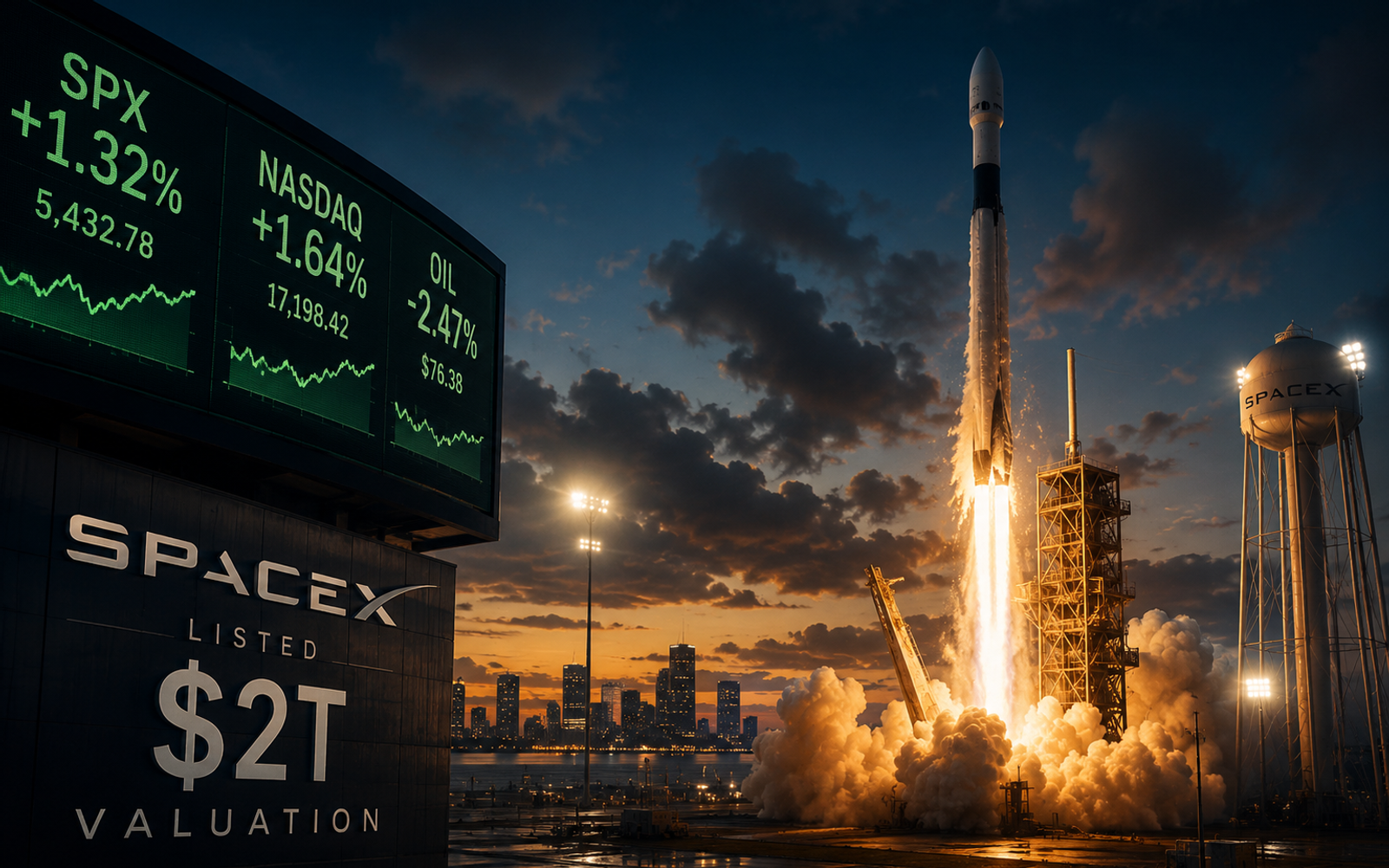
The numbers arrived first, then the crowd. On June 12, 2026, SpaceX shares began trading on the Nasdaq at $145 apiece. By the afternoon, the company's market cap sat north of $2.1 trillion, according to CNBC. Elon Musk's personal stake pushed his net worth past $1 trillion for the first time in history. The IPO raised $75 billion, making it the largest public offering ever recorded. These are not normal numbers. They describe something that existing financial language struggles to contain.
Consider the physics. SpaceX builds rockets that throw metal tubes through the upper atmosphere at 17,500 miles per hour. The Falcon 9 stands 70 meters tall. The Starship, still in testing, is taller than the Saturn V. These are industrial objects, built in factories south of Los Angeles and launched from pads in Texas and Florida. The gap between what the company physically produces and what the market says it's worth is the actual story. That gap is where the tension lives.
A $2.1 Trillion Bet on Leaving Earth
The valuation makes SpaceX more valuable than Broadcom, the chip giant whose market cap had been climbing for years. It puts SpaceX in the same weight class as Meta and just behind Amazon, which sits at $2.6 trillion according to Stock Analysis. A company that has yet to turn a consistent profit from its core operations is now worth more than most of the world's largest corporations. That inversion is the defining feature of this moment.
The math works like this. SpaceX generates revenue from three sources: launch services for government and commercial customers, Starlink's growing subscriber base, and NASA contracts for crew and cargo missions. The Physics Problem in SpaceX's $1.78 Trillion Orbit was already well documented before the IPO. Each Falcon 9 launch costs about $67 million to produce and sells for roughly $50 million on the open market. The company makes the numbers work through reusability. Block 5 boosters fly ten, fifteen, sometimes twenty times before retirement. Each reuse shaves millions off the marginal cost. Landing a booster on a droneship in the Atlantic Ocean is no longer remarkable. It's routine.
But even at scale, the operational numbers don't explain $2.1 trillion. The gap is filled by something Reuters described as the "Elon premium," a valuation boost driven as much by faith in Musk's vision as by traditional financial metrics. Investors aren't buying rockets. They're buying the idea that SpaceX will be the company that puts people on Mars, builds a permanent off-world economy, and owns the infrastructure for interplanetary travel. That vision is priced in. The question is whether the hardware can deliver.
What $75 Billion in New Money Buys
The IPO raised $75 billion. That is more cash than the annual operating budget of Nigeria, Africa's largest economy. It is enough money to build roughly 1,100 Falcon 9 rockets from scratch. SpaceX says it will use the funds to accelerate Starship development, expand the Starlink constellation, and build out its human spaceflight program. Each of those priorities comes with its own technical hurdles.
A concrete example of where that money goes: Starlink now operates in 22 African countries, according to a 2025 progress report from the company. Subscribers globally passed 10 million in early 2026. In December 2025, Airtel Africa signed an agreement with SpaceX to introduce Starlink Direct-to-Cell connectivity, allowing standard 4G and 5G phones to connect directly to satellites when no ground tower is available. That is a technical achievement with real consequences for people who live in areas without fiber backbone. It is also a revenue stream that grows whether or not anyone ever sets foot on Mars.
The economics of Starlink are worth examining. Each satellite costs roughly $250,000 to build and launch. A single Falcon 9 can carry 60 of them. The constellation now numbers over 6,000 satellites in low Earth orbit. Subscriber growth has been strong, particularly in regions where traditional broadband doesn't reach. The African market alone could eventually support millions of subscribers, each paying between $30 and $100 per month depending on the plan. Scale that across 22 countries and the revenue becomes material. That's the part of the business that doesn't require anyone to survive re-entry.
The Liquidity Event That Reshuffled the Board
SpaceX's public debut did not happen in a vacuum. The company had long resisted going public. Musk himself said for years that he wanted to keep SpaceX private to avoid short-term earnings pressure. That changed for partly regulatory and partly structural reasons. As SpaceX grew to dominate the launch market and Starlink began generating material revenue, the pressure from employees holding private shares became impossible to ignore. Secondary markets had already been trading SpaceX stock at high valuations. The IPO simply formalized what the gray market already knew.
The ripple effects were immediate. Broadcom lost its spot as the most valuable hardware company by market cap. Amazon, sitting at $2.6 trillion, became the next company in line behind SpaceX and the tech giants. The space economy, once a niche corner of aerospace, is now a mainstream asset class. Funds that never looked at launch vehicles are now building positions. Pension funds. Sovereign wealth funds. University endowments. They're all buying the story.
Meanwhile, in the Silicon Savannah
Here is where the story gets complicated. SpaceX's ascent is often told as an American triumph, a story of California engineering and Texas bravado. But the company's most consequential market may end up being Africa.
Starlink is live in 22 African countries as of early 2026, with Cameroon, Morocco, and Angola preparing for entry. The service faces resistance in places like South Africa and Namibia, where regulators have blocked licensing over sovereignty concerns. But the Airtel Africa partnership, signed in December 2025, bypasses traditional infrastructure entirely. Direct-to-cell satellite connectivity means a farmer in rural Kenya with a standard smartphone can get service without a dish on the roof. That changes the economics of connectivity in a region where fiber buildout has been slow and expensive.
Meanwhile, African space agencies are watching closely. Nigeria's National Space Research and Development Agency, NASRDA, has been seeking partners for advanced satellite development. The Africa Space Economy, Innovation and Communication Conference scheduled for 2026 in Nigeria will focus on exactly these questions: who builds the next generation of African satellites, and whether SpaceX becomes a partner or a competitor.
The tension is real. SpaceX offers cheap launch capacity and global connectivity. But it also concentrates power in a single American company. For countries that have spent decades trying to build domestic space capabilities, dependency on a private US firm is not a comfortable position. The calculus is different for each nation. Nigeria wants to build its own satellites but needs launch partners. Rwanda has embraced Starlink as a shortcut to connectivity. South Africa has pushed back, citing concerns about foreign control of critical infrastructure. There is no single African position on SpaceX. There are 54 of them.
The Engine That Can't Stop
The engineering challenges haven't gone away. SpaceX's Starship has flown multiple test flights but hasn't yet achieved reliable orbital refueling, a requirement for deep space missions. The Raptor engine, which runs on liquid methane and liquid oxygen, has experienced combustion instability issues at high chamber pressures. These are not marketing problems. They are physics problems. And physics doesn't care about valuations.
Orbital refueling is the next threshold. Starship needs to transfer propellant between vehicles in orbit to reach the Moon or Mars. That has never been done at scale. The tanks are enormous. The boil-off rates are punishing. The margins for error are thin. If SpaceX solves this, the architecture for deep space becomes real. If it doesn't, Starship remains a very large rocket that can't leave Earth orbit. The market has priced in the first outcome. It has not priced in the second.
What Comes Next
Amazon's Project Kuiper, a direct competitor to Starlink, has yet to launch its full constellation. The company sits at $2.6 trillion in market value, meaning it has the financial resources to compete but not the head start. SpaceX has been launching Starlink satellites for years. Kuiper is still building out its production line.
The real competition, though, might come from outside the US. China has its own broadband constellation plans. Europe is moving toward a sovereign launch capability with Ariane 6. And in Africa, the question of who controls orbital slots and spectrum rights is becoming a matter of policy, not just technology. The International Telecommunication Union allocates orbital slots on a first-come, first-served basis. Starlink has already filed for tens of thousands of them. Latecomers will find the best real estate already taken.
Elon Musk became the world's first trillionaire not because SpaceX sells tickets to space today, but because the market believes it will sell tickets to space tomorrow. That belief is priced in. The rockets have to catch up.
Comments (0)
No comments yet. Be the first to share your thoughts.