The Chip War Comes Down to Rare Earths
A 180-ton machine, a Taiwanese island, and China's rare earth monopoly decide who wins the chip war.

An extreme ultraviolet lithography scanner, the machine that prints the world's most advanced chips, weighs about 180 tons and costs more than a wide-body jetliner. ASML, the single Dutch company that builds it, assembles only a handful each year, then ships each one in pieces across the ocean to a cleanroom in Arizona, Taiwan, or South Korea. Every leading-edge processor that runs a smartphone, an AI data center, or an electric vehicle passes through that one production line. That concentration is the real subject of the chip war, not just which country designs the fastest transistor, but who controls each narrow link in a chain that spans half the planet.
What a Chip Actually Is
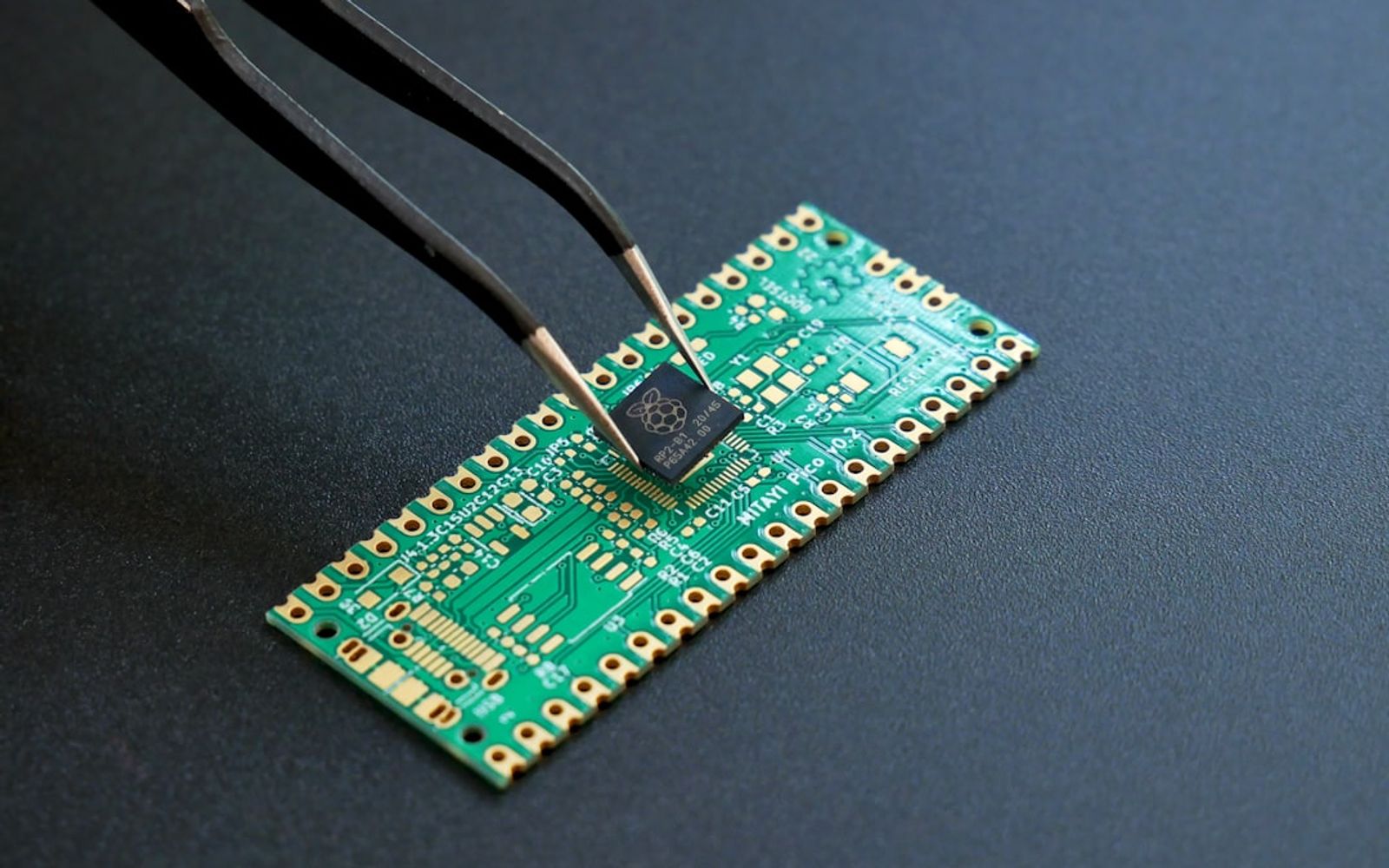
A chip is a flat slab of silicon, usually smaller than a fingernail, etched with billions of microscopic switches called transistors. Each transistor is a gate that either lets current through or blocks it, and strings of these gates encode the ones and zeroes that computers shuffle around. What makes a modern chip modern is scale: a leading-edge processor from TSMC or Samsung packs more than 20 billion transistors onto a piece of silicon the size of a postage stamp, which puts each switch only a few dozen atoms wide.
Printing something that small requires light with a wavelength short enough to draw those features, which is where the lithography machine comes in. ASML's EUV scanners generate extreme ultraviolet light by vaporizing tin droplets with a laser inside a vacuum chamber, then bounce it through mirrors coated in alternating layers until it focuses onto the wafer. The optics are so precise that a bump the height of a single atom would ruin the image. It's one of the most precisely controlled manufacturing processes ever built, and it happens in cleanrooms that cost billions to construct.
The lithography step is only one of hundreds. A wafer passes through deposition, etching, doping, cleaning, and testing before it's cut into individual dies, and each step depends on specialized equipment, chemicals, and gases from a different country. The design software comes from the United States, the lithography machines from the Netherlands, the photoresists from Japan, the silicon wafers from Japan and Taiwan, and much of the final assembly and packaging from Malaysia, Vietnam, or China. A single advanced chip is therefore a map of global trade routes, which is why a trade war can reach inside every device on Earth.
The Geography of the Bottleneck
Because every step is concentrated somewhere, the chain has structural weak points. TSMC, based in Taiwan, makes roughly 90 percent of the world's most advanced logic chips, the ones that train and run AI models, so its fabs are effectively the single point of failure for the entire industry. South Korea's Samsung and SK Hynix hold a similar grip on memory, controlling roughly 70 percent of the DRAM market that every server, phone, and laptop depends on. The chain behaves like a highway with a handful of bridges: traffic flows smoothly until one of them closes, and then everything stops at once.
The equipment side is no more distributed. ASML has a near monopoly on EUV lithography, and the United States has used its leverage over Dutch policy to keep those machines out of Chinese fabs. In April 2026, Washington proposed another round of export restrictions aimed at ASML and other equipment makers, according to Reuters. Japanese firms like Tokyo Electron and Shin-Etsu dominate etch tools and silicon wafers, while Applied Materials and Lam Research in the United States cover deposition and etching. The entire advanced ecosystem runs through Taiwan, South Korea, the Netherlands, Japan, and the United States.
China sits at the other end of the chain. It accounts for close to 70 percent of the world's mined rare earth output but more than 90 percent of the refining and processing, the stage that actually turns raw ore into usable materials, and it holds large shares of gallium and germanium, elements used in chips, sensors, and defense electronics. It also handles a significant share of chip assembly and packaging, the older, lower-tech step that turns a bare die into a component a manufacturer can solder onto a board. When Beijing restricted gallium and germanium exports in 2023, it demonstrated exactly where its leverage sits.
What Each Side Holds
The United States began its campaign in October 2022 with sweeping export controls, and it's tightened them steadily since. In May 2026, the Commerce Department moved to halt Nvidia's AI chip shipments to Chinese firms operating outside China, closing a loophole that had let overseas subsidiaries buy the most advanced accelerators, as Reuters reported. The logic is simple: slow China's access to the best tools and chips, and the gap between the two computing ecosystems widens.
That logic has real teeth in the short term. SMIC, China's most advanced foundry, was pushed to make 7-nanometer chips on modified older equipment after the first restrictions, and the 2023 launch of Huawei's Mate 60 phone showed the country could improvise under pressure. Yet each generation after that gets harder, and China has responded by pouring state money into domestic fabs, equipment startups, and chip design houses. By mid-2026, analysts were openly debating whether the controls were working as intended. China hasn't matched the leading edge, but it's built enormous capacity at mature nodes, the 28-nanometer and larger chips used in cars, appliances, and industrial gear.
The counter-leverage sits in the ground. Washington can restrict ASML machines, but Beijing can restrict the refined rare earths, gallium, and germanium that the rest of the chain can't do without. In July 2026, Reuters reported that China was weighing tighter export controls of its own, this time on AI models and chips. The result is a strategic imbalance that supply chain analysts have been describing all year: the United States may win the race to build the fastest chips while losing control of the base of the chain that every chip, fast or slow, depends on.
Why the Boom Touches Every Sector
The abstraction of chips hides how pervasive they are. A modern car contains thousands of semiconductors, from the engine control unit to the sensors that manage braking and lane keeping, and the 2021 shortage idled assembly lines on three continents and pushed automakers to ship vehicles missing chips. That episode turned semiconductor production into a mainstream economic indicator overnight.
AI has raised the stakes much higher. Training and running large models requires thousands of specialized accelerators, each one a leading-edge chip that costs tens of thousands of dollars, and the data centers absorbing them have driven a historic boom. The Semiconductor Industry Association reported global sales of $403.3 billion in the second quarter of 2026 alone, with June sales up 123.6 percent from a year earlier, and the industry's standard tracker, WSTS, raised its full-year forecast past $1.5 trillion in its spring update, powered by what it called an extraordinary memory expansion.
That's the sense in which chips touch everyone. On-device AI models that run entirely on a phone need a different class of silicon than data center accelerators, and the shift to electric vehicles multiplies the chip count per vehicle several times over. Grid modernization, medical imaging, industrial automation: all of it is gated by the same fragile geography. Deloitte's 2026 semiconductor outlook, published before the memory boom accelerated, warned that the industry's focus should shift to risk mitigation for a demand correction and toward a more balanced investment approach. Booms in this industry have a habit of ending in busts, and the subsidies now building fab capacity around the world are making that cycle harder to manage.
The Base of the Chain Belongs to Beijing
The hard part of the chip war is that the two sides' strengths line up badly. The United States, the Netherlands, and Japan hold the tools and the designs, while China holds the processed minerals, the mature-node capacity, and much of the assembly work. Each side can hurt the other, and neither can fully substitute for what the other controls.
Rebuilding the base of the chain is slow. New rare earth and mineral processing facilities outside China take years to permit and build, and even then they must match cost structures that Chinese companies have had two decades to refine. The CHIPS Act money flowing into American fabs is aimed mostly at leading-edge logic and memory, not at the materials and packaging steps where Beijing's leverage sits. Southeast Asia is quietly absorbing the packaging and assembly work, with Malaysia's Penang and Kulim clusters and Vietnam's new facilities taking on a growing share, a shift documented in recent academic research on the changing geography of semiconductor production.
That relocation is real but partial. Packaging and assembly are the lower-margin, higher-labor steps of the chain, and the most advanced packaging, the kind that stacks chips and connects them at microscopic scale for AI accelerators, is still dominated by TSMC and its Taiwanese supply chain. So the world is left with a division of labor that satisfies no one: the West can't make chips without Chinese-processed minerals, and China can't make the best chips without Western equipment. The leverage is mutual, and that is precisely why the conflict has no clean endpoint.
The Supply Chain That Doesn't Exist Yet
What would actually end the standoff is a second, fully independent advanced chip ecosystem, one that runs from mineral processing through design, manufacturing, and packaging inside a single political bloc. That doesn't exist anywhere. The United States is furthest along, with TSMC building fabs in Arizona, Samsung expanding in Texas, and Intel betting its turnaround on advanced manufacturing, but the materials, the chemicals, and the specialized equipment still cross borders at every step. China faces the mirror problem: its fabs can make plenty of chips, just not the most advanced ones, and its equipment industry trails the leaders by a generation or more.
The technical question that remains unresolved is whether either side can compress a generation of industrial development into a decade, because that's roughly the timeline that export controls and domestic subsidies have created. Engineers have solved harder physics than this. EUV lithography alone took thirty years from laboratory idea to working machine. The unsolved problem is organizational rather than scientific: coordinating minerals, tools, chemicals, talent, and capital into a self-contained supply chain outside East Asia.
Until that chain exists, every chip in every device on Earth carries a little of the same geopolitical risk, and the question of who wins the chip war stays permanently open. The current boom, powered by memory and AI, has made the stakes visible to everyone, and the 2021 shortage proved what a disruption costs. What hasn't been tested is whether the world has actually diversified its supply chain or just rearranged the concentration, moving the fragile links to new addresses without removing the fragility.
Comments (0)
No comments yet. Be the first to share your thoughts.